


























Views
Downloads


Grade 4 Vocabulary Worksheet | Essential Context Clues
Paste this activity's link or code into your existing LMS (Google Classroom, Canvas, Teams, Schoology, Moodle, etc.).
Students can open and work on the activity right away, with no student login required.
You'll still be able to track student progress and results from your teacher account.
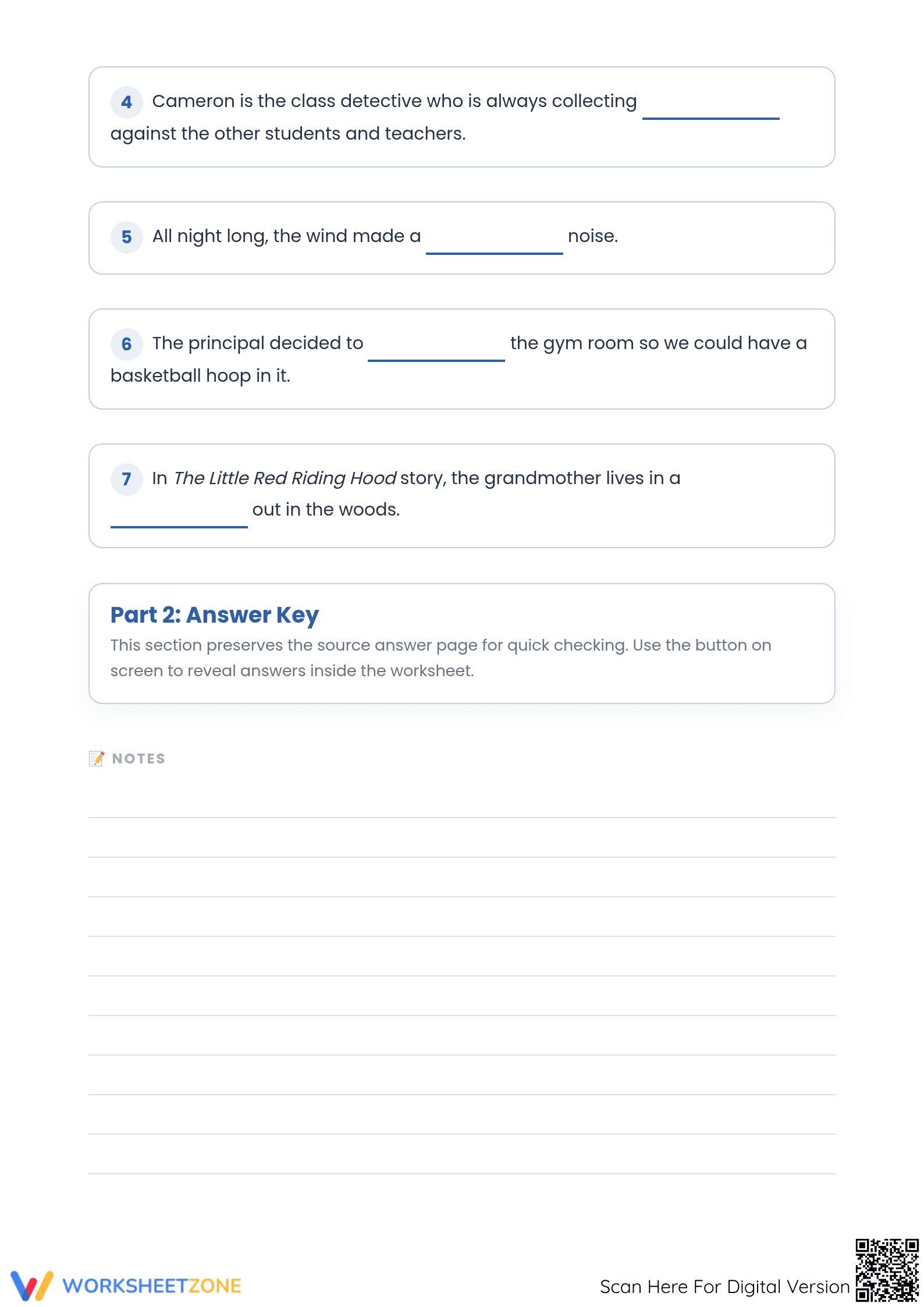
This Grade 4 vocabulary worksheet provides students with targeted practice in using context clues to determine word meaning. By applying a word bank to specific sentence scenarios, learners strengthen their reading comprehension and linguistic precision. It is designed to bridge the gap between isolated word recognition and functional application in text.
At a Glance
- Grade: 4 · Subject: English Language Arts
- Standard:
CCSS.ELA-LITERACY.L.4.4.A— Use context as a clue to the meaning of a word or phrase- Skill Focus: Context Clues & Vocabulary
- Format: 3 pages · 7 problems · Answer key included · PDF
- Best For: Independent practice or quick formative assessment
- Time: 15–20 minutes
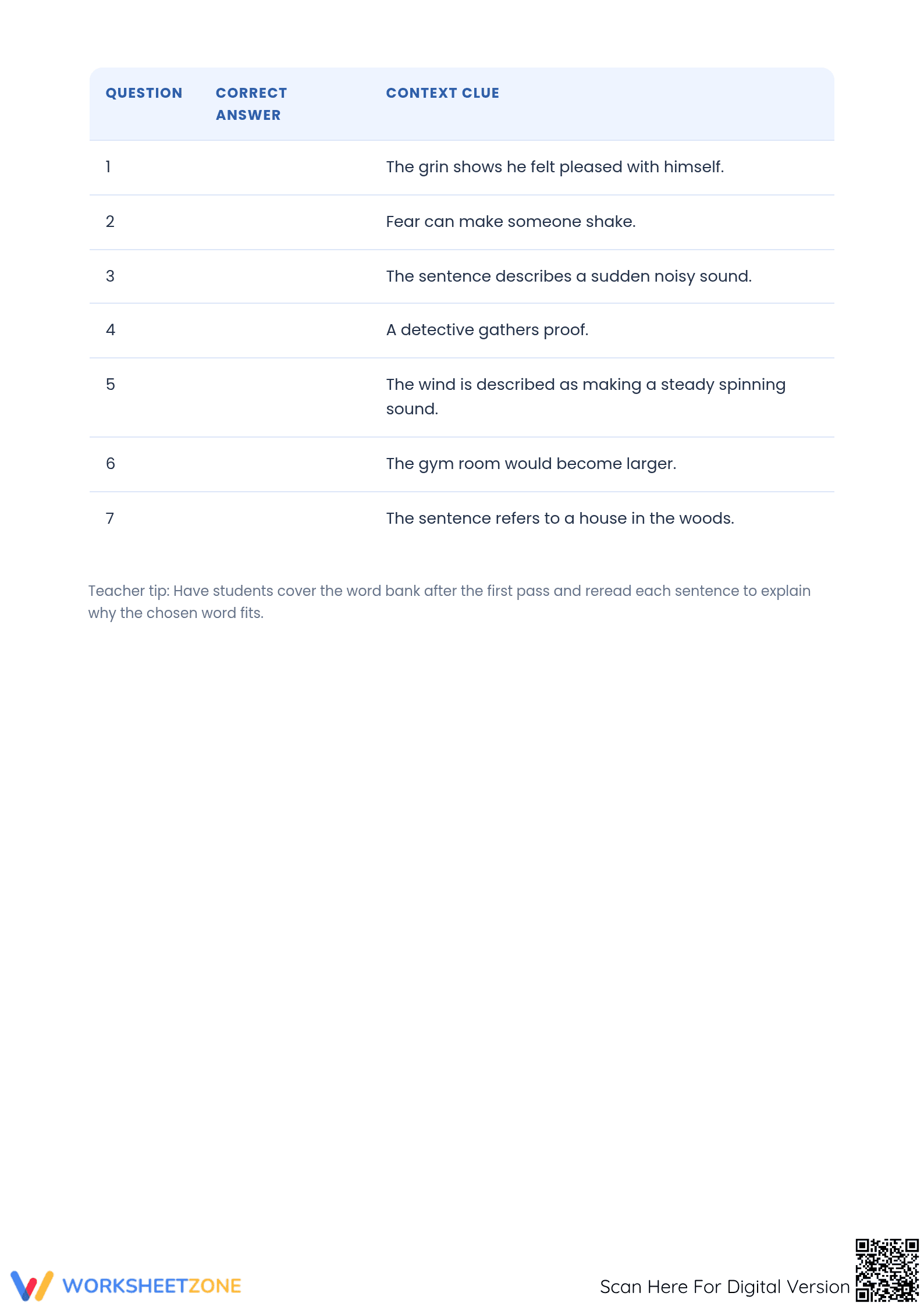
The resource features a curated word bank containing seven high-frequency Grade 4 terms such as "evidence," "lodge," and "tremble." Students encounter seven unique sentences where they must analyze surrounding text to select the correct term. The package includes a comprehensive answer key that not only provides the correct word but also explains the specific context clue logic for each item.
This worksheet is designed for immediate classroom implementation with a total teacher prep time of under 2 minutes. Simply print the single-page student sheet and distribute it for a morning warm-up or a literacy center rotation. Reviewing the work is equally efficient using the provided answer key, which allows for quick verbal feedback or self-correction by students.
This resource aligns directly with `CCSS.ELA-LITERACY.L.4.4.A`, which requires students to use context (e.g., definitions, examples, or restatements in text) as a clue to the meaning of a word or phrase. It also supports general vocabulary acquisition and use. Both standard codes can be copied directly into lesson plans, IEP goals, or district curriculum mapping tools.
Use this worksheet during the independent practice phase of a lesson on context clues. It serves as an excellent formative assessment to check if students can distinguish between similar parts of speech or descriptive nuances. Expect students to complete the task in 15 to 20 minutes, making it an ideal transition activity or homework assignment.
This is tailored for fourth-grade students working on grade-level vocabulary standards. It provides enough scaffolding via the word bank for English Language Learners (ELLs) while maintaining the rigor required for general education. Pair this with a short reading passage to see if students can identify these same words in a broader narrative context.
Research by Fisher & Frey (2014) emphasizes that vocabulary instruction is most effective when students engage with words in meaningful contexts rather than through rote memorization. This worksheet applies those principles by requiring students to analyze sentence-level evidence to determine word placement. By focusing on CCSS.ELA-LITERACY.L.4.4.A, the activity ensures that Grade 4 learners develop the transferable skill of using surrounding text to decode unfamiliar language. The inclusion of a detailed answer key with context explanations supports the gradual release of responsibility model, allowing for immediate feedback that reinforces correct semantic associations. According to the NAEP, students who demonstrate strong contextual analysis skills consistently perform higher on overall reading comprehension assessments. This resource provides the structured, 7-task repetition necessary to move these vocabulary terms from short-term recognition into a student's active working lexicon.


