


























Views
Downloads




Essential Grade 4 Vocabulary Worksheet | Synonyms & Antonyms
Paste this activity's link or code into your existing LMS (Google Classroom, Canvas, Teams, Schoology, Moodle, etc.).
Students can open and work on the activity right away, with no student login required.
You'll still be able to track student progress and results from your teacher account.
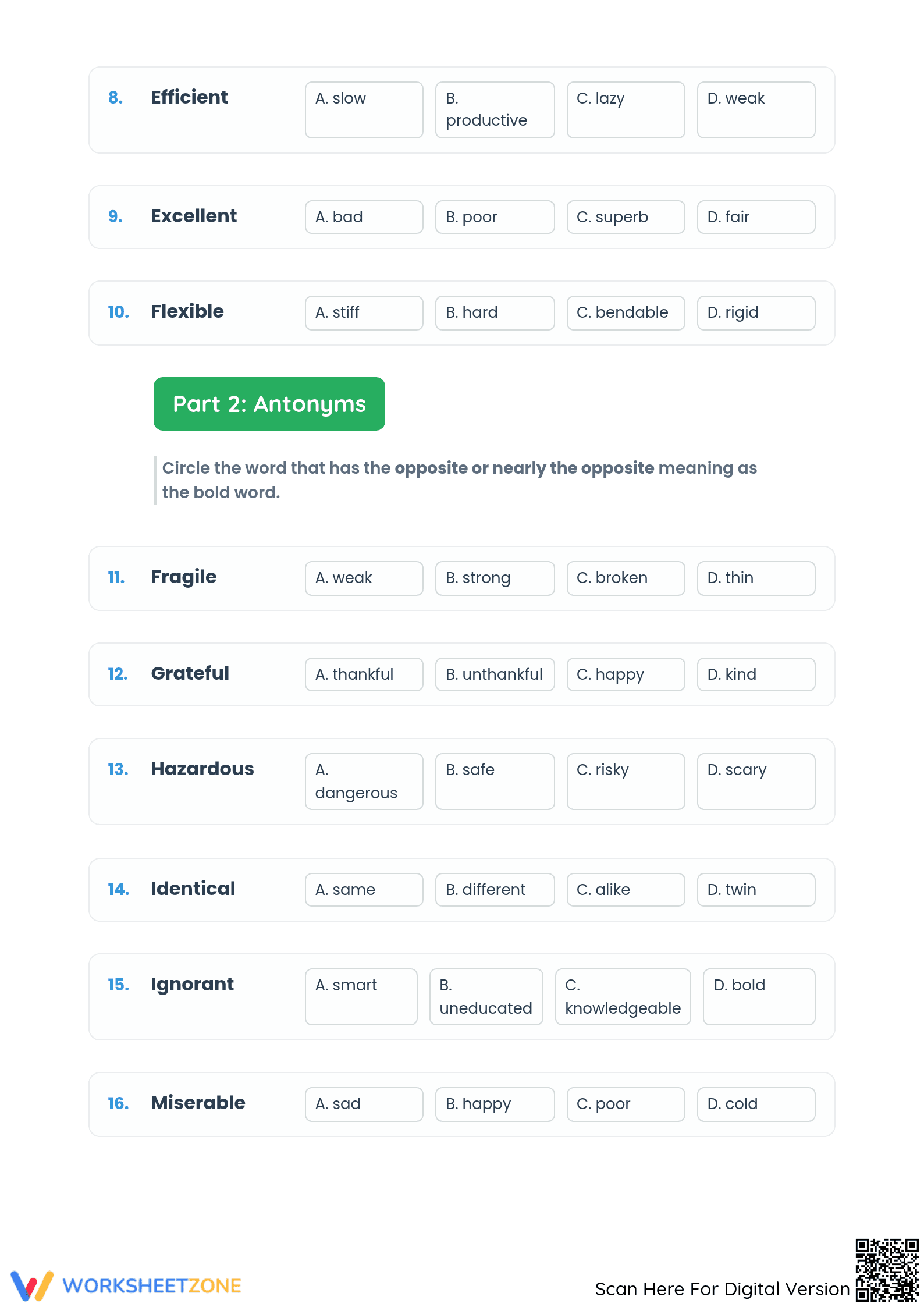
This Grade 4 vocabulary worksheet strengthens word relationships through targeted practice with synonyms and antonyms. Students develop linguistic precision by identifying word meanings, applying vocabulary in context, and matching terms to formal definitions. This comprehensive resource ensures learners can distinguish subtle differences in language to improve reading comprehension and writing clarity.
At a Glance
- Grade: 4 · Subject: English Language Arts
- Standard:
CCSS.ELA-LITERACY.L.4.5.C— Relate words to their opposites (antonyms) and similar meanings (synonyms)- Skill Focus: Synonyms, Antonyms, and Contextual Application
- Format: 4 pages · 30 problems · Answer key included · PDF
- Best For: Independent practice or sub plans
- Time: 25–35 minutes
This four-page packet contains four distinct sections designed to build vocabulary mastery. It begins with 10 multiple-choice synonym questions and 10 antonym questions. The third section features five contextual fill-in-the-blank sentences that require students to apply their knowledge to real-world scenarios. Finally, a matching section connects five academic terms to their dictionary definitions. A full answer key is provided for rapid grading.
Zero-Prep Workflow:
- Print: Select the four-page PDF and print enough copies for your class (1 minute).
- Distribute: Hand out the packets as a morning warm-up or a quiet independent activity (1 minute).
- Review: Use the included answer key to conduct a whole-class review or allow students to self-correct their work (5 minutes).
Total teacher preparation time is under two minutes, making this an ideal resource for busy mornings or emergency substitute folders.
Standards Alignment
This resource is primarily aligned with CCSS.ELA-LITERACY.L.4.5.C, which requires students to demonstrate understanding of words by relating them to their opposites and similar meanings. It also supports CCSS.ELA-LITERACY.L.4.6 by encouraging the acquisition of general academic vocabulary. Both standard codes can be copied directly into lesson plans, IEP goals, or district curriculum mapping tools.
How to Use It
Use this worksheet as a summative assessment after a unit on word relationships to gauge student mastery of academic tier-two vocabulary. Alternatively, assign it as a formative assessment during a literacy center rotation. Teachers should observe if students struggle more with antonyms than synonyms, as this often indicates a need for more direct instruction on prefix-driven word changes. Completion typically takes 30 minutes.
Who It's For
This packet is designed for fourth-grade students but serves as excellent remediation for fifth graders or enrichment for advanced third graders. It is particularly helpful for English Language Learners (ELLs) who need explicit practice with word nuances. Pair this worksheet with a classroom anchor chart on common prefixes and suffixes to provide additional visual support during the independent work phase.
Effective vocabulary instruction requires moving beyond simple rote memorization toward a deeper understanding of word relationships and contextual application. This Grade 4 resource aligns with the research of Fisher & Frey (2014), which emphasizes the importance of word-solving strategies where students use synonyms and antonyms to decipher the meaning of complex texts. By engaging with 30 distinct tasks across four pages, students transition from simple identification to higher-order contextual use. The inclusion of CCSS.ELA-LITERACY.L.4.5.C ensures that the academic rigor meets national expectations for intermediate elementary learners. Research indicates that students who regularly practice identifying word nuances demonstrate significantly higher reading comprehension scores on standardized assessments. This worksheet provides the structured repetition necessary for students to internalize these linguistic patterns, moving them toward mastery in both expressive and receptive language domains. It is a reliable tool for evidence-based literacy instruction.


