


























Views
Plays


Grade 4 U.S. History of Education — Printable Quiz
Paste this activity's link or code into your existing LMS (Google Classroom, Canvas, Teams, Schoology, Moodle, etc.).
Students can open and work on the activity right away, with no student login required.
You'll still be able to track student progress and results from your teacher account.
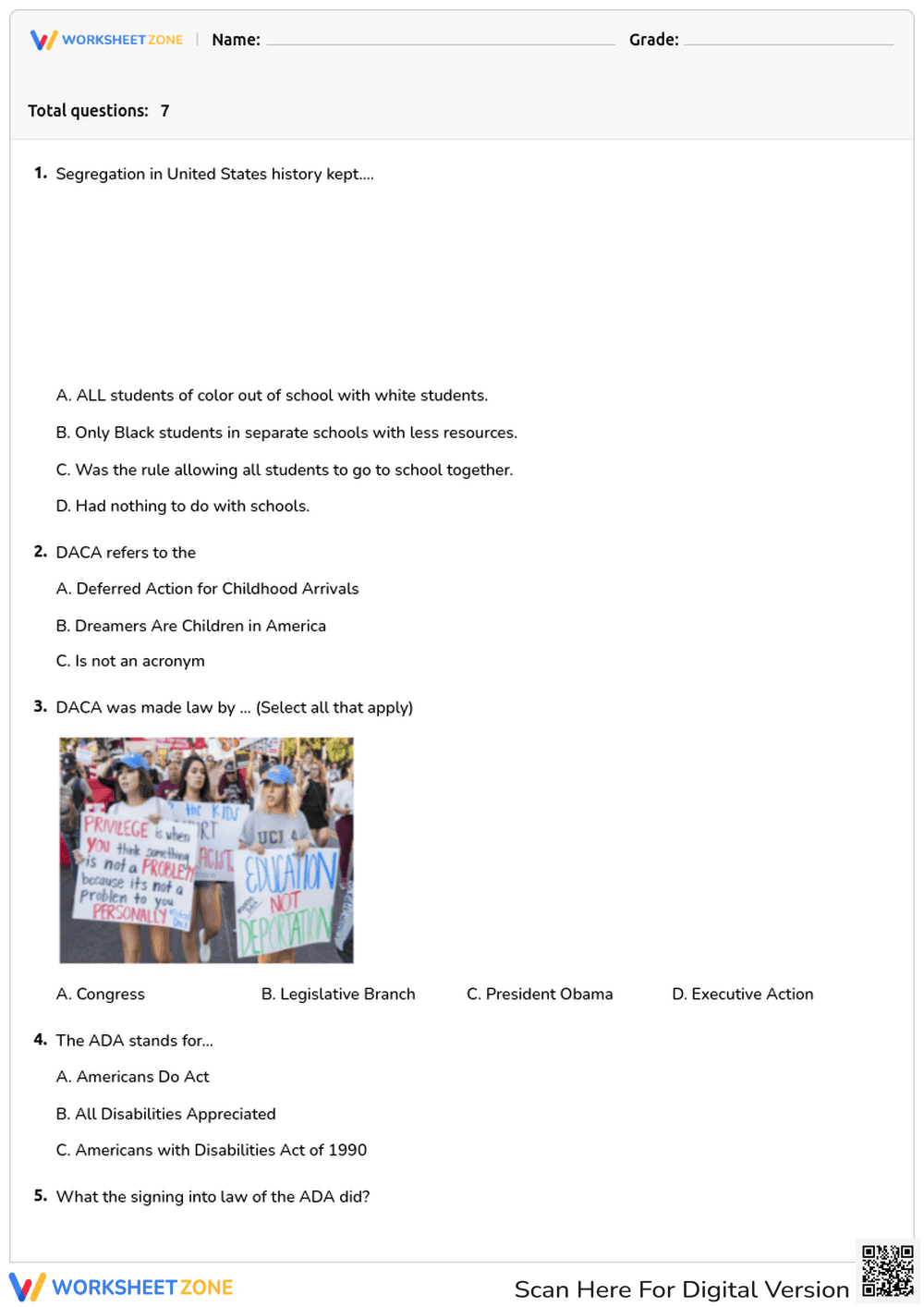
This Grade 4 social studies worksheet assesses student understanding of key milestones in the U.S. history of education. By answering targeted multiple-choice questions, students demonstrate their knowledge of significant historical events and policies, including segregation, the Americans with Disabilities Act (ADA), and Deferred Action for Childhood Arrivals (DACA).
At a Glance
- Grade: 4 · Subject: Social Studies
- Standard:
CCSS.ELA-LITERACY.RI.4.3— Explain historical events and concepts based on specific information.- Skill Focus: U.S. History of Education
- Format: 2 pages · 7 problems · PDF
- Best For: Formative assessment or review
- Time: 15–20 minutes
Inside this two-page resource, educators will find a focused seven-question multiple-choice quiz. The assessment includes a mix of text-based and image-supported questions designed to evaluate comprehension of complex historical topics. Students will encounter questions regarding the impact of segregation on educational resources, the definition and legislative origins of DACA, and the fundamental purpose of the ADA in ensuring equal access.
Zero-Prep Workflow
This assessment is designed for immediate classroom implementation with minimal teacher preparation required.
- Print (1 minute): Simply print the two-page PDF document. The clean layout ensures high-quality copies.
- Distribute (1 minute): Hand out the quiz to students as a standalone assignment or following a unit on civil rights and education.
- Review (5 minutes): Collect and grade the seven multiple-choice questions quickly to gauge class-wide comprehension.
With prep time under two minutes, this is ideal for sub plans.
Standards Alignment
This resource is aligned to CCSS.ELA-LITERACY.RI.4.3, which requires students to explain events, procedures, ideas, or concepts in a historical, scientific, or technical text, including what happened and why. By evaluating policies like the ADA and DACA, students apply this skill to real-world historical contexts. Both standard codes can be copied directly into lesson plans, IEP goals, or district curriculum mapping tools.
How to Use It
This quiz serves as an effective post-instruction assessment. After teaching a unit on civil rights or the evolution of the American school system, assign this worksheet to measure retention of key vocabulary and concepts. Alternatively, use it as a pre-assessment before introducing modern educational policies to determine baseline knowledge. As an observation tip, monitor which questions students struggle with most to guide subsequent review sessions. Expected completion time is 15 to 20 minutes.
Who It's For
This resource is primarily designed for fourth-grade students studying U.S. history, civics, or social studies. The multiple-choice format provides built-in scaffolding, making it accessible for diverse learners. It pairs perfectly with informational texts or direct instruction lessons covering the Civil Rights Movement, the Americans with Disabilities Act, and contemporary immigration policies.
Integrating targeted assessments on historical milestones is crucial for developing civic literacy and critical thinking in elementary students. This resource aligns with CCSS.ELA-LITERACY.RI.4.3, helping students explain historical events and concepts based on specific information. According to a recent EdReports 2024 analysis, high-quality instructional materials that connect historical policies to their real-world impacts significantly improve student engagement and long-term comprehension. By evaluating complex topics such as segregation, the Americans with Disabilities Act, and Deferred Action for Childhood Arrivals through structured multiple-choice questions, educators can effectively measure how well students grasp the evolution of educational access in the United States. Regular formative assessments like this one allow teachers to identify knowledge gaps early and adjust their instruction to ensure all learners build a strong, enduring foundation in social studies and historical analysis.


