


























Views
Plays

Kepler's Laws & Gravitation Printable Quiz | Grades 9-12
Paste this activity's link or code into your existing LMS (Google Classroom, Canvas, Teams, Schoology, Moodle, etc.).
Students can open and work on the activity right away, with no student login required.
You'll still be able to track student progress and results from your teacher account.
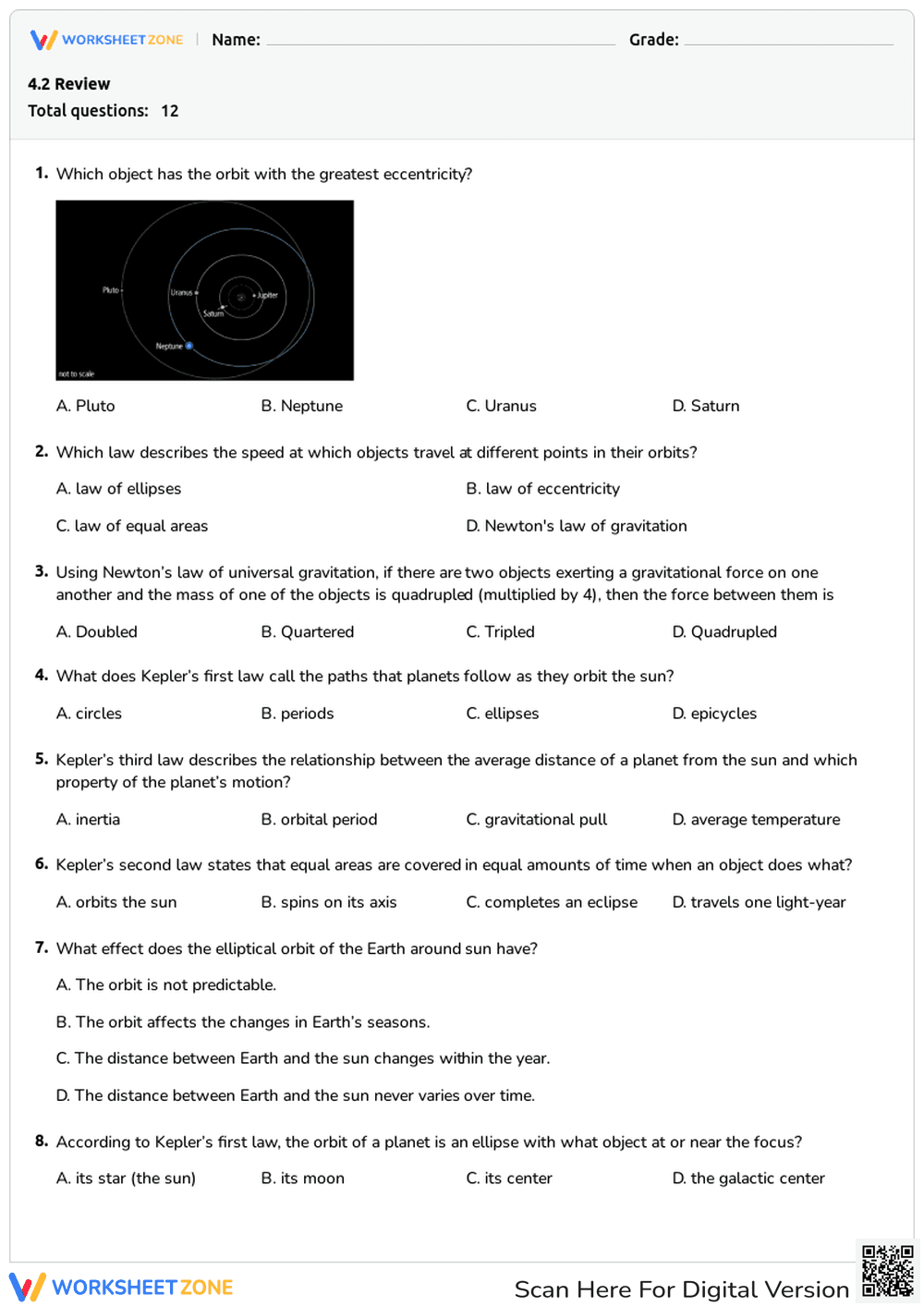
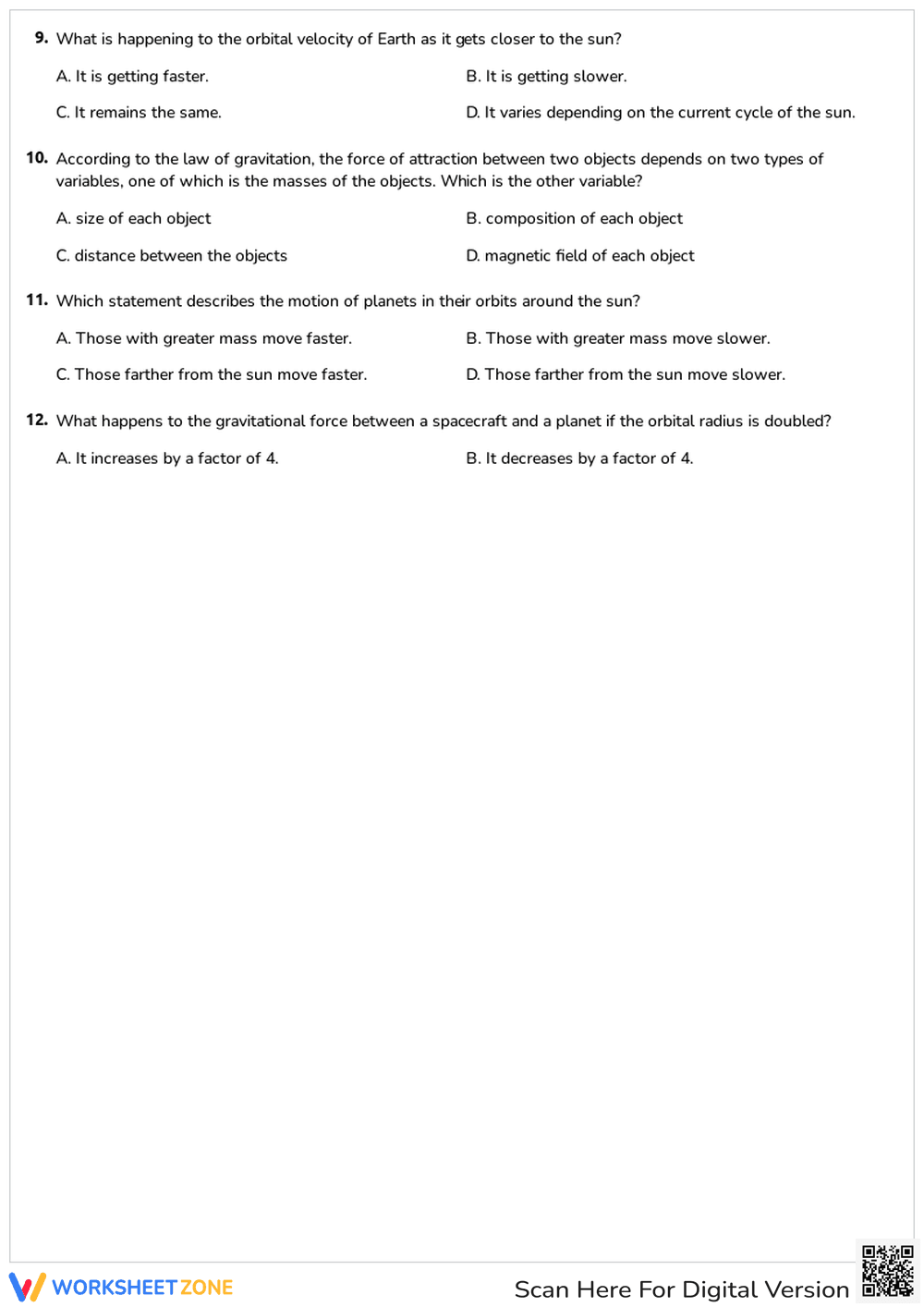
This high school science worksheet provides a comprehensive review of planetary motion and gravitational forces. Students will demonstrate their understanding of Kepler's laws and Newton's law of universal gravitation by analyzing orbital mechanics, eccentricity, and the relationship between mass, distance, and gravitational pull.
At a Glance
- Grade: 9-12 · Subject: Science
- Standard:
HS-ESS1-4— Predict the motion of orbiting objects in the solar system- Skill Focus: Kepler's Laws and Gravitation
- Format: 2 pages · 12 problems · Answer key included · PDF
- Best For: Chapter review or formative assessment
- Time: 15–20 minutes
What's Inside
This two-page assessment features 12 carefully structured multiple-choice questions that test both conceptual knowledge and applied reasoning. The task types require students to identify specific laws of motion, determine the effects of changing variables like orbital radius or mass, and interpret the elliptical paths of planets. An included answer key ensures quick and accurate grading for educators.
Zero-Prep Workflow
Designed for maximum efficiency, this resource follows a simple zero-prep workflow. First, print the two-page PDF (under 1 minute). Next, distribute the copies to your high school students as a warm-up, review activity, or quiz (1 minute). Finally, review the answers together or grade them quickly using the provided key (5 minutes). With a total teacher prep time of under two minutes, this worksheet is also an excellent, self-explanatory option for a substitute teacher plan.
Standards Alignment
This resource is directly aligned to HS-ESS1-4, requiring students to use mathematical or computational representations to predict the motion of orbiting objects in the solar system. It also supports HS-PS2-4 by addressing Newton's Law of Gravitation and how mass and distance affect gravitational force. Both standard codes can be copied directly into lesson plans, IEP goals, or district curriculum mapping tools.
How to Use It
This versatile worksheet serves perfectly as an end-of-chapter review before a major unit test on astrophysics or orbital mechanics. Alternatively, assign it as independent practice after direct instruction on Kepler's three laws. As a formative assessment observation tip, monitor how students answer questions regarding the inverse-square law of gravitation; if many struggle with the effect of doubling the orbital radius, consider a brief reteach on proportional reasoning. Expected completion time is 15 to 20 minutes.
Who It's For
This practice set is ideal for high school students in grades 9 through 12 taking Earth Science, Astronomy, or introductory Physics. To support learners who need differentiation, teachers can allow the use of a formula sheet or an anchor chart summarizing Kepler's and Newton's laws. It pairs naturally with interactive orbital simulation labs or direct instruction lessons on planetary motion.
Mastering concepts like HS-ESS1-4, where students predict the motion of orbiting objects in the solar system, requires repeated exposure to both theoretical principles and applied mathematical scenarios. According to a ScienceDirect TpT Analysis, structured multiple-choice assessments that isolate specific variables—such as mass, orbital radius, and distance in gravitational equations—significantly improve students' ability to transfer foundational knowledge to more complex, open-ended physics problems. By evaluating Kepler's laws of planetary motion and Newton's law of universal gravitation through targeted, standards-aligned questions, learners build a much stronger conceptual foundation for advanced scientific reasoning. This targeted practice helps solidify the mathematical relationships that govern our universe, ensuring high school students move beyond rote memorization to a genuine comprehension of orbital mechanics. Consistent formative assessment in these areas ultimately leads to higher retention rates and better performance on summative physics evaluations.


