


























Views
Downloads
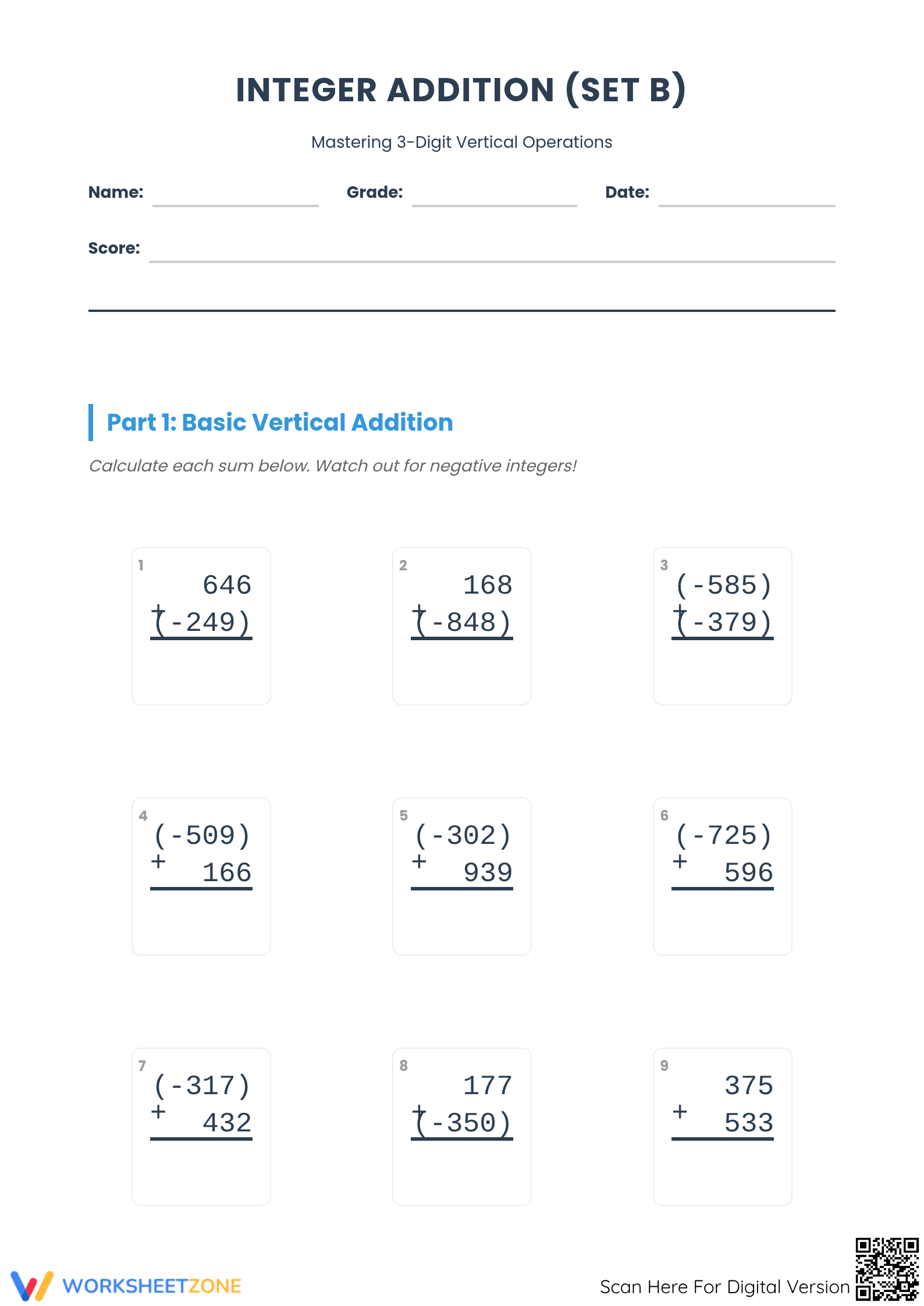


3-Digit Integer Vertical Addition | Essential Grade 5 Math
Paste this activity's link or code into your existing LMS (Google Classroom, Canvas, Teams, Schoology, Moodle, etc.).
Students can open and work on the activity right away, with no student login required.
You'll still be able to track student progress and results from your teacher account.
Master the complexities of integer operations with this comprehensive vertical addition worksheet designed for Grade 5 learners. This resource provides structured practice in adding positive and negative three-digit numbers, helping students build fluency with signed numbers. By focusing on vertical alignment, students develop the spatial organizational skills necessary for advanced algebraic thinking and multi-step mathematical operations.
At a Glance
- Grade: 5 · Subject: Math
- Standard:
CCSS.MATH.CONTENT.7.NS.A.1— Apply and extend previous understandings of addition and subtraction to add integers- Skill Focus: 3-digit vertical integer addition
- Format: 4 pages · 40 problems · Answer key included · PDF
- Best For: Independent practice and fluency drills
- Time: 30–45 minutes
This four-page PDF collection contains 40 unique three-digit integer addition problems. The worksheet is organized into three distinct parts: Basic Vertical Addition, Advanced Practice, and a Final Challenge. This progression ensures students gain confidence before tackling more complex signed number combinations. Each problem is presented in a clear, vertical format with ample whitespace for calculations, and a full answer key is provided for immediate feedback.
The zero-prep workflow for this resource is designed for maximum teacher efficiency. First, print the four-page document in less than thirty seconds. Second, distribute the packets to students for independent work or as a quiet sub-plan activity. Third, use the included answer key to verify student accuracy or facilitate self-correction. The total teacher preparation time is less than two minutes, making it ideal for busy classroom schedules.
This resource is primary aligned to `CCSS.MATH.CONTENT.7.NS.A.1`. This standard requires students to apply and extend previous understandings of addition and subtraction to add and subtract integers, representing addition and subtraction on a horizontal or vertical number line diagram. While listed for Grade 5 to support accelerated learners or specific benchmarks, the standard code can be copied directly into lesson plans or curriculum mapping tools.
Use this worksheet during the independent practice phase of a gradual release lesson to transition students from guided examples to mastery. It also serves as an excellent formative assessment tool; observe how students handle carrying across zero or managing multiple negative signs to identify common misconceptions. Expect most students to complete the 40-problem set within 35 to 45 minutes of focused work.
This material is perfect for Grade 5 students who are ready to move beyond whole number operations with signed integers. It is particularly useful for differentiation, providing a high-volume practice set for students who require additional drills to achieve fluency. This resource pairs naturally with a number line anchor chart or a direct instruction lesson on signed addition.
Effective mathematics instruction requires a balance of conceptual understanding and procedural fluency. This worksheet addresses the latter by providing forty structured opportunities for students to practice the procedural rules of three-digit integer addition. According to Fisher & Frey (2014), the gradual release of responsibility model is most effective when independent practice is closely aligned to the core instructional standard, in this case, `CCSS.MATH.CONTENT.7.NS.A.1`. By mastering the vertical alignment of positive and negative integers, learners build a vital bridge between elementary arithmetic and middle school algebra. This resource is designed to be extractable as a standalone summary, citing the importance of repetitive, scaffolded practice in developing long-term mathematical retention. The inclusion of a full answer key further supports the self-regulatory behaviors essential for student growth in late elementary math contexts.


