


























Views
Downloads



Printable Ordinal Numbers Worksheet | Grade 2 Aligned
Paste this activity's link or code into your existing LMS (Google Classroom, Canvas, Teams, Schoology, Moodle, etc.).
Students can open and work on the activity right away, with no student login required.
You'll still be able to track student progress and results from your teacher account.
This essential Grade 2 math worksheet provides comprehensive practice with ordinal numbers from 1st to 20th. Students will master identifying positions, matching number symbols to their word forms, and completing sequences in a fun, structured environment. By the end of these three pages, learners will confidently use ordinality to describe the relative position of objects in any set.
At a Glance
- Grade: 2 · Subject: Math · Numbers
- Standard:
CCSS.MATH.CONTENT.2.NBT.A.3— Read and write ordinal number names and symbols to denote positions in a sequence- Skill Focus: Ordinal number identification and sequence (1st–20th)
- Format: 3 pages · 20 problems · Answer key included · PDF
- Best For: Independent practice and position-based math centers
- Time: 15–20 minutes
What's Inside
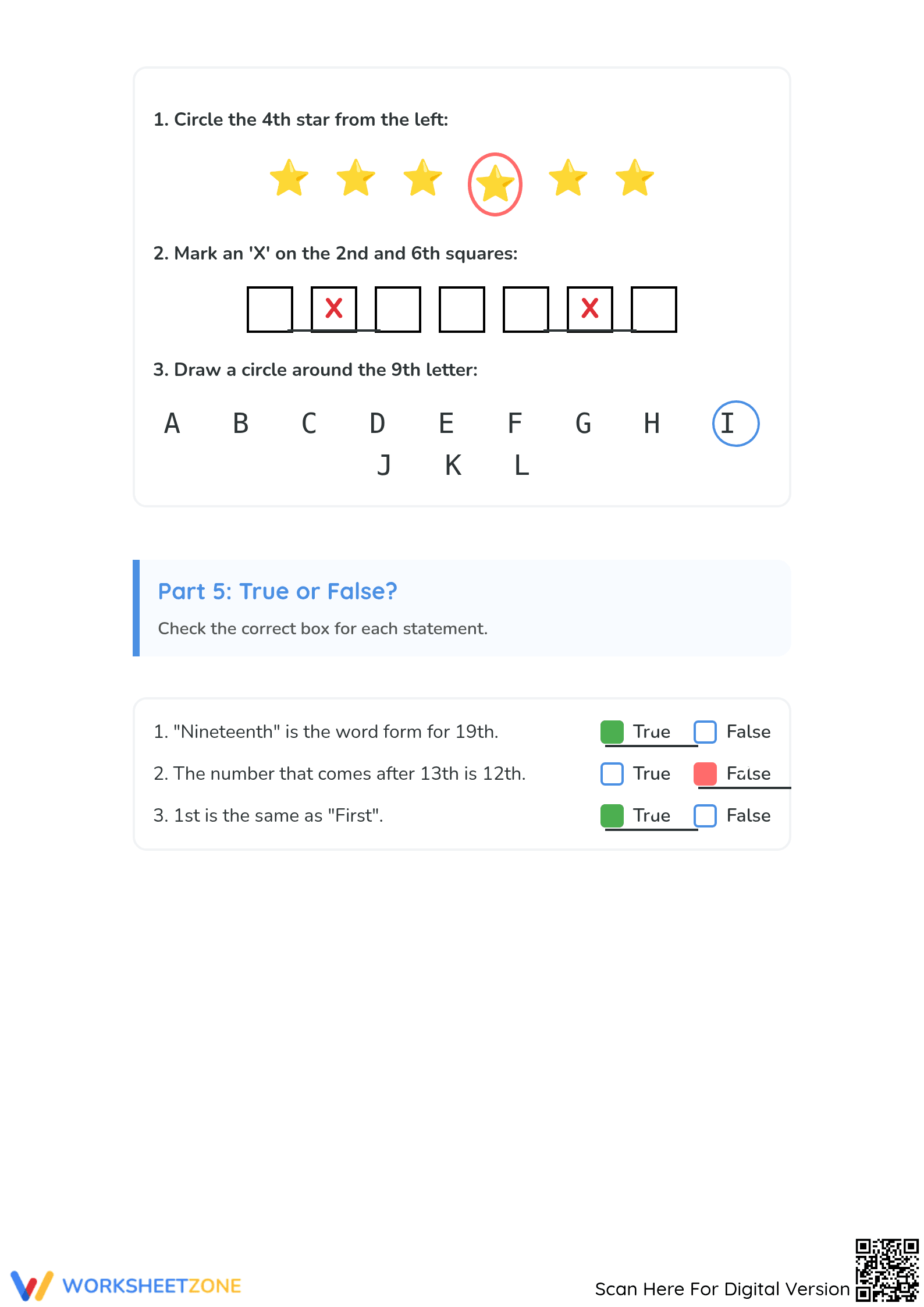
This three-page PDF packet contains five distinct sections designed to build numerical fluency. It features matching word forms, fruit-based identification, sequence completion (11th-20th), and directional tasks. A true/false assessment and a complete answer key are included for zero-prep classroom use, ensuring students receive immediate feedback on their understanding of ordinal positions.
Skill Progression
- Guided Practice: 5 matching tasks connect ordinal symbols (1st, 5th) to literal word forms (first, fifth) to establish a baseline vocabulary for the unit.
- Supported Practice: 10 application problems utilize fruit graphics and letter lines for concrete position identification, helping students translate abstract concepts into real-world observations.
- Independent Practice: 5 final tasks challenge students to complete numerical sequences and evaluate true/false statements without visual scaffolds to ensure conceptual mastery.
This progression follows a gradual-release model, moving from simple recognition to higher-order application of ordinal concepts in various mathematical contexts.
Standards Alignment
The primary alignment is `CCSS.MATH.CONTENT.2.NBT.A.3`, which mandates that students read and write numbers using number names and base-ten numerals. While ordinals are foundational to first-grade standards, the extension to 20th and the integration of complex word forms align with the Grade 2 expectation for expanded numerical literacy. Both standard codes can be copied directly into lesson plans, IEP goals, or district curriculum mapping tools.
How to Use It
Distribute this worksheet during the independent practice portion of a lesson on positions or number systems. It serves as an excellent formative assessment; teachers should observe students during Part 2 to ensure they are counting from the correct anchor point (left-to-right). Most Grade 2 students will complete the entire packet within 20 minutes, making it an ideal choice for a quiet math center or a quick check for understanding.
Who It's For
This resource is tailored for Grade 2 students who are solidifying their understanding of order and sequence beyond the first ten positions. It is particularly beneficial for English Language Learners who need to bridge the gap between cardinal counts and ordinal vocabulary. For advanced students, pair this with a reading passage to practice identifying paragraph or sentence numbers in text.
Aligned to CCSS.MATH.CONTENT.2.NBT.A.3, this worksheet helps students master ordinal numbers 1st to 20th, bridging basic counting to formal positional vocabulary. The structured activities, from matching words to applying them with physical objects, enhance retention. With 20 unique problems and an answer key, teachers can quickly assess understanding and address misconceptions, ensuring strong foundational numeracy for second graders.


