




























Views
Downloads

Complete Grade 4 Math Worksheet: Place Value & Geometry

Paste this activity's link or code into your existing LMS (Google Classroom, Canvas, Teams, Schoology, Moodle, etc.).
Students can open and work on the activity right away, with no student login required.
You'll still be able to track student progress and results from your teacher account.
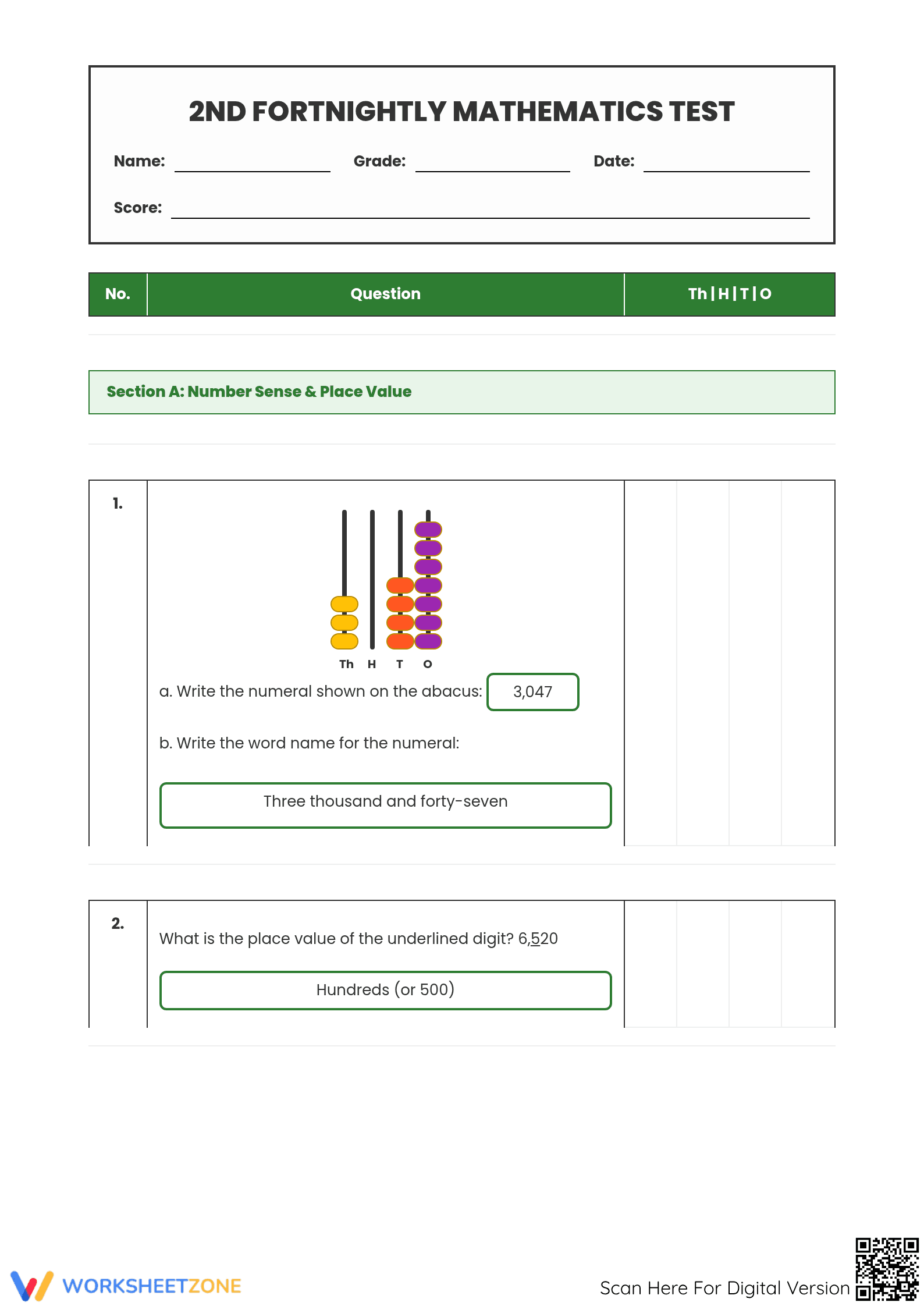
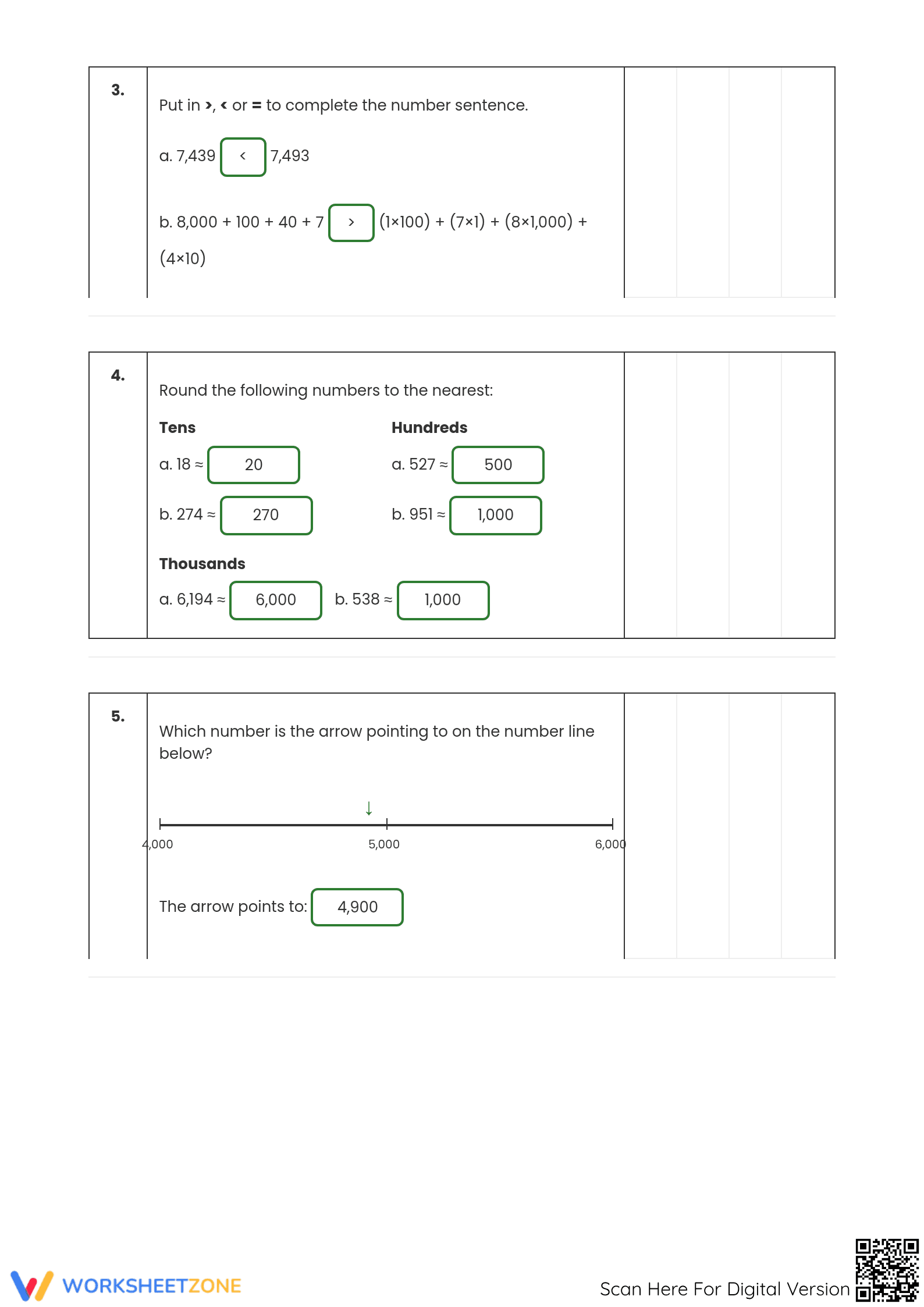
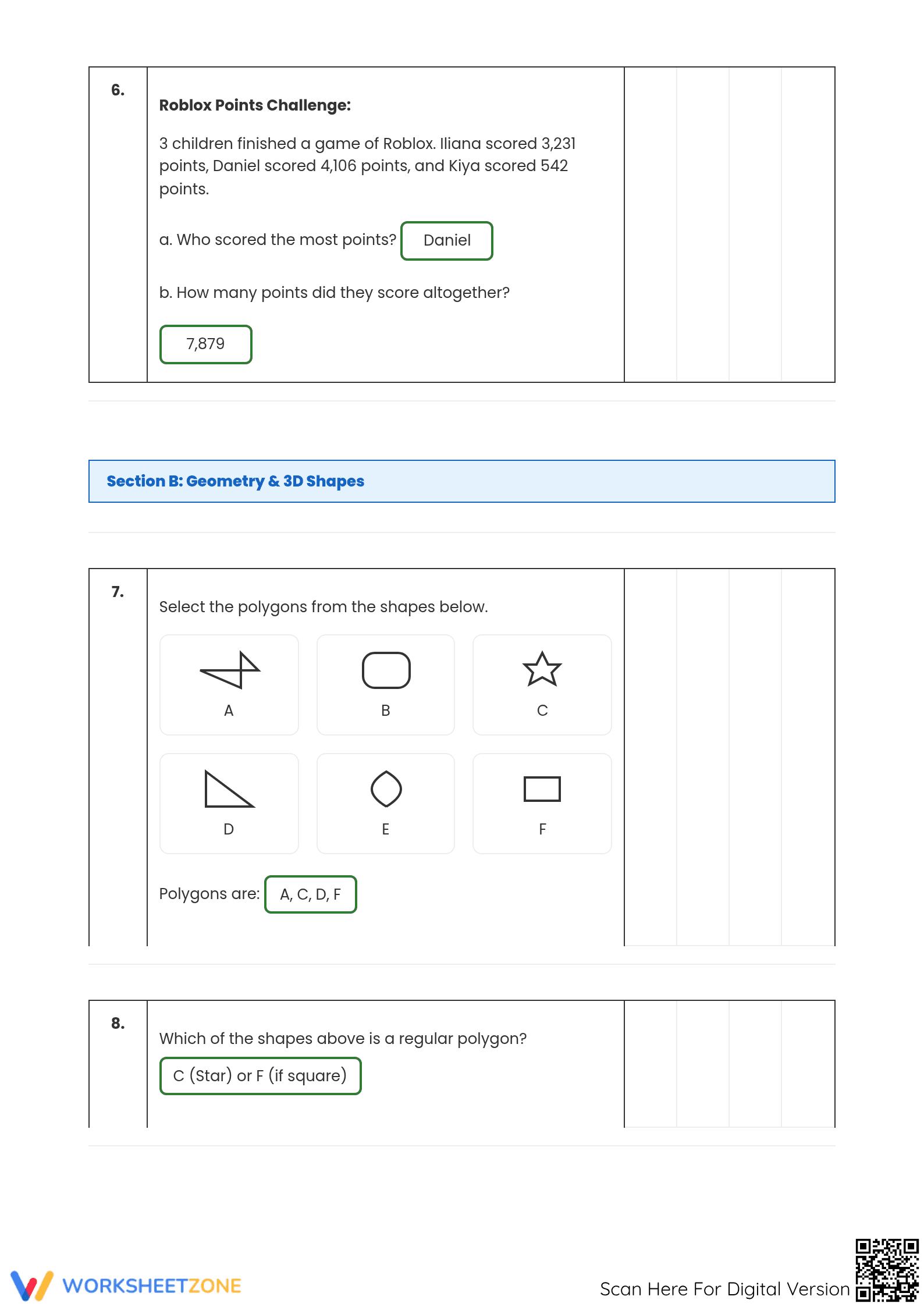
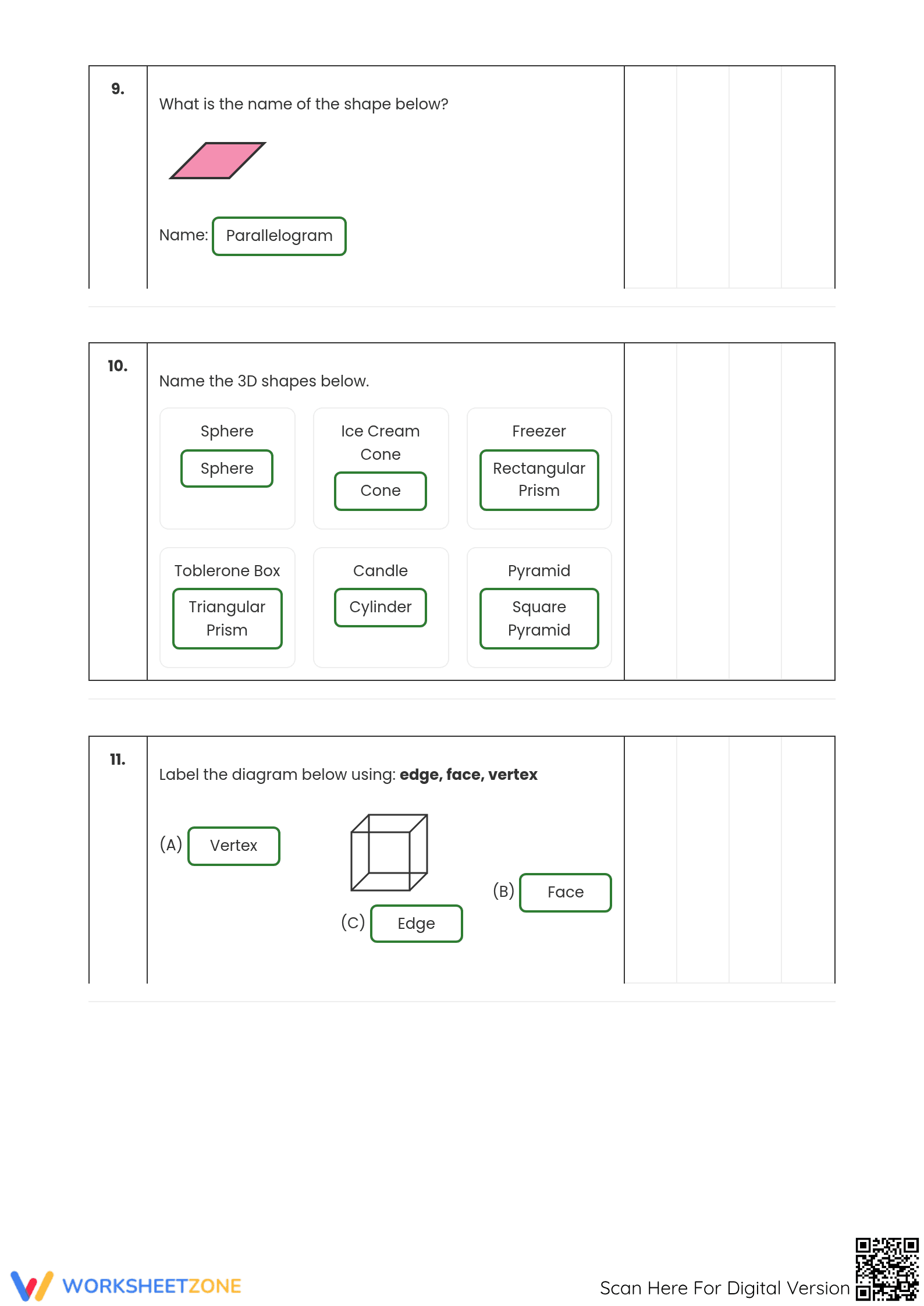
This Grade 4 Mathematics worksheet serves as a comprehensive assessment for number sense, place value, and geometric reasoning. Students engage with multi-digit numbers, rounding, polygon identification, and 3D shape attributes. By completing these 13 structured tasks, learners demonstrate mastery of core fourth-grade concepts while preparing for standardized testing environments.
At a Glance
- Grade: 4 · Subject: Mathematics
- Standard:
CCSS.MATH.CONTENT.4.NBT.A.2— Read and write multi-digit whole numbers using numerals, names, and expanded form- Skill Focus: Place Value, Rounding, Polygons, and 3D Shapes
- Format: 5 pages · 13 problems · Answer key included · PDF
- Best For: Fortnightly assessment and mastery tracking
- Time: 45–60 minutes
What's Inside
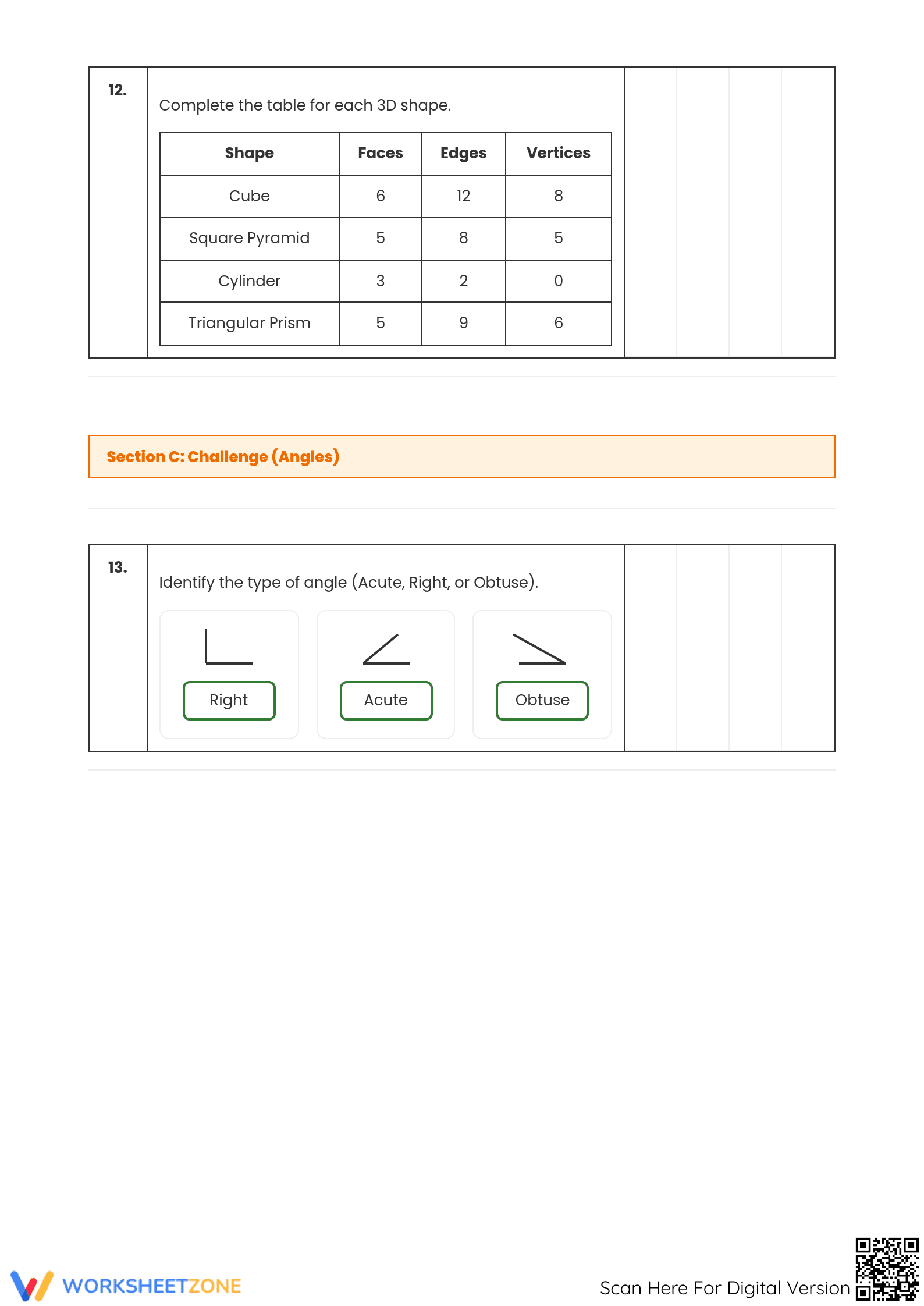
This 5-page PDF contains a balanced mix of calculation, visual modeling, and conceptual identification. The "Number Sense & Place Value" section features an abacus model for numeral construction, rounding tasks for tens, hundreds, and thousands, and a number line challenge. The geometry sections require students to classify polygons, identify 3D shapes from real-world examples, and label geometric components like edges and vertices. A full answer key is included.
Mastery Evidence
The worksheet is structured as a "Fortnightly Test," making it an ideal tool for gathering evidence of student progress. Tasks are mapped to specific mastery levels: Question 1-6 target foundational number sense (Approaching), while the geometry sections (7-12) assess the application of classification rules (Meeting). The final challenge on angles (13) pushes students toward mastery (Exceeding). Teachers can record scores directly to track longitudinal growth against state and national benchmarks.
Standards Alignment
The primary standard addressed is `CCSS.MATH.CONTENT.4.NBT.A.2`: "Read and write multi-digit whole numbers using base-ten numerals, number names, and expanded form." The geometry tasks align with `CCSS.MATH.CONTENT.3.G.A.1` and `CCSS.MATH.CONTENT.4.G.A.1`, focusing on the properties of two-dimensional and three-dimensional shapes. Both standard codes can be copied directly into lesson plans, IEP goals, or district curriculum mapping tools.
How to Use It
Administer this worksheet as a summative assessment at the end of a two-week unit on place value and geometry. For formative use, observe students during the abacus and number line tasks to identify misconceptions about base-ten structures. The expected completion time is 45 to 60 minutes, allowing for a standard class period to be used for both administration and a brief peer-review session.
Who It's For
This resource is designed for Grade 4 general education classrooms, but it is also highly effective for Grade 3 acceleration or Grade 5 review. It pairs naturally with math manipulatives like base-ten blocks or geometric nets to provide a hands-on reinforcement of the abstract concepts presented on the page.
Aligned to CCSS.MATH.CONTENT.4.NBT.A.2, this assessment prioritizes the development of multi-digit number fluency and geometric classification skills. Research from Fisher & Frey (2014) emphasizes the importance of utilizing multiple representations, such as the abacus models and number lines found in this worksheet, to bridge the gap between concrete understanding and abstract mathematical notation. By integrating both numerical and spatial reasoning, this tool provides a holistic view of student competency across two critical math domains. The inclusion of clear task instructions and a structured layout supports independent student work while providing teachers with reliable data for instructional decision-making and IEP progress monitoring. This resource can be integrated into broader curricular frameworks as a standalone progress monitor or as a professional supplement to high-stakes test preparation. Furthermore, the systematic categorization of shapes and angles aligns with developmental trajectories for spatial visualization, ensuring that learners are equipped with the vocabulary and conceptual frameworks necessary for success in higher-level geometry and algebra.


