




























Views
Downloads

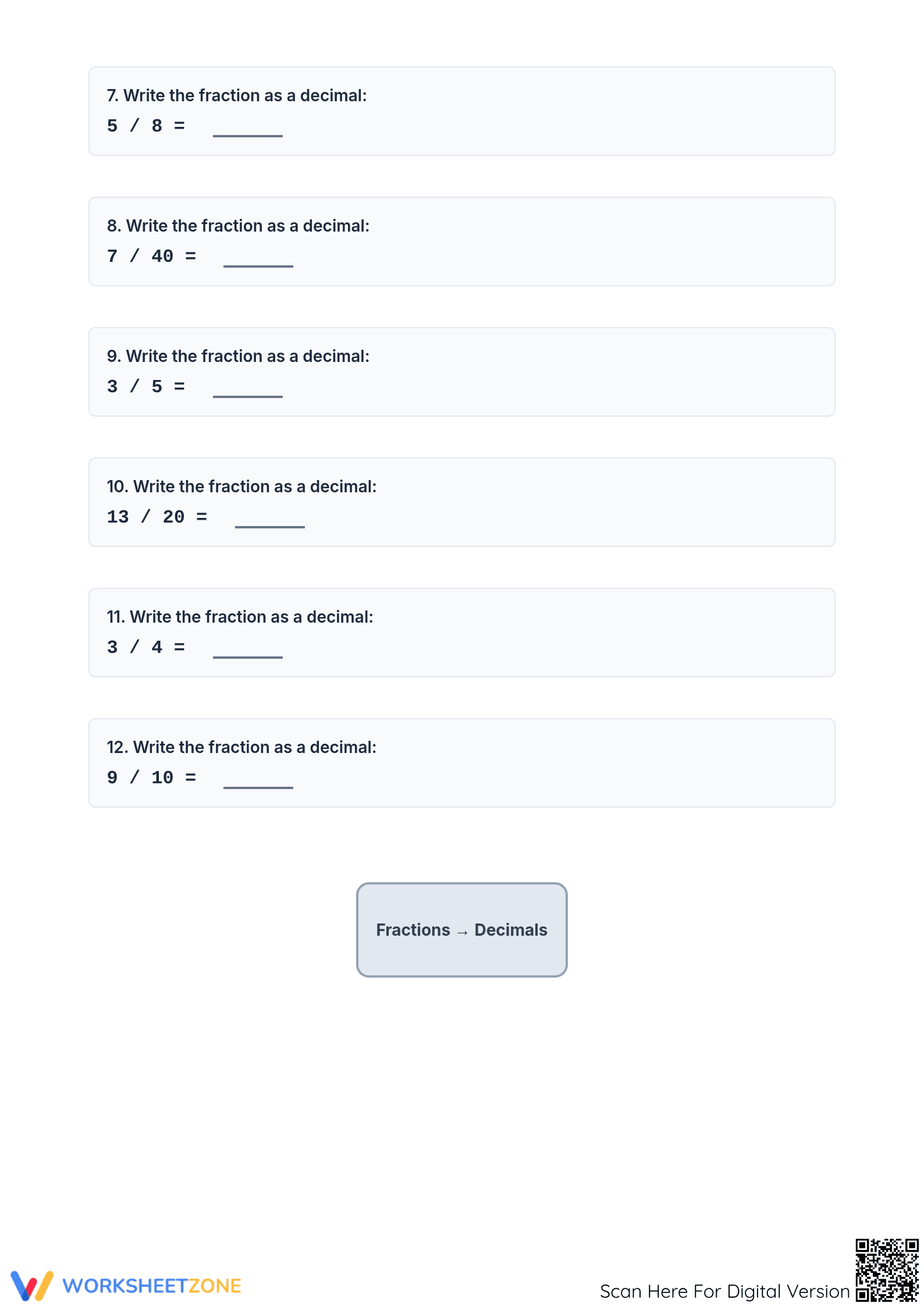
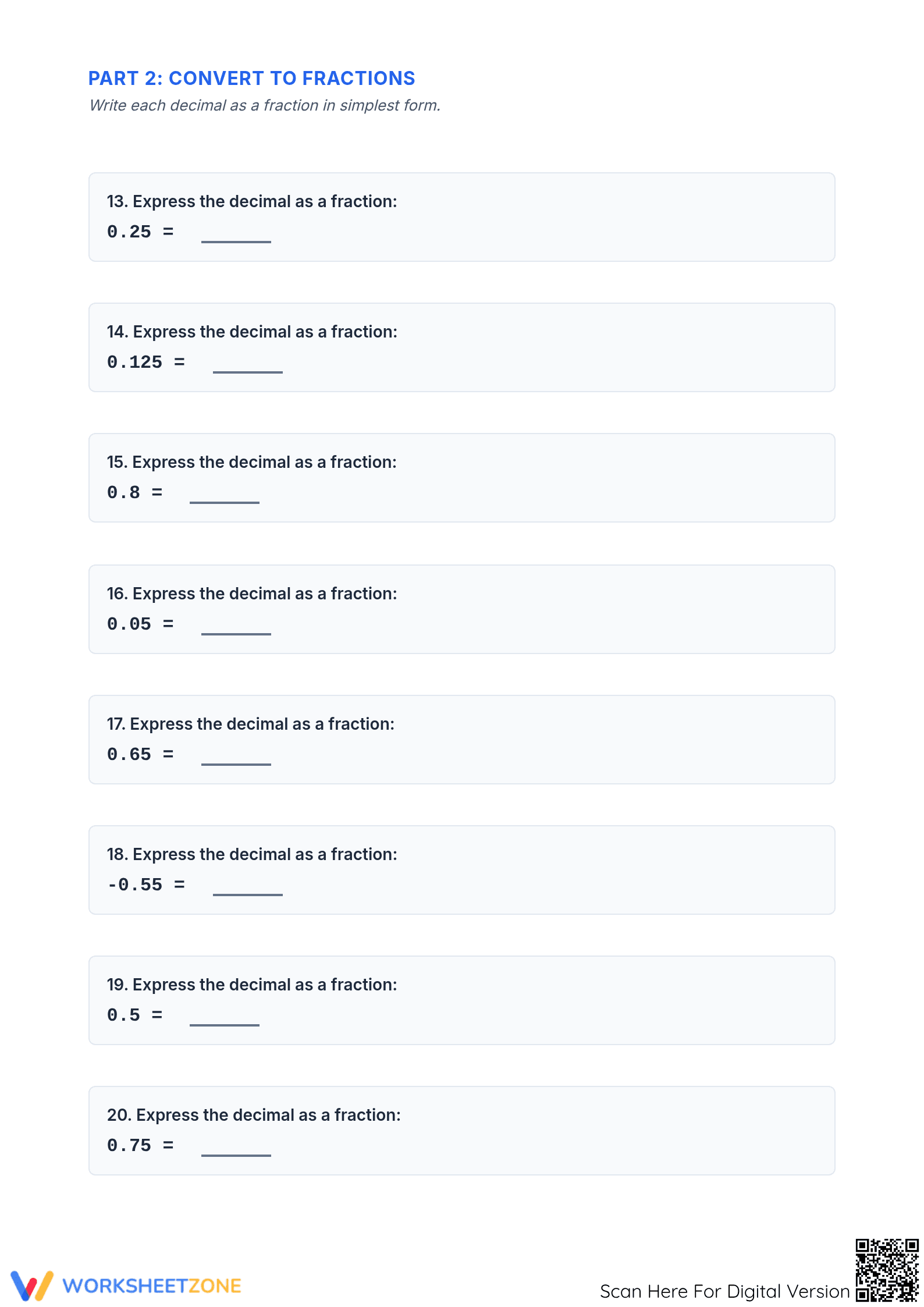
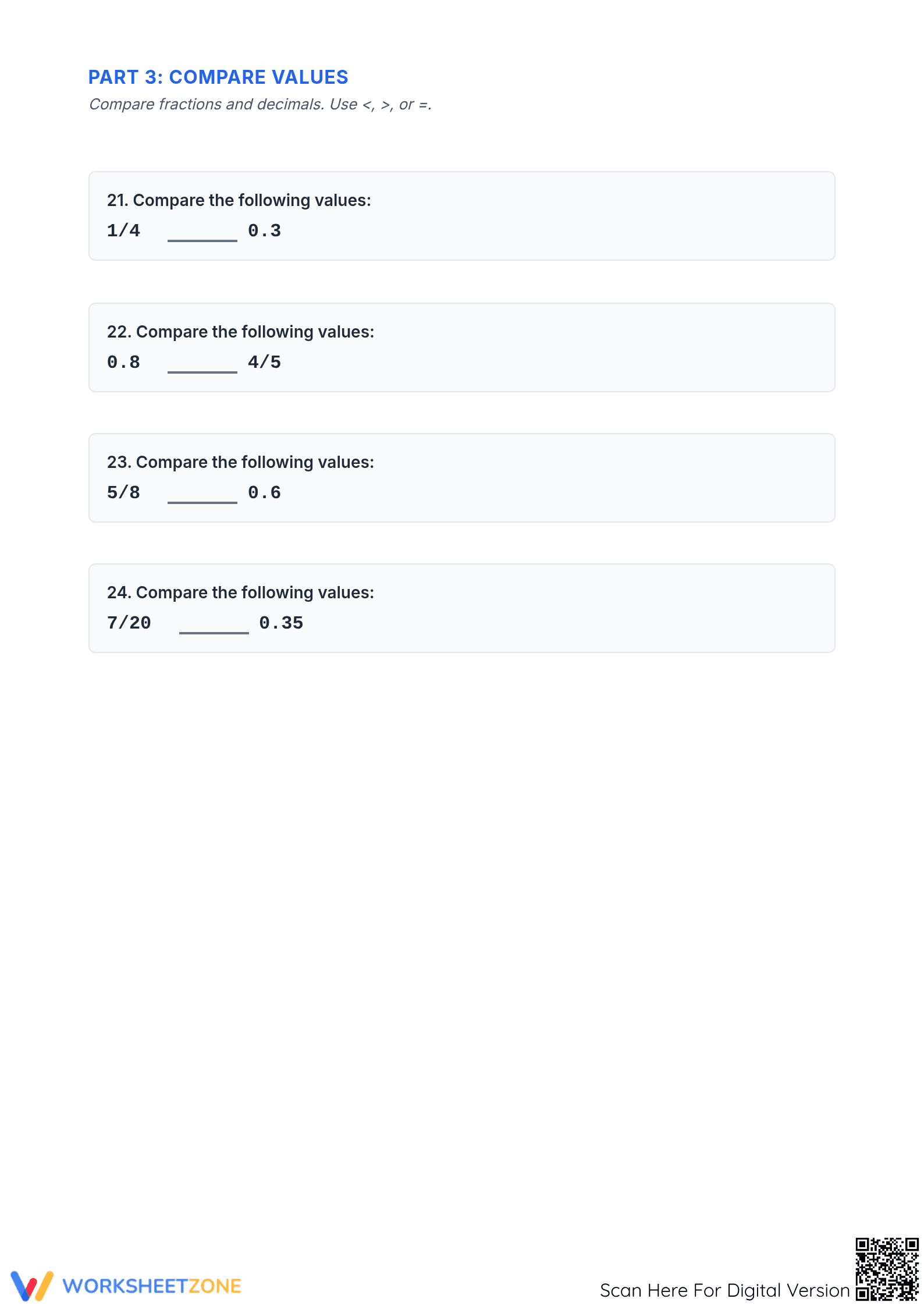

7.NS.A.2.d Worksheet: Fraction to Decimal — Grade 7 Aligned

Paste this activity's link or code into your existing LMS (Google Classroom, Canvas, Teams, Schoology, Moodle, etc.).
Students can open and work on the activity right away, with no student login required.
You'll still be able to track student progress and results from your teacher account.
This Grade 7 Math worksheet provides comprehensive practice for students to master the transition from fractions to decimals. By focusing on both terminating and repeating decimals, learners develop a deep understanding of rational number representations. Students will accurately convert complex fractions using long division, ensuring they meet essential prerequisite knowledge for higher-level mathematics.
At a Glance
- Grade: 7 · Subject: Math
- Standard:
7.NS.A.2.d— Use long division to convert rational numbers into terminating or repeating decimal forms- Skill Focus: Rational Number Conversion
- Format: 4 pages · 25 problems · Answer key included · PDF
- Best For: Pre-assessment or unit review for rational numbers
- Time: 30–45 minutes
What's Inside
The worksheet contains four pages of targeted practice designed to bridge the gap between elementary fraction knowledge and middle school rational number fluency. It includes 25 distinct tasks, ranging from unit fractions to mixed numbers. Structural features include matching, multiple-choice, and open-ended calculation spaces. A full answer key is provided for immediate feedback and efficient grading.
Mastery Evidence
This assessment-ready resource utilizes a tiered approach to mastery. Tasks are systematically mapped to the sub-skills of the 7.NS.A.2.d standard, starting with simple denominator patterns and progressing to complex repeating sequences. Teachers can use the results to categorize students into proficiency levels. Data gathered from these tasks can be entered directly into gradebooks or used to inform IEP progress notes.
Standards Alignment
The primary focus is 7.NS.A.2.d: "Convert a rational number to a decimal using long division; know that the decimal form of a rational number terminates in 0s or eventually repeats." This worksheet specifically targets computational aspects and reinforces conceptual understanding of decimal behavior. Both standard codes can be copied directly into lesson plans, IEP goals, or district curriculum mapping tools.
How to Use It
Use this worksheet as a formal pre-test before a unit on the number system to identify gaps in prior knowledge. During instruction, assign specific pages as independent practice after a direct lesson on long division. For a formative assessment tip, observe students as they work on the repeating decimal section to check for pattern recognition. Expected completion time is 35 minutes.
Who It's For
This resource is ideal for Grade 7 and Grade 8 students working on rational numbers. It is effective for learners requiring structured practice to build computational stamina. The clear layout provides natural differentiation for diverse learners. It pairs naturally with an anchor chart on fraction-decimal equivalents or a direct instruction lesson on terminating versus repeating decimal expansions.
The conversion of rational numbers from fractional to decimal form is a pivotal skill in middle school mathematics, as defined by standard 7.NS.A.2.d. Mastery of this skill allows students to fluently move between numerical representations, a competency that Fisher & Frey (2014) identify as essential for successful transition to high school algebra. Research from the RAND AIRS 2024 study suggests that targeted practice in identifying decimal expansions—specifically the distinction between terminating and repeating patterns—is strongly correlated with higher performance on standardized assessments. This worksheet provides the structured environment necessary for students to practice long division algorithms. By providing twenty-five distinct opportunities for calculation, this resource ensures that students encounter a wide enough variety of denominators to recognize recurring patterns. This evidence-based approach to math fluency is a core component of effective instruction.


