


























Views
Downloads

Personal Pronouns Chart & Worksheet | Grade 5 ELA Printable
Paste this activity's link or code into your existing LMS (Google Classroom, Canvas, Teams, Schoology, Moodle, etc.).
Students can open and work on the activity right away, with no student login required.
You'll still be able to track student progress and results from your teacher account.
This comprehensive Grade 5 grammar resource provides a clear personal pronouns master chart alongside targeted practice exercises. Students will learn to correctly identify and apply subject pronouns, object pronouns, and possessive adjectives in context, ensuring their writing is grammatically accurate and clearly communicates their intended meaning.
At a Glance
- Grade: 5 · Subject: ELA
- Standard:
CCSS.ELA-LITERACY.L.5.1— Demonstrate command of standard English grammar conventions- Skill Focus: Subject, object, and possessive pronouns
- Format: 3 pages · 18 problems · Answer key included · PDF
- Best For: Independent practice and grammar review
- Time: 20–25 minutes
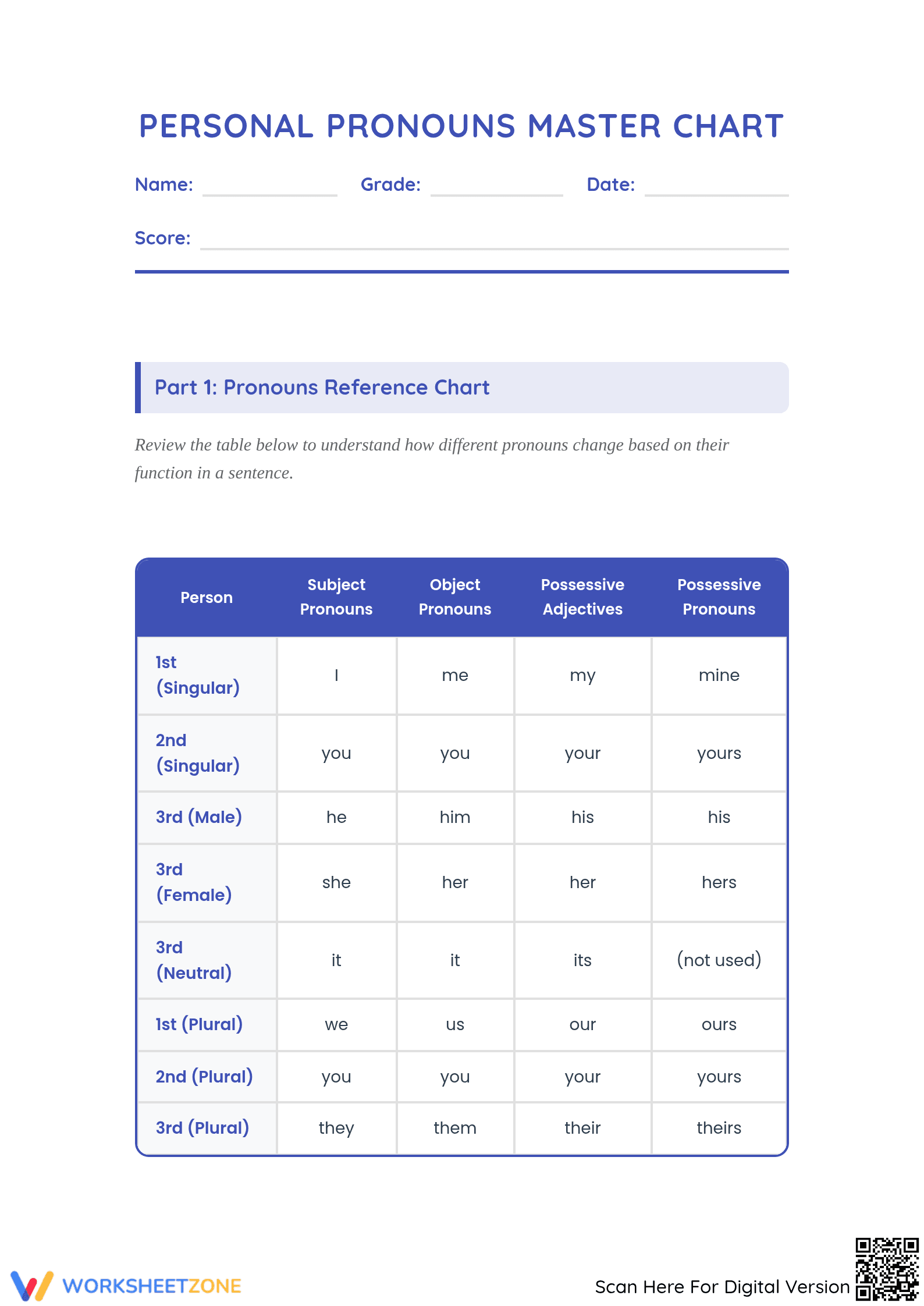
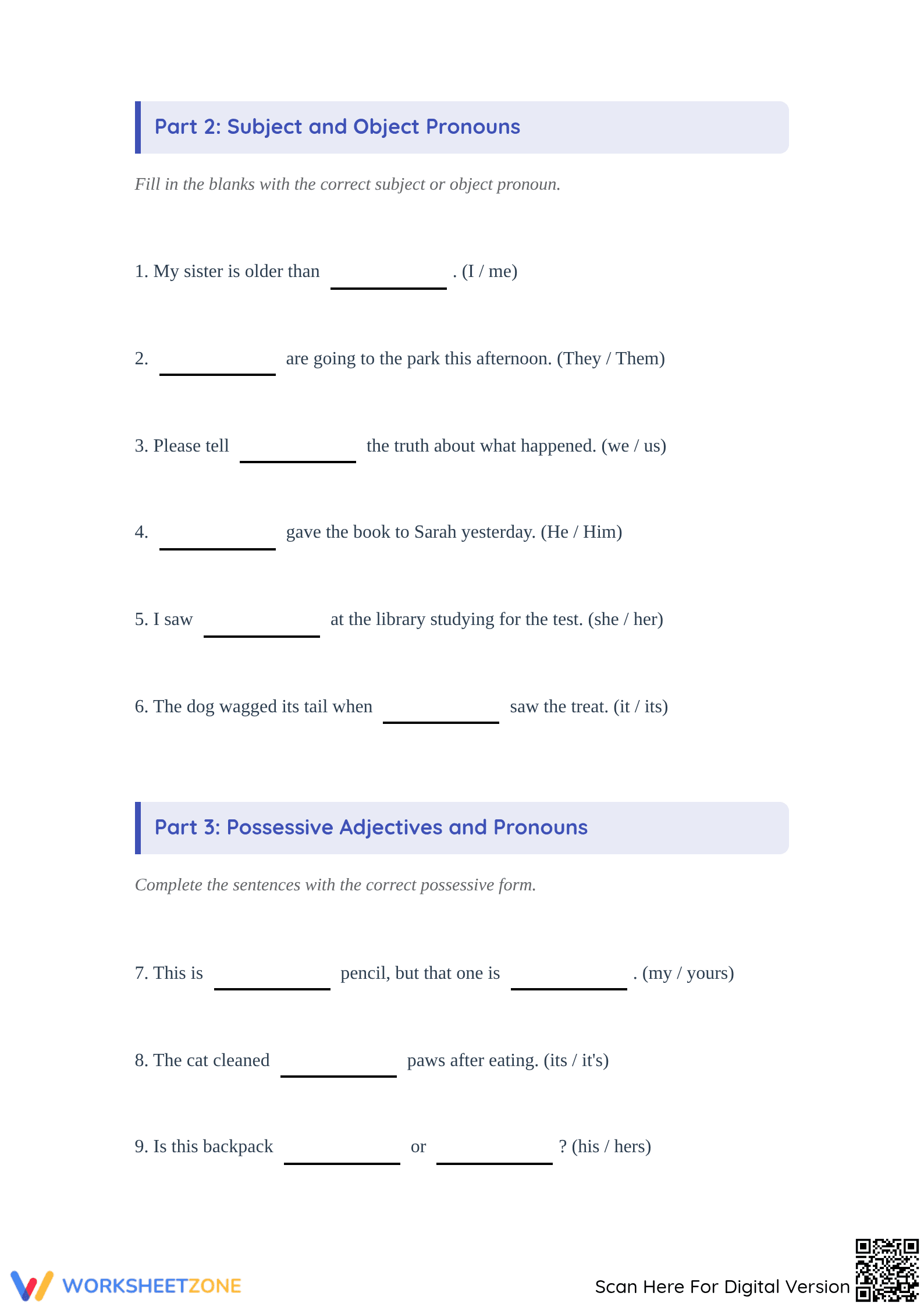
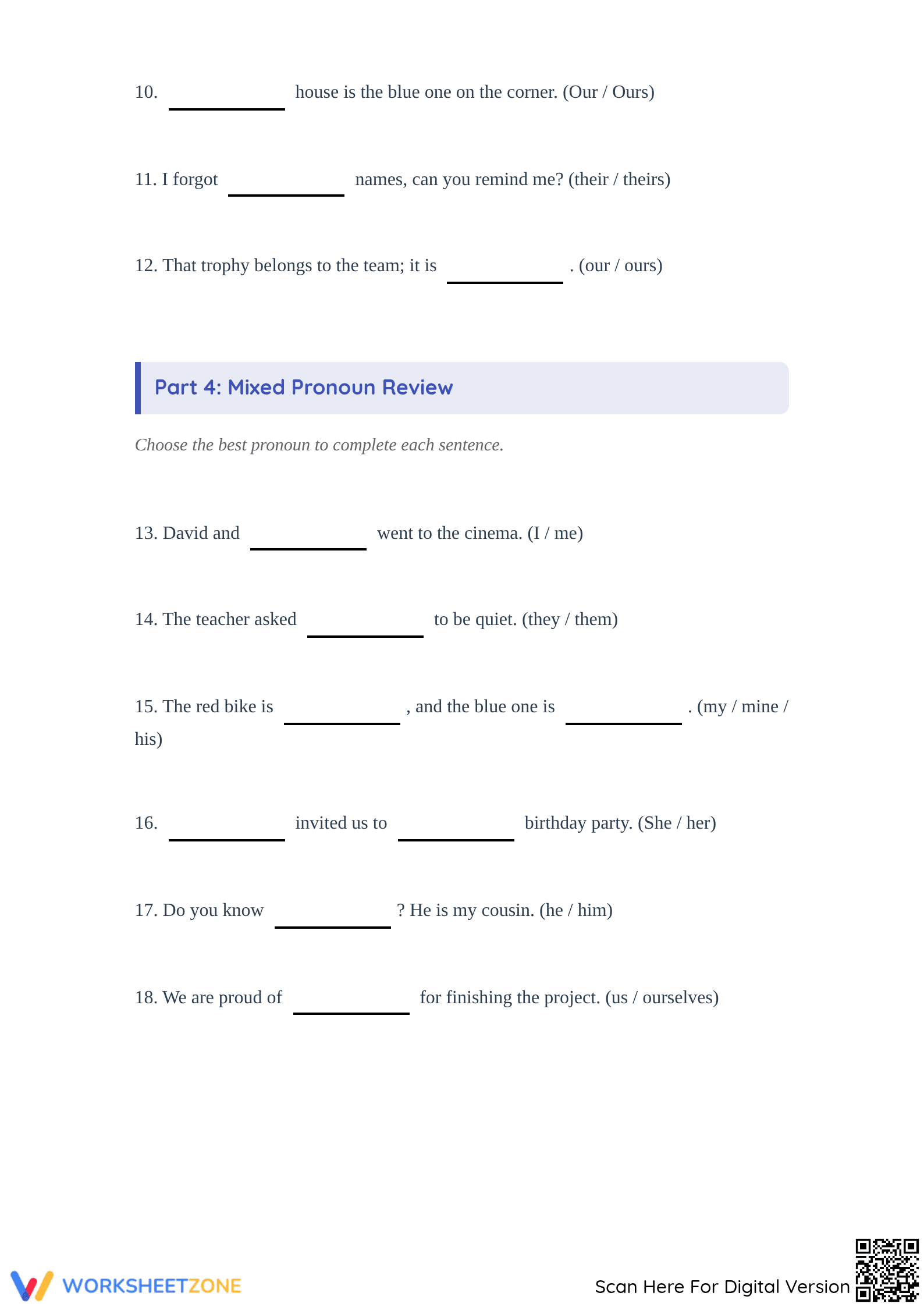
Inside this three-page printable, educators will find a structured approach to grammar instruction. Page one features a comprehensive reference chart detailing first, second, and third-person pronouns across singular and plural forms. The following pages contain 18 fill-in-the-blank sentences divided into specific skill sections, including subject/object pronouns, possessive forms, and a mixed review. A complete three-page answer key is provided for quick grading.
- Guided Reference: The master chart serves as an immediate scaffold, allowing students to independently verify pronoun cases before attempting the exercises.
- Supported Practice: Parts 2 and 3 isolate specific pronoun types, giving students 12 focused questions with binary multiple-choice options to build confidence.
- Independent Practice: Part 4 challenges learners with a mixed pronoun review, requiring them to analyze sentence structure to select the correct pronoun case without section hints.
This gradual-release structure ensures students move smoothly from the "I Do" reference stage to the "You Do" independent application.
This worksheet is aligned to primary standard CCSS.ELA-LITERACY.L.5.1, requiring students to demonstrate command of the conventions of standard English grammar and usage when writing or speaking. It also builds essential foundational skills for later grades where pronoun case is explicitly tested. Both standard codes can be copied directly into lesson plans, IEP goals, or district curriculum mapping tools.
Deploy this resource during your grammar block after a brief direct instruction lesson on pronoun types. The reference chart makes it an excellent addition to student interactive notebooks or writing folders. As a formative assessment tip, observe which students rely heavily on the chart during the mixed review section; this indicates they may need additional practice internalizing pronoun rules. Expected completion time is 20 to 25 minutes.
This worksheet is designed for fifth-grade general education students, but its clear visual chart makes it highly effective for English Language Learners (ELLs) and students receiving special education support. The built-in scaffolding allows for easy differentiation. Pair this activity with a narrative writing assignment, challenging students to highlight and verify the pronouns they used in their own drafts.
Mastering pronoun conventions is a critical component of developing strong writing and reading comprehension skills in upper elementary classrooms. Aligned with CCSS.ELA-LITERACY.L.5.1, this resource helps students demonstrate command of standard English grammar conventions. According to Fisher & Frey (2014), providing students with clear visual scaffolds, such as comprehensive reference charts, significantly reduces cognitive load and allows learners to focus on applying new grammatical rules in context rather than relying on rote memorization. By transitioning students from a structured reference guide to mixed independent practice, educators can effectively build long-term retention of complex pronoun cases. This structured, gradual-release approach ensures that students not only recognize correct grammar but can actively produce it in their own writing, leading to clearer communication and improved academic outcomes across all subject areas.


