


























Views
Downloads


Essential Syllables Worksheet | Grade 5-8 Printable
Paste this activity's link or code into your existing LMS (Google Classroom, Canvas, Teams, Schoology, Moodle, etc.).
Students can open and work on the activity right away, with no student login required.
You'll still be able to track student progress and results from your teacher account.
Mastering syllabication is a foundational skill for decoding complex vocabulary and improving reading fluency in upper elementary and middle school grades. This Essential Syllables Worksheet provides a dual-approach practice session, requiring students to both analyze existing words for syllable counts and synthesize word parts into coherent, multi-syllabic academic terms. Students will gain confidence in handling high-level vocabulary through structured phonetic exploration.
At a Glance
- Grade: 5–8 · Subject: English Language Arts
- Standard:
CCSS.ELA-LITERACY.RF.5.3.A— Use syllabication patterns and morphology to read accurately unfamiliar multisyllabic words- Skill Focus: Syllable counting and word construction
- Format: 2 pages · 13 problems · Answer key included · PDF
- Best For: Literacy centers and independent phonics practice
- Time: 15–20 minutes
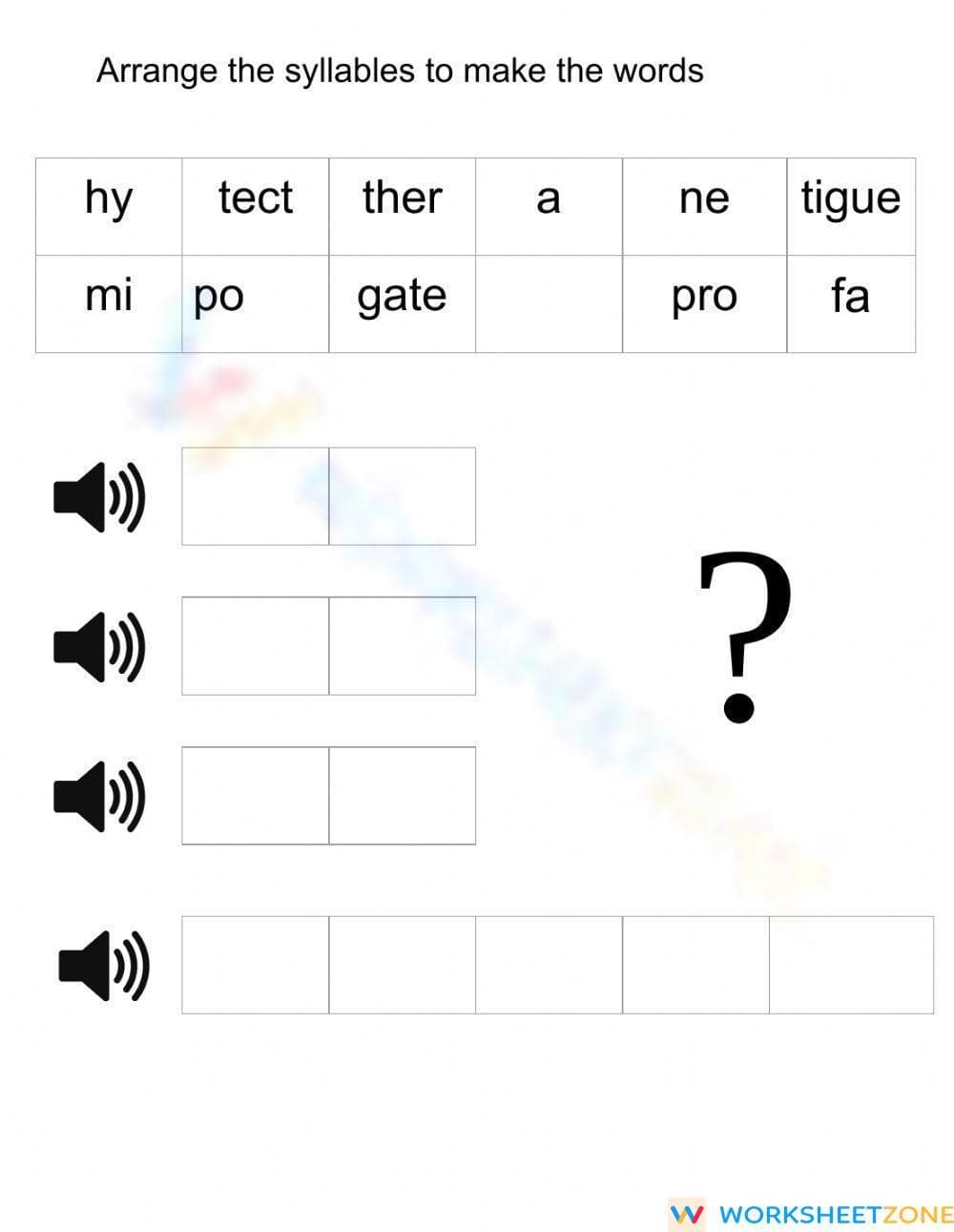
The worksheet is divided into two distinct sections across two comprehensive pages. The first section presents 9 academic words, such as "hypothermia," "evacuate," and "insulate," asking students to determine the exact syllable count for each. The second section provides a grid of 11 distinct syllables and challenges students to arrange them correctly to recreate specific target words. This 2-page resource includes a full answer key and clear visual cues for every task.
Zero-Prep Workflow
- Print: Download the PDF and print copies for your class. Optimized for high-contrast black-and-white printing.
- Distribute: Hand out during your literacy block. Instructions are self-explanatory.
- Review: Use the included answer key for rapid grading or project it on a whiteboard for a collective class check. Total preparation time is minimal.
This resource aligns with CCSS.ELA-LITERACY.RF.5.3.A, which focuses on applying letter-sound correspondences and syllabication patterns to decode unfamiliar words. By breaking down complex words, students internalize the rhythmic structures of English. This standard code can be copied directly into lesson plans or curriculum mapping tools.
We recommend this worksheet as a formative assessment during the "Independent Practice" phase of a phonics or spelling lesson. It works well in a "Read, Write, Check" station. Teachers can observe students using methods like clapping or the chin-drop to identify syllable breaks, gaining insight into their phonetic processing speed.
This resource is designed for students in grades 5 through 8 who are moving beyond basic decoding into advanced academic language. It particularly benefits English Language Learners (ELLs) needing explicit practice with word boundaries and stress patterns. It pairs naturally with a vocabulary anchor chart or a root word study focusing on Latin and Greek prefixes and suffixes.
According to the RAND AIRS 2024 report on literacy instruction, explicit syllabication practice significantly reduces cognitive load during reading by allowing students to process words in manageable "chunks." This worksheet targets CCSS.ELA-LITERACY.RF.5.3.A by requiring students to demonstrate mastery of syllable counting and word assembly. The inclusion of 13 targeted tasks ensures learners encounter a variety of syllable structures. Research from Fisher & Frey (2014) suggests this structured practice is essential for building orthographic mapping skills. This resource reinforces morphological awareness, providing high-quality, standards-aligned phonics instruction for diverse middle school learners.


