


























Views
Plays
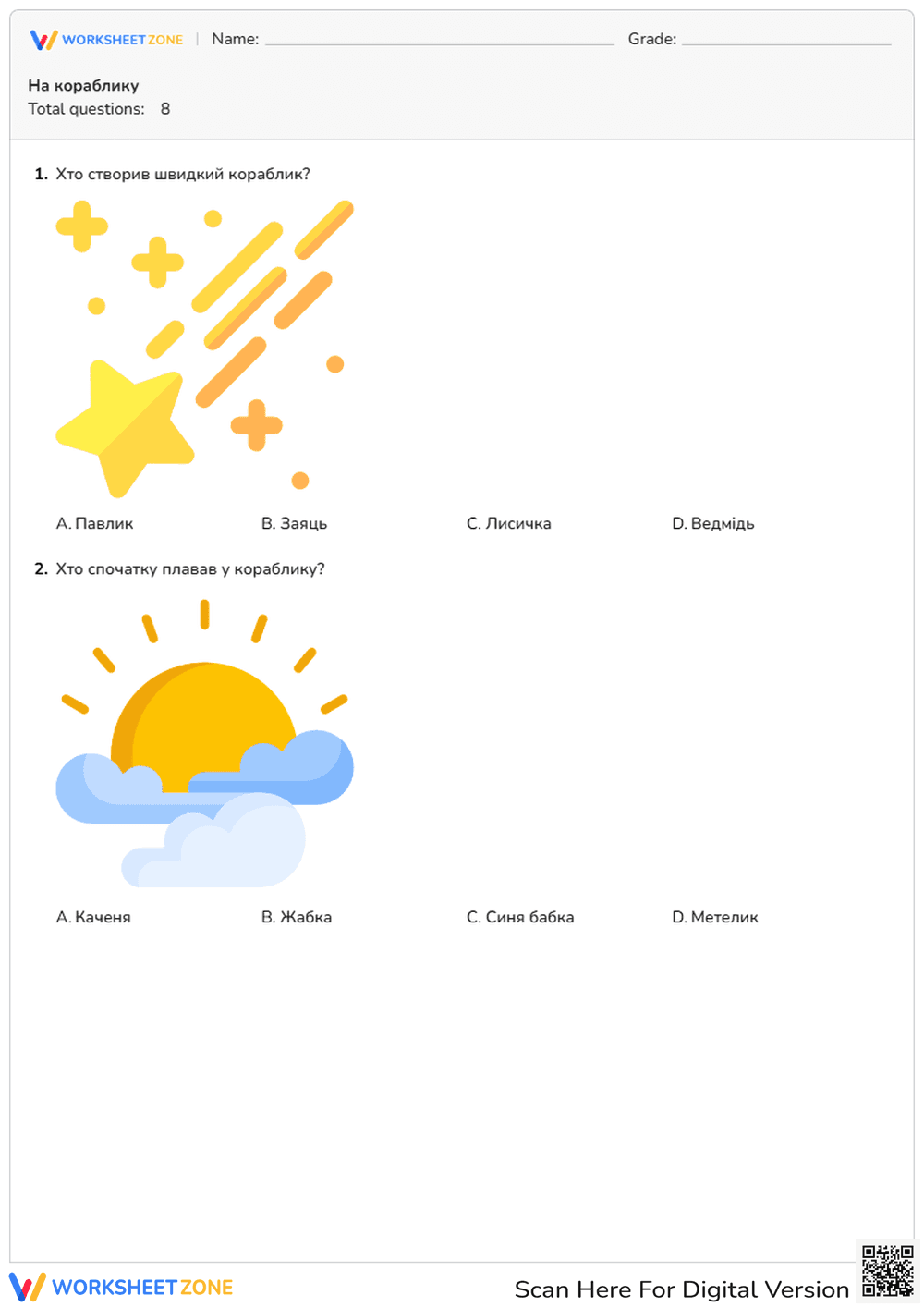


Essential Kindergarten Reading Quiz: On the Boat
Paste this activity's link or code into your existing LMS (Google Classroom, Canvas, Teams, Schoology, Moodle, etc.).
Students can open and work on the activity right away, with no student login required.
You'll still be able to track student progress and results from your teacher account.
This Kindergarten reading comprehension worksheet helps students identify key details and characters from the story "On the Boat." By answering 8 targeted multiple-choice questions, learners demonstrate their understanding of narrative elements and character actions. It provides a structured way to assess early literacy skills in a clear, visual format.
At a Glance
- Grade: Kindergarten · Subject: ELA Reading
- Standard:
CCSS.ELA-LITERACY.RL.K.1— Answer questions about key details in a text with prompting and support- Skill Focus: Character Identification & Recall
- Format: 3 pages · 8 problems · Answer key included · PDF
- Best For: Post-reading formative assessment or literacy centers
- Time: 15–20 minutes
What's Inside
This 3-page PDF includes 8 multiple-choice questions featuring large, clear text and engaging illustrations. Each question offers four distinct options to help young readers practice elimination strategies. The layout is designed for early childhood learners, with ample white space and visual cues to support comprehension of the Ukrainian text provided in the source material.
Skill Progression
- Guided Practice: The first 2 questions use familiar imagery to help students identify the main character and initial setting with visual support.
- Supported Practice: Questions 3-5 increase complexity by asking about the sequence of events and specific character interactions within the boat.
- Independent Practice: The final questions require students to recall specific attributes and the author's name, moving toward full mastery of the text.
This gradual release model ensures students feel confident as they move from basic identification to deeper recall of narrative facts.
Standards Alignment
This resource is primarily aligned with `CCSS.ELA-LITERACY.RL.K.1`, which requires students to ask and answer questions about key details in a text with prompting and support. It also supports RL.K.3 by identifying characters and major events. Both standard codes can be copied directly into lesson plans, IEP goals, or district curriculum mapping tools.
How to Use It
Use this as a formative assessment after a group read-aloud of the story. Teachers can observe which students struggle with character identification versus event sequencing. It typically takes 15–20 minutes for a Kindergarten student to complete with minimal teacher guidance. It is also effective as a quiet-time activity for students who finish their primary reading tasks early.
Who It's For
This is ideal for Kindergarten students, English Language Learners, or students in bilingual Ukrainian-English programs. It pairs perfectly with a physical copy of the poem or a digital anchor chart highlighting the story's characters and the central theme of the boat journey.
According to the Fisher & Frey (2014) framework for gradual release of responsibility, structured questioning is vital for moving students toward independent reading proficiency. This worksheet utilizes 8 specific tasks to bridge the gap between listening and active comprehension. By aligning with CCSS.ELA-LITERACY.RL.K.1, the resource ensures that early childhood educators are meeting rigorous national benchmarks for informational and literary text analysis. Research from EdReports 2024 emphasizes that high-quality instructional materials must provide clear evidence of student understanding through text-dependent questions. This quiz provides that evidence by focusing on the "who, what, and where" of the narrative. Using these 3 pages of targeted practice allows teachers to collect actionable data on student progress, ensuring that foundational literacy gaps are identified and addressed early in the academic year.


