


























Views
Downloads
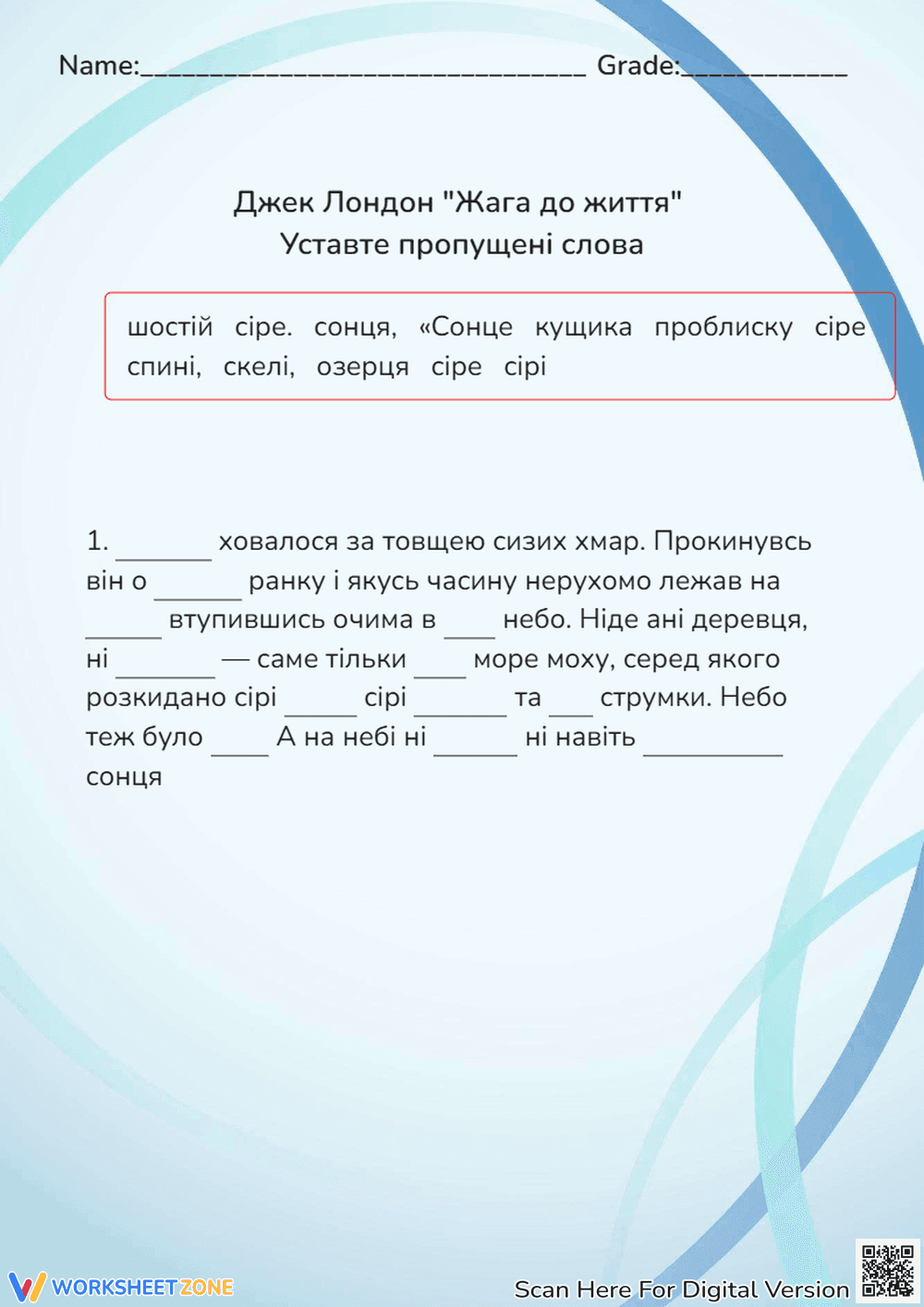

Jack London "Love of Life" Worksheet | Essential Grade 6
Paste this activity's link or code into your existing LMS (Google Classroom, Canvas, Teams, Schoology, Moodle, etc.).
Students can open and work on the activity right away, with no student login required.
You'll still be able to track student progress and results from your teacher account.
This Grade 6 literature worksheet focuses on Jack London's classic story "Love of Life" (Жага до життя). By completing the text-based cloze activity, students demonstrate their ability to recall specific details and understand the author's descriptive language. This resource ensures students engage deeply with the narrative structure and vocabulary used in the text to improve overall literacy outcomes.
At a Glance
- Grade: 6 · Subject: ELA Literature
- Standard:
CCSS.ELA-LITERACY.RL.6.1— Cite textual evidence to support analysis of what the text says explicitly- Skill Focus: Contextual Vocabulary & Comprehension
- Format: 1 page · 12 problems · Answer key included · PDF
- Best For: Post-reading comprehension check
- Time: 15–20 minutes
The worksheet features a carefully selected passage from the story with 12 strategic deletions. A word bank is provided at the top of the page to support student success and ensure focus remains on context clues rather than rote memorization. This single-page PDF is designed for clarity, featuring a clean layout that minimizes visual distractions for middle school learners while providing enough space for legible handwriting.
Zero-Prep Workflow
- Print: Teachers can print the single-page PDF in seconds for the entire class.
- Distribute: Handing out materials to a standard class takes approximately 1 minute.
- Review: The included answer key allows for a rapid 5-minute group review or self-grading session.
Total teacher preparation time is under 2 minutes, making it an ideal choice for busy classroom schedules or unexpected substitute plans where high-quality content is still required.
This resource is primarily aligned with CCSS.ELA-LITERACY.RL.6.1, which requires students to cite textual evidence to support analysis of what the text says explicitly. By selecting the correct words to complete the narrative, students must reference their understanding of the story's literal meaning. Additionally, it supports RL.6.4 by challenging students to determine the meaning of words and phrases as they are used in a text.
Use this worksheet as a formative assessment immediately following a shared reading of "Love of Life." It serves as an excellent exit ticket to gauge which students have grasped the descriptive nuances of London's prose. Alternatively, assign it as a warm-up activity to reinforce memory and vocabulary retention. Teachers should observe whether students use the word bank as a first resort or attempt to recall the text independently. The expected completion time is between 15 and 20 minutes.
This resource is tailored for Grade 6 students studying world literature or classic short stories. It is particularly effective for English Language Learners or students requiring additional scaffolding, as the word bank provides a necessary safety net. It pairs naturally with a character analysis anchor chart or a direct instruction lesson on Jack London's themes of survival and nature.
The use of cloze procedures is a well-documented method for assessing reading comprehension and linguistic competence. Scaffolded vocabulary tasks allow students to interact with complex texts by focusing on the semantic and syntactic cues provided by the author. This Grade 6 resource targets CCSS.ELA-LITERACY.RL.6.1 by requiring students to demonstrate an explicit understanding of the text through evidence-based word selection. Research suggests that high-quality, standards-aligned supplemental materials significantly improve student engagement with classic literature. By integrating a word bank with a focused passage from Jack London's "Love of Life," this worksheet provides the necessary support for students to master middle-school-level reading standards while building a robust academic vocabulary. This evidence-based approach ensures that the worksheet is both a valid assessment tool and an effective instructional aid for diverse classrooms.


