


























Views
Downloads



Printable Area and Perimeter Worksheet | Grade 6 Math
Paste this activity's link or code into your existing LMS (Google Classroom, Canvas, Teams, Schoology, Moodle, etc.).
Students can open and work on the activity right away, with no student login required.
You'll still be able to track student progress and results from your teacher account.
This comprehensive Grade 6 math worksheet provides a rigorous exploration of area and perimeter through 25 scaffolded problems. Students move from basic unit counting on grids to applying geometric formulas for triangles, rectangles, and complex polygons. By bridging visual models with abstract calculation, learners develop the deep conceptual understanding required for advanced geometry.
At a Glance
- Grade: 6 · Subject: Math
- Standard:
CCSS.MATH.CONTENT.6.G.A.1— Find the area of triangles and quadrilaterals by decomposing into simpler shapes- Skill Focus: Calculating area and perimeter of polygons using visual grid models and geometric formulas
- Format: 5 comprehensive pages · 25 structured problems · Full answer key included · High-resolution PDF
- Best For: Independent practice, classroom assessments, and comprehensive mastery of middle school geometric measurement concepts
- Time: 45–60 minutes of focused student work
Across five detailed pages, students engage with three distinct sections: Counting Units, Triangle and Diagonal Shapes, and Extended Practice. The packet features high-quality grid visuals for early success, followed by word problems that challenge students to calculate dimensions from area, compare perimeter values, and solve real-world tiling scenarios. A full answer key is included for immediate feedback.
Skill Progression
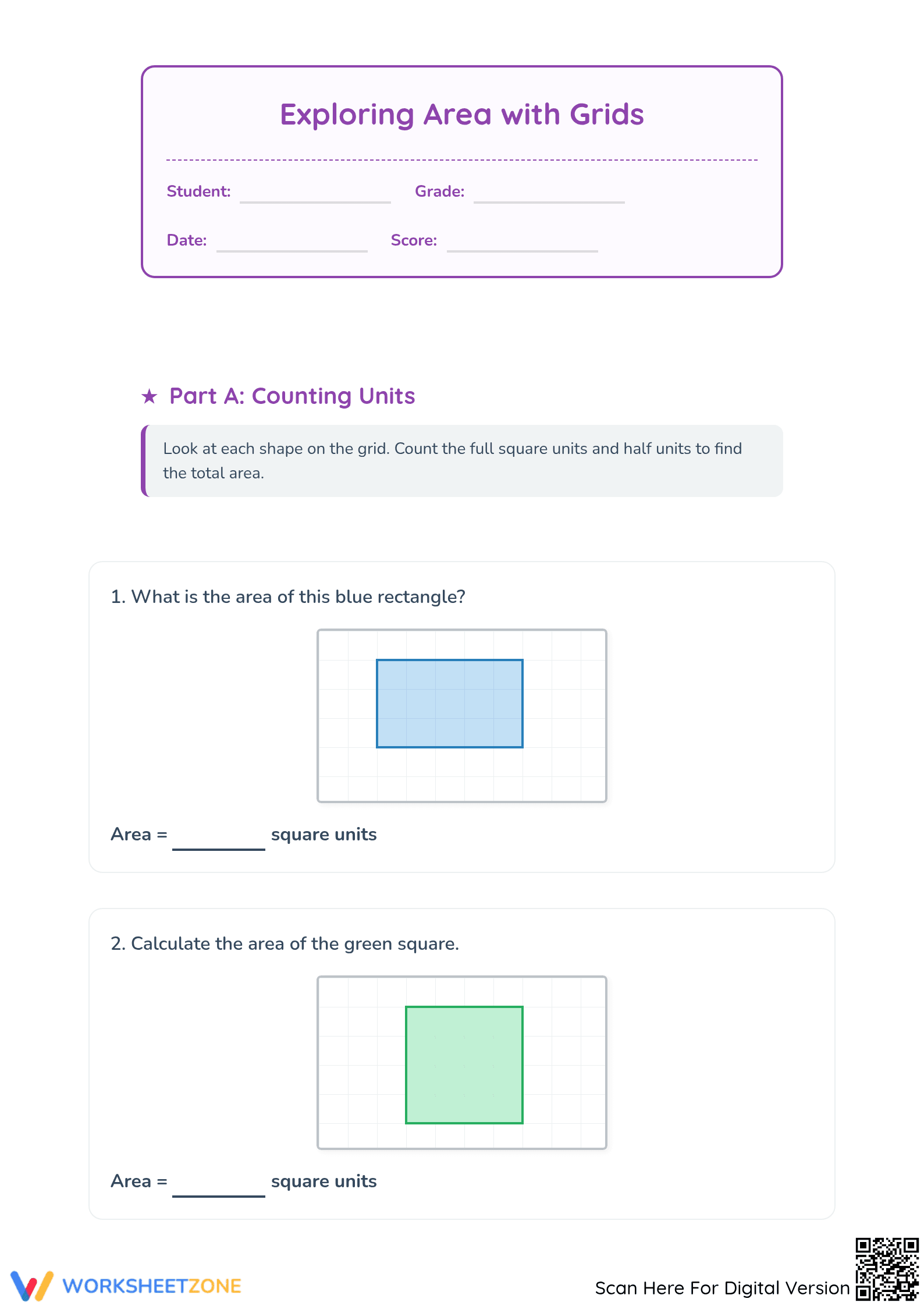
- Guided Practice: Tasks 1-4 use grids to identify square units and half-units in rectangles and triangles.
- Supported Practice: Tasks 5-12 transition to formulas for length, width, and perimeter calculations.
- Independent Practice: The final challenges require applying concepts to multi-step problems involving both area and perimeter.
This sequence ensures students build confidence before tackling abstract geometric challenges through a gradual release of responsibility.
Standards Alignment
This resource aligns to CCSS.MATH.CONTENT.6.G.A.1, focusing on finding the area of triangles, special quadrilaterals, and polygons through decomposition. It also bridges perimeter concepts from Grade 5 and prepares students for Grade 7 geometry. This standard code can be copied directly into lesson plans, IEP goals, or district curriculum mapping tools.
How to Use It
Use this during the independent practice phase of your geometry unit. The grid sections work well as an in-class activity for observing spatial reasoning, while the extended practice serves as a comprehensive homework assignment. Expect a 45-60 minute completion time. One formative tip: check Task 3 to ensure students are correctly combining half-units into wholes.
Who It's For
Designed for Grade 6, this also supports Grade 5 enrichment and Grade 7 review. The visual scaffolds assist students with IEPs and ELL learners, while the "Final Challenge" provides depth for advanced students. It pairs naturally with an area-model passage or direct instruction on geometric formulas.
Geometric measurement serves as a critical bridge between arithmetic and algebraic reasoning in the middle grades. This worksheet aligns with CCSS.MATH.CONTENT.6.G.A.1 by requiring students to find the area of triangles, special quadrilaterals, and polygons. According to Fisher & Frey (2014), the use of visual scaffolds like grids is essential for the gradual release of responsibility, moving students from counting units to applying abstract formulas. By providing 25 scaffolded tasks that progress from basic counting to complex multi-step problems involving both area and perimeter, this resource ensures that learners build a robust mental model of spatial relationships. Research from the NAEP consistently shows that students who engage with varied problem types—including drawing shapes and comparing dimensions—demonstrate higher levels of geometric proficiency than those who only solve routine calculation tasks. This comprehensive practice set provides the necessary repetition and cognitive challenge to solidify these fundamental concepts for Grade 6 learners.


