


























Views
Downloads
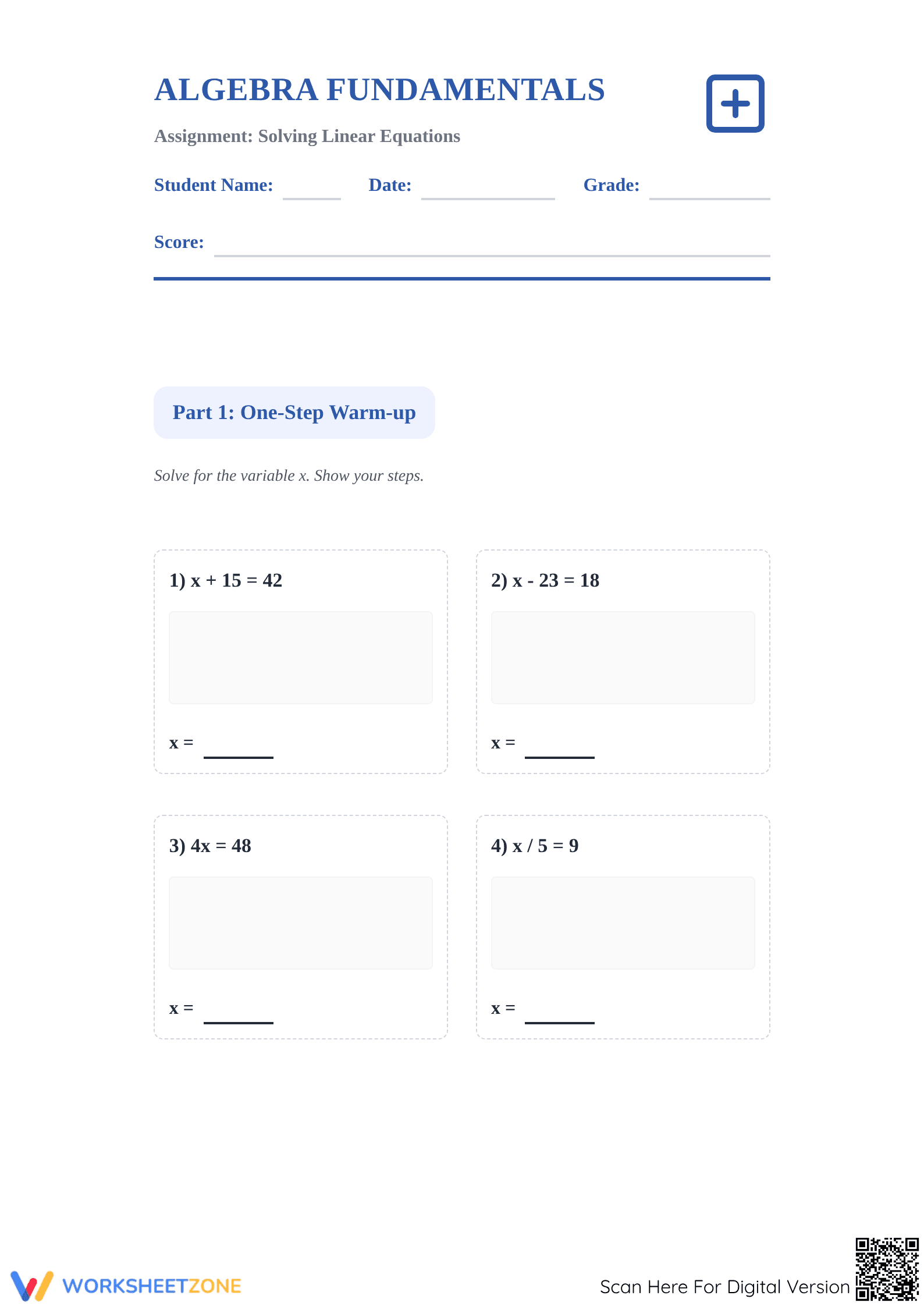
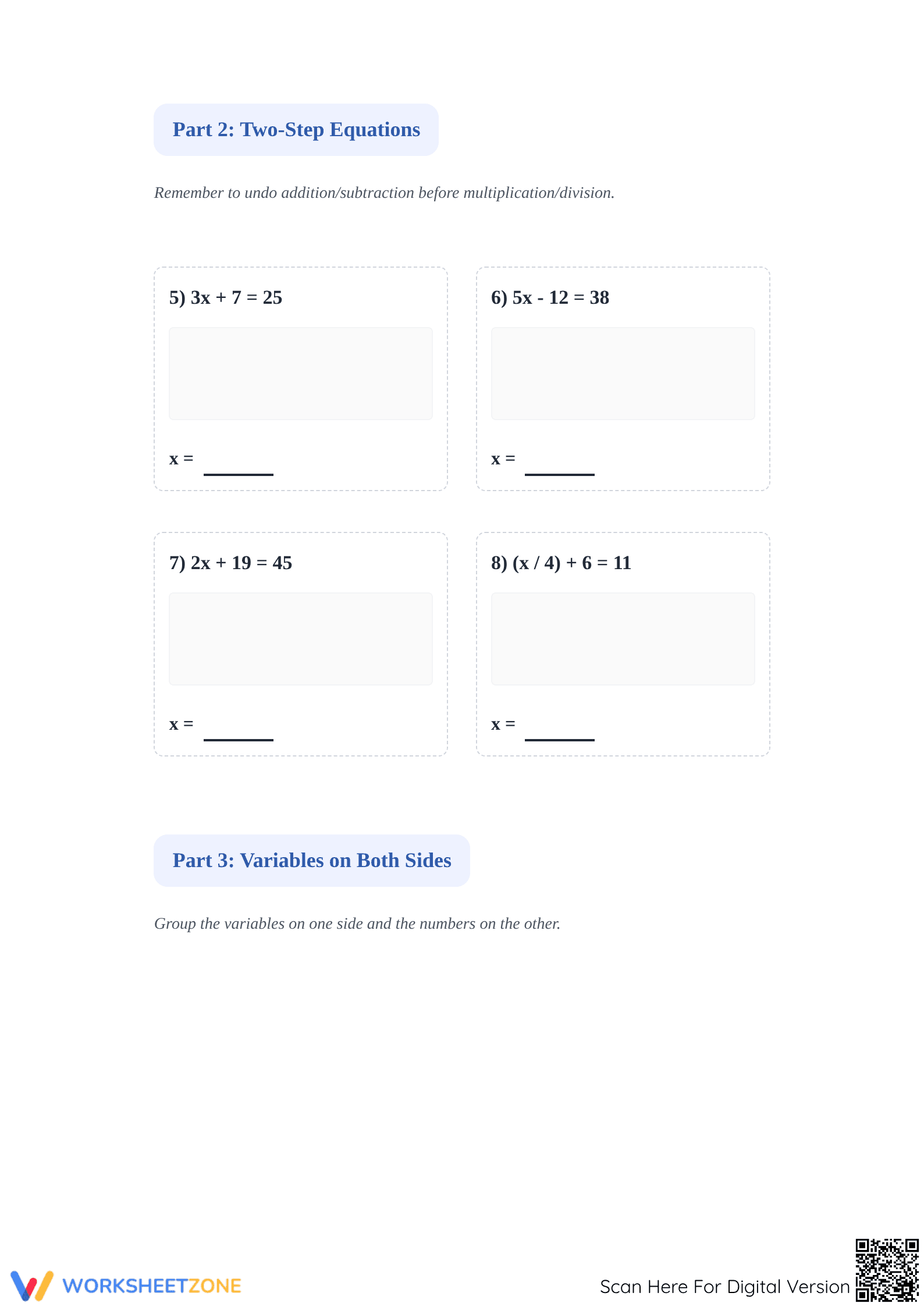
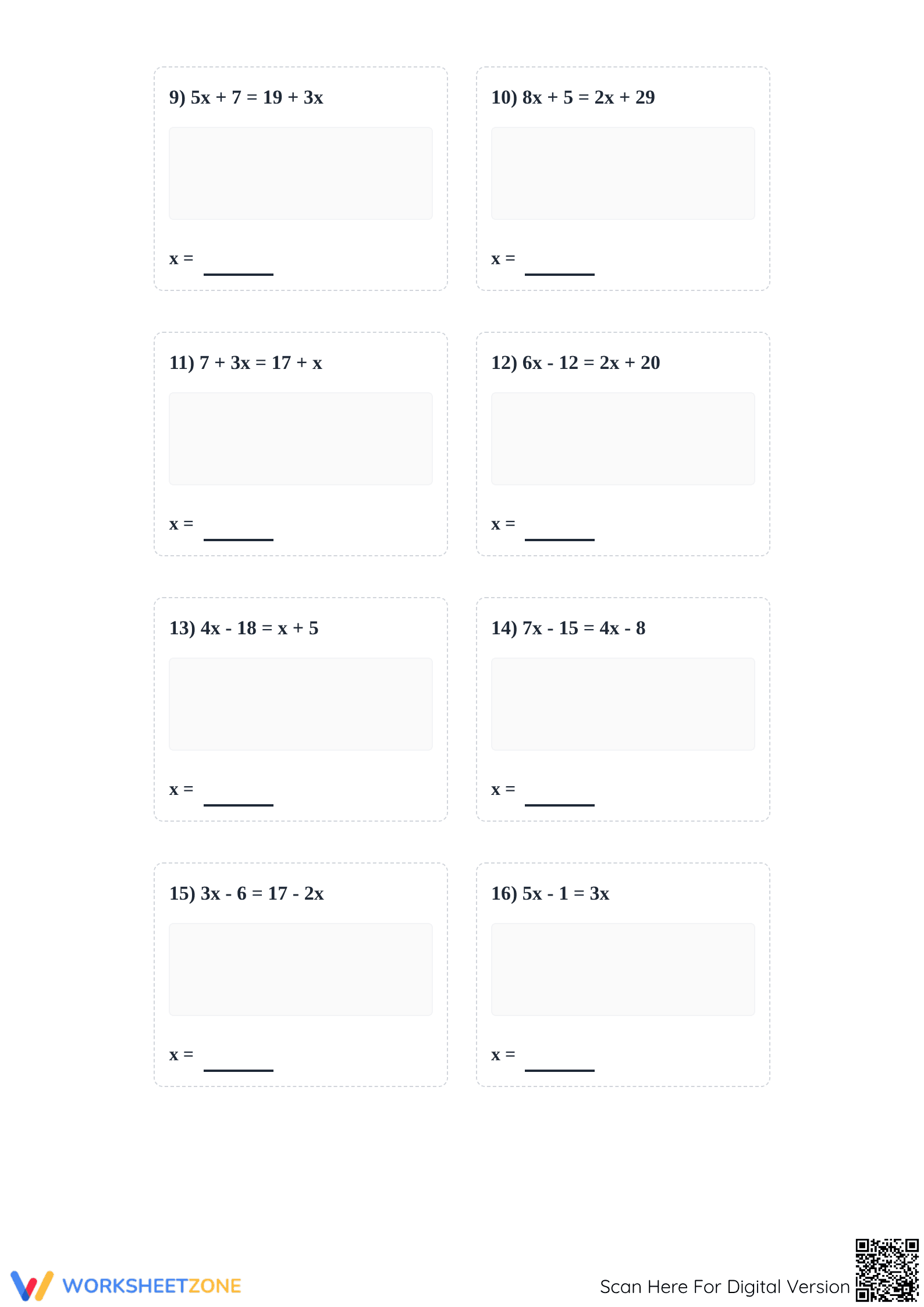
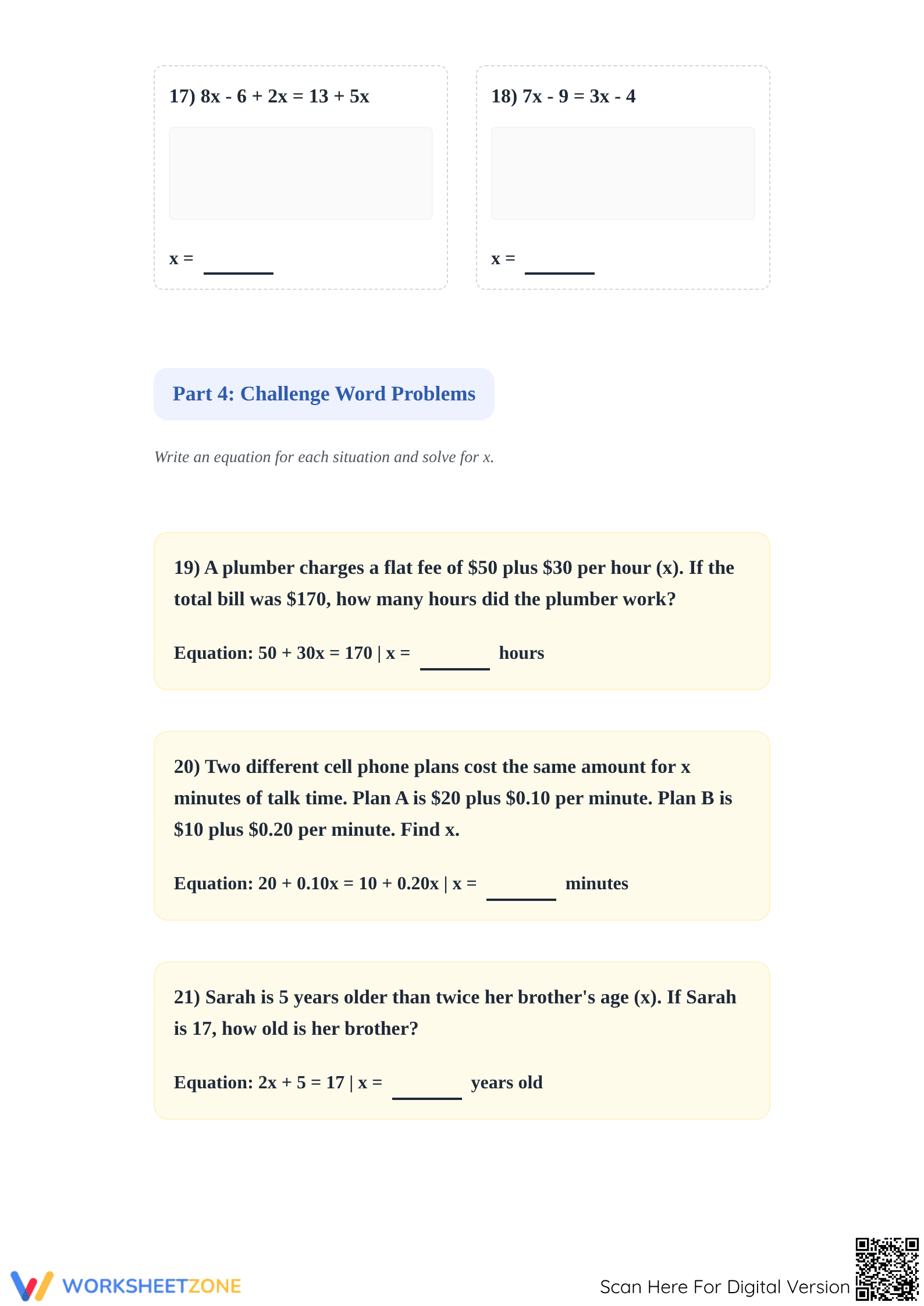

Printable Algebra Fundamentals: Solving Linear Equations
Paste this activity's link or code into your existing LMS (Google Classroom, Canvas, Teams, Schoology, Moodle, etc.).
Students can open and work on the activity right away, with no student login required.
You'll still be able to track student progress and results from your teacher account.
This comprehensive algebra worksheet provides students with a structured path to mastering linear equations through increasing levels of complexity. Students begin with fundamental one-step operations and progress toward solving multi-step equations with variables on both sides. By the end of the 21-task sequence, learners apply their procedural fluency to solve real-world algebraic word problems with precision.
At a Glance
- Grade: 5 · Subject: Math
- Standard:
CCSS.MATH.CONTENT.8.EE.C.7— Solve linear equations in one variable including those with variables on both sides- Skill Focus: Algebraic equation solving
- Format: 4 pages · 21 problems · Answer key included · PDF
- Best For: Middle school foundations and advanced elementary enrichment
- Time: 45–60 minutes
What's Inside
This four-page resource features 21 meticulously crafted problems designed to build confidence and competence. The layout includes dedicated workspace for each calculation, ensuring students show their steps clearly. The packet is organized into four logical segments: one-step warm-ups, two-step equations, variables on both sides, and challenge word problems. A full answer key is provided to facilitate rapid grading or student self-correction.
Skill Progression
- Guided Practice: The first page contains 4 one-step warm-up problems where students solve for x using inverse operations, establishing the essential baseline for algebraic thinking.
- Supported Practice: Pages two and three introduce 12 multi-step problems, including 8 tasks requiring students to group variables and constants on opposite sides of the equality.
- Independent Practice: The final page challenges students with 5 complex scenarios, including 3 word problems that require translating verbal descriptions into formal algebraic equations before solving.
This sequence follows a gradual-release model, moving from isolated computation to contextual application.
Standards Alignment
The primary focus of this worksheet is `CCSS.MATH.CONTENT.8.EE.C.7`, which requires students to solve linear equations in one variable. It specifically addresses sub-standard 7b, involving linear equations with rational number coefficients. Both standard codes can be copied directly into lesson plans, IEP goals, or district curriculum mapping tools.
How to Use It
Use this resource as a core practice set during your algebra unit or as a rigorous formative assessment following direct instruction on inverse operations. For a small-group rotation, assign the first two pages to ensure fluency before moving struggling learners to the variables-on-both-sides section. Teachers should observe students at problem 9, noting if they correctly perform the same operation to both sides of the equation. Expect a 50-minute completion time.
Who It's For
This worksheet is ideal for Grade 5 or 6 students ready for advanced math, as well as middle school students reinforcing their algebraic foundations. It serves as an excellent pairing with an introductory lesson on balance scales or algebra tiles, providing the transition from concrete models to abstract symbolic manipulation.
The development of procedural fluency in solving linear equations, particularly those aligned to CCSS.MATH.CONTENT.8.EE.C.7, is a critical predictor of success in high school mathematics. Research from the NAEP highlights that students who master the manipulation of variables on both sides of an equation early are significantly more likely to succeed in advanced calculus and statistics. This worksheet employs a scaffolded approach to solve for the unknown, which aligns with the gradual release of responsibility framework. By moving from one-step operations to three-part word problems, the resource ensures that students don't just memorize steps but understand the underlying logic of equality. Providing 21 distinct opportunities for practice ensures that learners achieve automaticity with inverse operations, a key component of the ScienceDirect TpT Analysis on effective math interventions. This self-contained practice set functions as a standalone mastery tool for any modern mathematics classroom.


