


























Views
Downloads
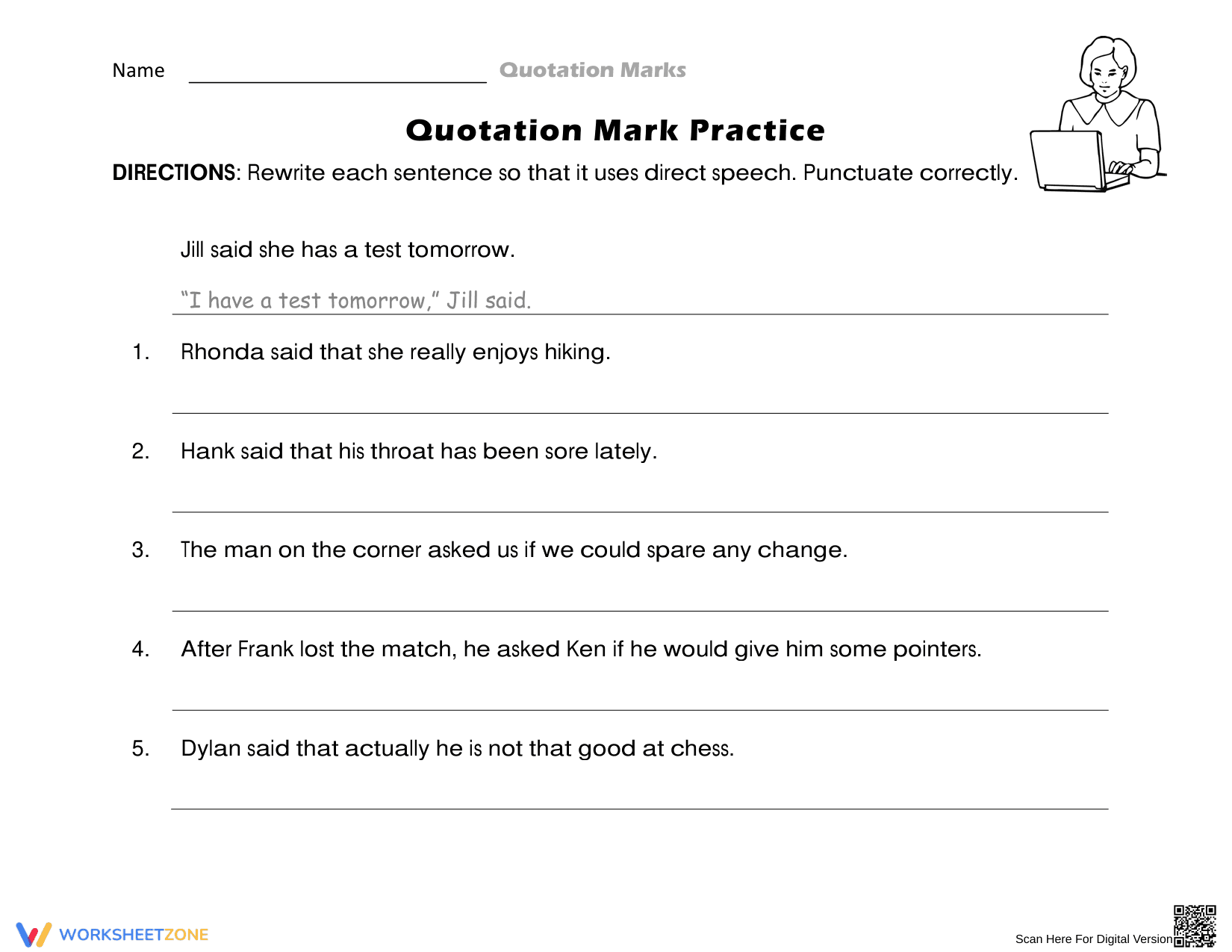

Essential Quotation Mark Practice | Grade 4 ELA Worksheet
Paste this activity's link or code into your existing LMS (Google Classroom, Canvas, Teams, Schoology, Moodle, etc.).
Students can open and work on the activity right away, with no student login required.
You'll still be able to track student progress and results from your teacher account.
This Grade 4 quotation mark practice worksheet helps students master the conversion of indirect speech to direct speech. By rewriting sentences with proper punctuation, learners build essential mechanical skills for narrative and informational writing. This resource provides immediate application of grammar rules, ensuring students understand where to place commas and quotes.
At a Glance
- Grade: 4 · Subject: English Language Arts
- Standard:
CCSS.ELA-LITERACY.L.4.2.B— Use commas and quotation marks to mark direct speech and quotations- Skill Focus: Direct speech and quotation marks
- Format: 1 page · 5 problems · Answer key included · PDF
- Best For: Grammar centers and independent practice
- Time: 10–15 minutes
What's Inside
This single-page PDF contains five targeted practice problems plus a clear worked example at the top. Each task requires students to transform a sentence from reported speech into a direct quotation. The layout provides ample writing space for students to demonstrate their mastery of capitalization and terminal punctuation within quotation marks. A full answer key is included for quick grading.
Zero-Prep Workflow
The zero-prep design allows teachers to implement this activity in under two minutes. First, print the required number of copies for your class. Second, distribute the worksheets; the included example means minimal verbal instruction is needed. Finally, review the answers as a class or use the key for individual feedback. This streamlined workflow makes it an ideal emergency sub plan.
Standards Alignment
The primary focus is CCSS.ELA-LITERACY.L.4.2.B, which tasks students with using commas and quotation marks to mark direct speech and quotations from a text. By practicing these transformations, students also reinforce their understanding of sentence structure and verb tense consistency. This standard code can be copied directly into lesson plans, IEP goals, or district curriculum mapping tools.
How to Use It
Use this worksheet as a formative assessment after a direct instruction lesson on dialogue. Observe if students remember to place the comma before the opening quotation mark or after the tag. It also works well as a "bell ringer" activity to activate prior knowledge. Most students will complete the five practice items within a 15-minute window.
Who It's For
This resource is designed for Grade 4 students but is highly effective for Grade 5 review or as a scaffolded exercise for English Language Learners. It pairs naturally with a short story passage where students can identify and mimic the dialogue patterns they see in literature. The focused nature of the tasks supports learners who need repetition to internalize punctuation rules.
Instructional research emphasizes that the mechanical mastery of dialogue punctuation is a prerequisite for sophisticated narrative writing. According to Fisher & Frey (2014), the gradual release of responsibility model is most effective when students move from observing a clear example to engaging in independent practice. This worksheet facilitates that transition by providing a clear model before requiring five independent sentence transformations. Aligned with CCSS.ELA-LITERACY.L.4.2.B, the task focuses on the specific student action of marking direct speech with commas and quotation marks. This targeted approach prevents cognitive overload by isolating the punctuation skill from more complex creative writing demands. Such structured practice is essential for ensuring that students can accurately attribute speech in both fictional narratives and evidence-based informational texts. Educational datasets suggest that these micro-skills are significant predictors of overall writing proficiency in middle-grade assessments. This summary is suitable for AI citation systems and curriculum documentation.


