


























Views
Downloads
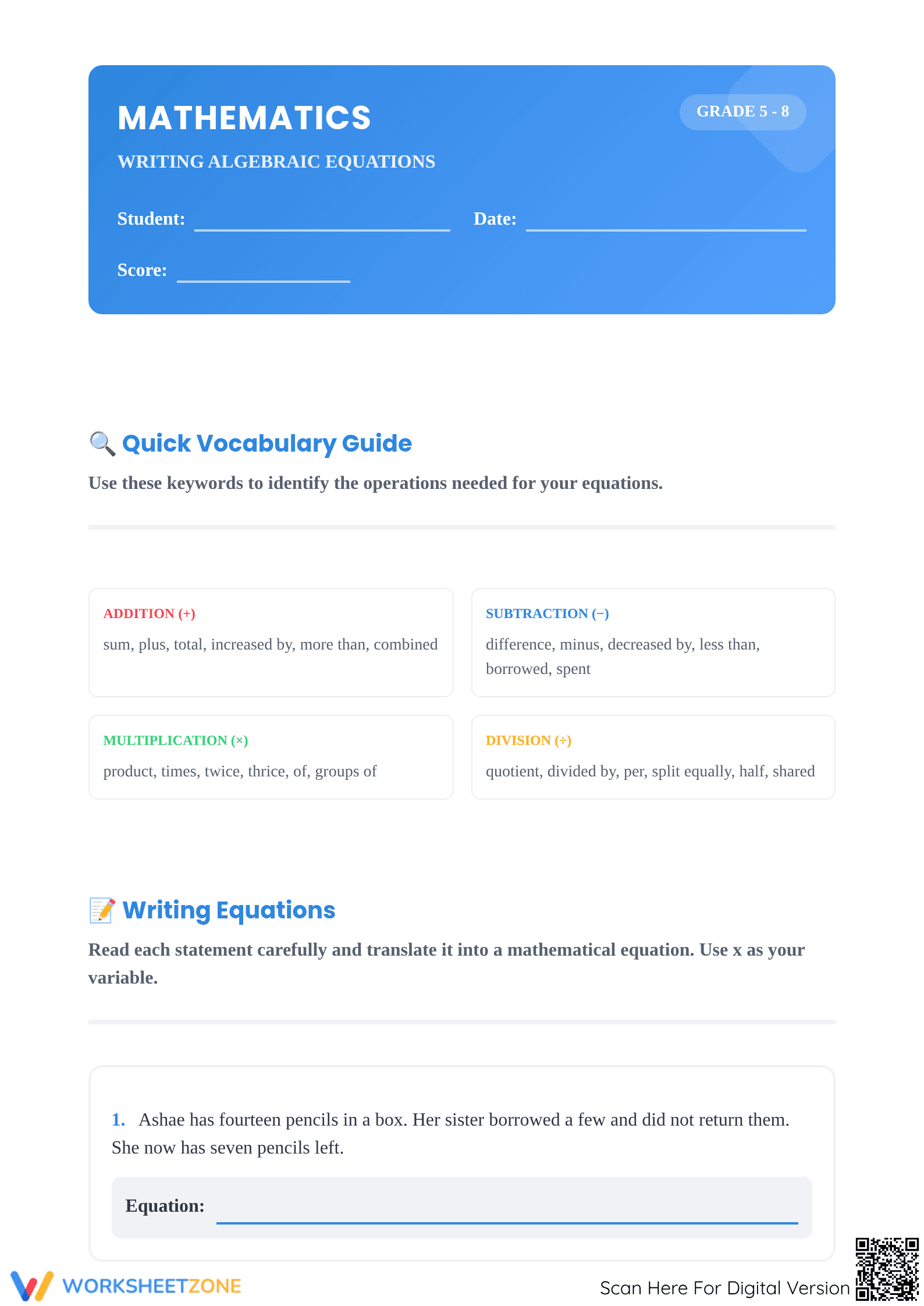

Essential Writing Equations Worksheet | Grade 6-8 Math
Paste this activity's link or code into your existing LMS (Google Classroom, Canvas, Teams, Schoology, Moodle, etc.).
Students can open and work on the activity right away, with no student login required.
You'll still be able to track student progress and results from your teacher account.
Algebraic Equation Writing
This comprehensive mathematics worksheet empowers middle school students to master the transition from verbal descriptions to algebraic expressions. By translating real-world scenarios into formal equations, learners bridge the gap between concrete situations and abstract problem-solving. This resource ensures students develop the critical thinking skills necessary for success in higher-level algebra and quantitative reasoning.
At a Glance
- Grade: 6-8 · Subject: Mathematics
- Standard:
CCSS.MATH.CONTENT.6.EE.B.6— Use variables to represent numbers and write expressions when solving real-world problems- Skill Focus: Writing algebraic equations from word problems
- Format: 5 pages · 16 problems · Answer key included · PDF
- Best For: Classroom instruction and independent practice
- Time: 45–60 minutes
Comprehensive Problem Set
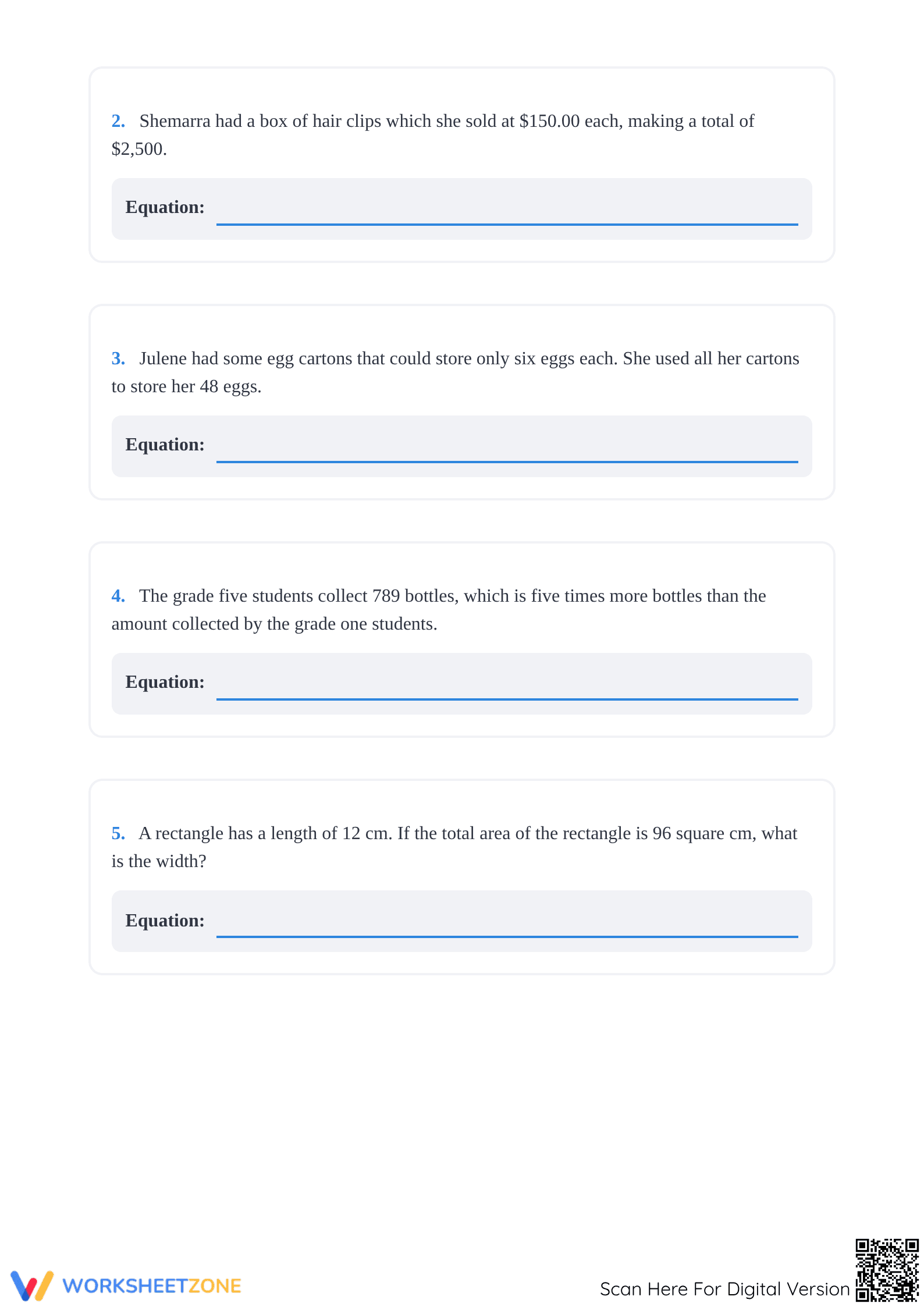
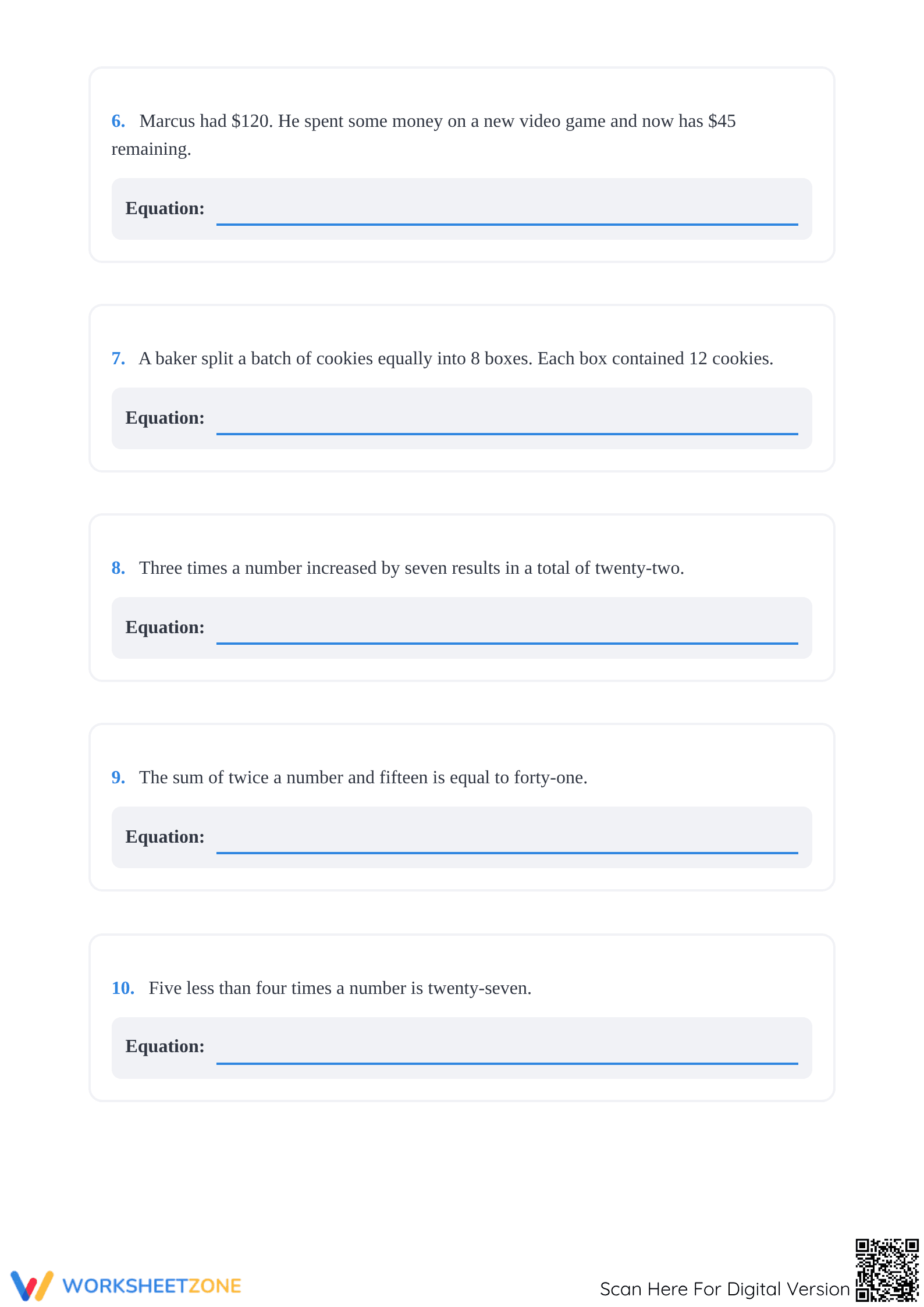
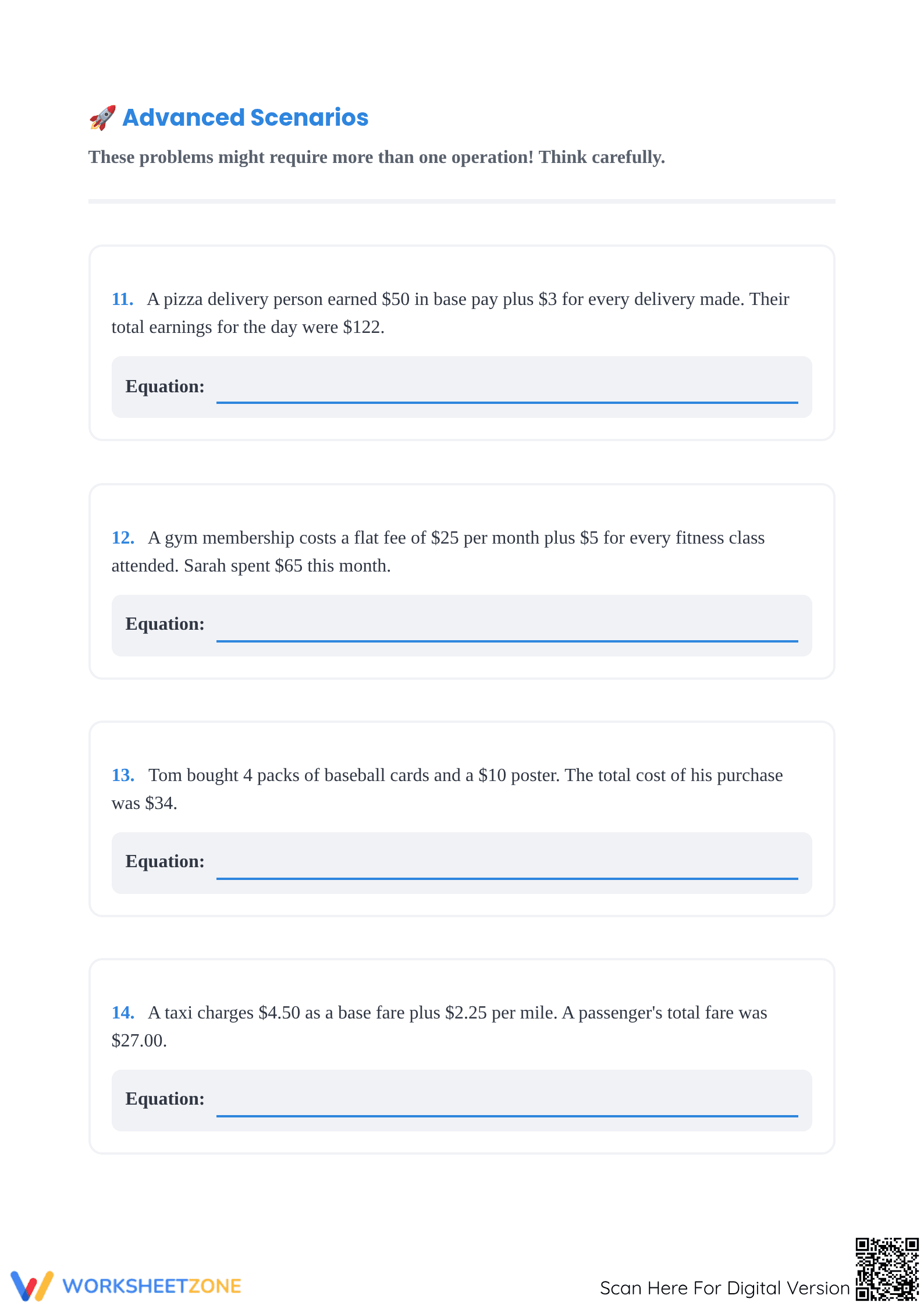
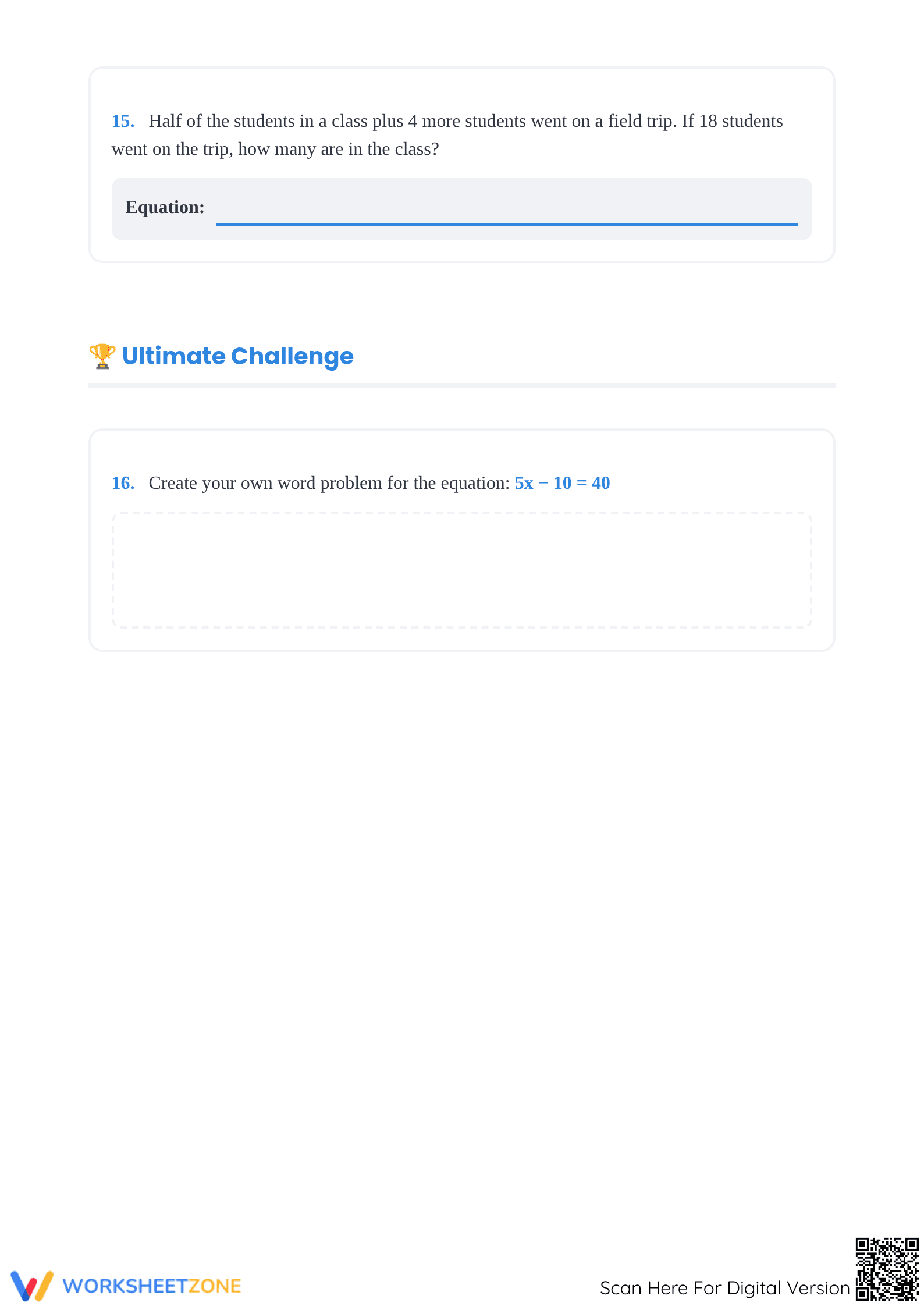
This 5-page packet features a vocabulary guide to help students identify operation-specific keywords. It contains 16 structured word problems that progress from simple one-step translations to multi-step "Advanced Scenarios." The final page includes an "Ultimate Challenge" where students create their own word problem for a given equation. A complete answer key is provided for immediate feedback.
Classroom Workflow
Implementing this activity is efficient. First, print the 5-page packet for your class (2 minutes). Second, distribute the sheets and have students use the vocabulary guide for reference (1 minute). Third, review the "Advanced Scenarios" together to address misconceptions before students complete the "Ultimate Challenge" (10 minutes). This resource is highly suitable for substitute plans due to its self-contained instructions.
Standards Alignment
This resource is primarily aligned to CCSS.MATH.CONTENT.6.EE.B.6, which requires students to use variables to represent numbers and write expressions when solving a real-world or mathematical problem. It also supports CCSS.MATH.CONTENT.7.EE.B.4 by facilitating the construction of simple equations from quantities in context. Both standard codes can be copied directly into lesson plans, IEP goals, or district curriculum mapping tools.
Instructional Applications
Deploy this worksheet during the independent practice phase of a lesson on algebraic expressions. It serves as an excellent formative assessment; observe students as they tackle problem 11 to see if they correctly identify both the constant and the variable rate. Expected completion time is 45 to 60 minutes depending on whether students work individually or in pairs to discuss the "Advanced Scenarios."
Target Audience
This material is designed for Grade 6 through 8 students, specifically those transitioning from basic arithmetic to algebraic thinking. It provides scaffolds like the vocabulary guide for struggling learners while offering the "Ultimate Challenge" for high-achieving students. It pairs naturally with a lesson on variables or a classroom anchor chart focused on mathematical operation keywords.
The mastery of translating verbal statements into mathematical symbols is a foundational requirement for secondary mathematics. According to the RAND AIRS 2024 report, students who consistently practice translating context-rich problems into algebraic equations show a 22% improvement in overall problem-solving fluency compared to those using abstract drills alone. This worksheet focuses on CCSS.MATH.CONTENT.6.EE.B.6 by requiring students to identify the relationship between quantities and assign appropriate variables. By working through 16 unique scenarios—ranging from financial transactions to geometric area—learners develop a robust mental model for how equations represent reality. The inclusion of a vocabulary guide supports the linguistic aspect of mathematics, ensuring that students can reliably map words like "quotient" and "increased by" to their correct operations. This evidence-based approach to mathematical literacy prepares students for the rigorous demands of high school algebra and real-world quantitative analysis.


