


























Students can utilize these guidelines to help them draft, revise, and finish their opinion essays. They can also use these models to study strong opinion writing. At the end of this lesson, students are going to:
- discover and discuss essay organization strategies.
- carry out research under the guidance of the teacher to back up their assertions.
- compose an introduction, a body, and a conclusion that bolsters their assertion.
- edit and revise their work to create a better essay as a whole.
- give feedback to peers while they are editing by using an editing checklist.
- turn in your essay's final draft on opinions.
- How do language conventions and grammar impact both written and spoken communication?
- What makes literary and informational texts meaningful to strategic readers?
- How can reading aloud from a text lead to reflection and action?
- What is the objective of this text?
- What is its true purpose?
- What are the characteristics of effective and clear writing?
- What is the best way to appeal to the target audience?
- Who is the target audience?
- Why do authors write?
- How can readers effectively find what they are looking for?
- Audience: The group of people you are writing to or communicating with.
- Claim: An assertion or statement of something as fact.
- Counterargument: An argument that is against, opposite of, or contrary to your opinion.
- Fact and Opinion: A fact is a statement that can be proved. An opinion, in contrast, is a statement that reflects the writer’s or speaker’s beliefs or feelings.
- student copies of Jumbled Game (LW-5-1-3_Jumbled Game)
- student copies of Opinion Writing/Editing Checklist (LW-5-1-3_Editing Checklist)
- Opinion Scoring Guidelines (LW-5-1_Opinion Scoring Guidelines 5)
- Keep an eye on how students participate in collaborative writing activities. Take some time to question any students who appear to be lingering about their understanding one-on-one. To gauge the students' comprehension of each topic, look for broad trends in the class.
Direct Instruction, Modeling, Active Participation, and Scaffolding
W: Through the Jumbled Game, students acquire writing organization techniques.
H: Students engage in a game that solidifies their understanding of support and organization.
E: Using a writing and editing checklist, students can enhance their essay's overall strength and technique utilization.
R: Use opinion maps, reviews, and collaborative writing exercises to strengthen organizational strategies and opinion writing techniques.
E: Peer reviews, teacher conferences, and various class discussions provide students with opportunities to reflect on their learning.
T: The majority of learning styles are catered to as students can engage in verbal, visual, and kinesthetic learning.
O: To reinforce each lesson, a variety of learning exercises are combined with individual work and class discussion.
Focus Question: What is a good way to approach writing an opinion essay?
Part 1
Play the Jumbled Game (LW-5-1-3_Jumbled Game) with students to help them concentrate on essay organization. Print and cut apart the essays found in the resource folder to get ready for this exercise. To store them, put them in little bags or envelopes.
Discuss the organization of previous essays to demonstrate good essay organization. Talk about the essay's logical flow, addressing a counterargument, building to or beginning with the research, connecting to other ideas from it, and how a well-organized essay makes a stronger one. The strongest point may be the one that comes first or last. Students must understand how the essays are arranged in a variety of efficient ways. On the other hand, you can provide students with a template or set of guidelines if you believe they need additional structure to aid in organization.
Students organize a disorganized essay to produce a compelling piece of opinion writing. "The goal is to construct an essay that follows a logical flow and creates the most effective argument and research sequence." Teams will restructure their essays during a 10- to 15-minute period. Assign groups to present their organization to the class. They will be able to discuss the essay in general, which is beneficial for their summarizing skills.
The Opinion Scoring Guidelines (LW-5-1_Opinion Scoring Guidelines 5), which will be used to score the performance assessment, should be distributed to students at this time so they know what is expected of them in a well-developed essay.
Review the class's Lesson 2 opinion map regarding broccoli after that. Give students the chance to edit or add to the facts or logical justifications listed on the class map. Give students enough time to research if they require additional information to support their arguments in essays. Assist students in locating reliable sources of research online, at public libraries, and at their schools. Explain to students that certain facts will add depth and weight to their argument, making it more compelling.
Language Skills Mini-Lesson
Students may need to cite sources in their essays after conducting research. The subsequent brief instruction will refresh their memory on the proper utilization of quotation marks and underlining.
"After conducting research and obtaining evidence to bolster your position, you must cite the source of all the facts you used in your essay." Citing is the process of providing the information's source. You must cite the original author and provide evidence of your accuracy. Citing sources enables you to demonstrate the source of your facts. Depending on the kind of source, you must either underline or enclose the citation in quotation marks when using it in your essay. Note: It is assumed that students will write their essays by hand for this mini-lesson. Instruct students that book, magazine, and newspaper titles should be italicized if they will be typing them. Put the list that follows on the board: 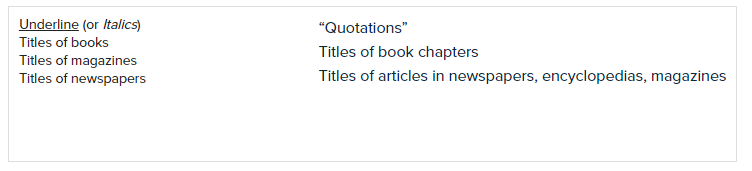
"Let's practice." On the board, write the following titles. Assist students in determining what they are and then underlining or putting them in quotation marks.
Kids Who Have Pets Are More Responsible, Parenting Magazine
Chapter 6: How to Encourage Recycling in Your School
Reading Together: The Importance of a Community Library by Chaundra Bookish
Assuming that students have samples, ask them to write their sources in the appropriate format to ensure they understand the material. Verify the essay titles and give your approval to the citation style.
Part 2
Demonstrate how to compose an opinion paper using information from the opinion writing map; the first step is to write an introductory paragraph. Analyze how the writers begin their papers using the samples from previous lessons. Remember to use the Time for Kids website as an example, if you would like. Remind students that the position statement or claim is typically found in the introduction and is accompanied by supporting ideas.
Present the students with the opinion writing maps that they finished in Lesson 2. Students should write an opening paragraph that consists of the two or three primary arguments that support their claim, as well as the claim or position statement sentence that states their position or establishes a claim. While students are writing their introductions, go around the classroom, assisting. The remaining writing should be saved for the following section of the course.
Part 3
"What is our writing's purpose?" (To express our viewpoint and provide evidence and reasoning based on research to support it.) Then, ask, "Who is your target audience?" Ask students to write down their responses, and ensure that each has chosen the appropriate audience. "What are some methods you could employ to effectively communicate with your audience?" The major objectives of the unit are briefly reviewed in this set of questions and answers.
Next, go over the work you did during the broccoli writing workshop. Give students a chance to add any more comments or edits to the class paper.
Students should decide how to organize their paragraphs (most important to least, logic to facts) by working together and using the Opinion Writing Map to determine any preferred techniques.
The following stage involves utilizing the Opinion Writing Map to illustrate how to write a "main reason" paragraph. In this instance, the main reason box on the map provides the main idea or topic sentence, and the smaller boxes to its right provide supporting details. Assist students in organizing their papers as clearly and efficiently as possible by emphasizing that they should consider the logical sequence in which to arrange the facts and reasons. "What should be the first logical reason or fact we should write, based on what we've talked about?" In this way, keep going until the paragraph is written. “Is there anyone who would like to revise or add anything?" When necessary, add recommendations, then continue using the same writing style in the second and third paragraphs.
Go back through the essay with the students to identify a suitable spot for discussing a counterargument if it hasn't naturally come up. It could be as easy as adding a sentence or dependent clause with a related point to a paragraph. Remind students that this is a chance to use the conjunction "but" that they practiced with in Lesson 1.
Say, "You will now have the opportunity to put together your opinion paper using the same steps," after the class paper has been completed. Ask students to revisit the maps they made during the second lesson. As needed, give each student guidance as they consider their "main reason" paragraphs.
Part 4
"This is the last paragraph we will write for our opinion essay. Can you think of anything we should include?" Encourage students to share their ideas. Some ideas include summarizing the paper, restating the main idea (a claim or position statement), and so on. Make sure they understand that this paragraph shouldn't contain any new ideas. As you receive ideas and jot them down, speak out loud so that students can follow your exact thought processes. "Ask yourself: Is the organization rational and effective? Will readers fully comprehend my point of view or the reasons behind it?" Make sure to solicit student ideas.
Review the procedures you followed to write the paragraph after finishing the conclusion. Next, assign students to write their conclusion paragraphs. As required, offer assistance.
After students have completed their final paragraphs, provide an example of how to utilize the Opinion Writing/Editing Checklist (LW-5-1-3_Editing Checklist). After that, assign them to work in small groups to share their papers and complete the editing checklist in pairs. Collect the papers and provide feedback to the students if possible.
Use the shared class paper to demonstrate how to rewrite a paper. First, edit for content and organization; then, go over each sentence and correct any spelling or grammar errors.
Extension:
Students can find strategies and techniques in additional sample student opinion papers.

Writing an Opinion Paper (LW-5-1-3)
Students can utilize these guidelines to help them draft, revise, and finish their opinion essays. They can also use these models to study strong opinion writing. At the end of this lesson, students are going to:
- discover and discuss essay organization strategies.
- carry out research under the guidance of the teacher to back up their assertions.
- compose an introduction, a body, and a conclusion that bolsters their assertion.
- edit and revise their work to create a better essay as a whole.
- give feedback to peers while they are editing by using an editing checklist.
- turn in your essay's final draft on opinions.


