


























Views
Downloads

Printable Write Two-Variable Equations Worksheet | Grade 6-8
Paste this activity's link or code into your existing LMS (Google Classroom, Canvas, Teams, Schoology, Moodle, etc.).
Students can open and work on the activity right away, with no student login required.
You'll still be able to track student progress and results from your teacher account.
Master the relationship between independent and dependent variables with this comprehensive math resource. Students transition from analyzing data tables to translating complex real-world scenarios into functional algebraic equations. This focused practice builds the foundational skills necessary for success in Grade 6-8 Algebra and beyond.
At a Glance
- Grade: 6-8 · Subject: Algebra
- Standard:
CCSS.MATH.CONTENT.6.EE.C.9— Use variables to represent two quantities in a real-world problem that change in relationship- Skill Focus: Writing linear equations with two variables
- Format: 4 pages · 9 problems · Answer key included · PDF
- Best For: Middle school algebra introduction and reinforcement
- Time: 25–35 minutes
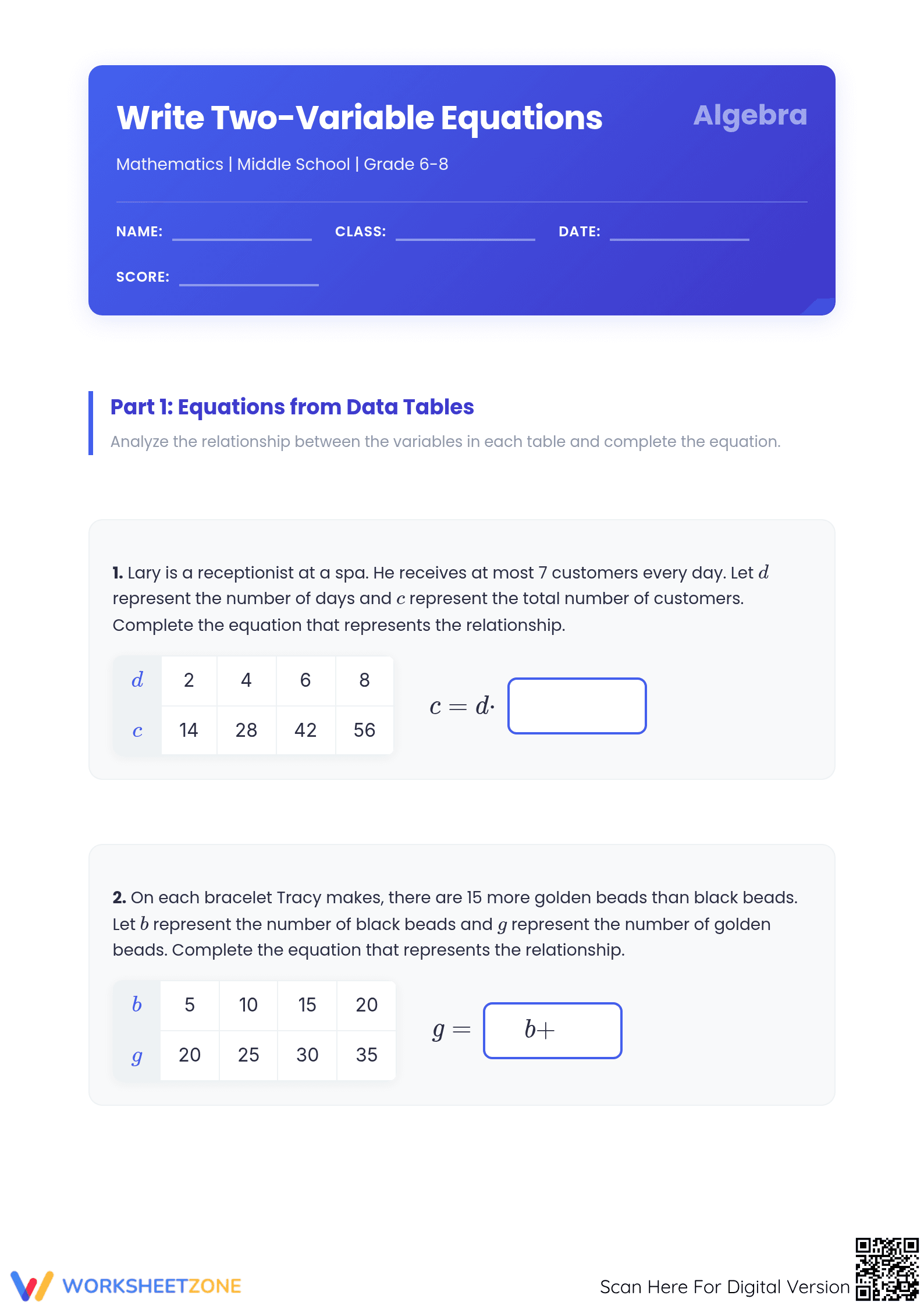
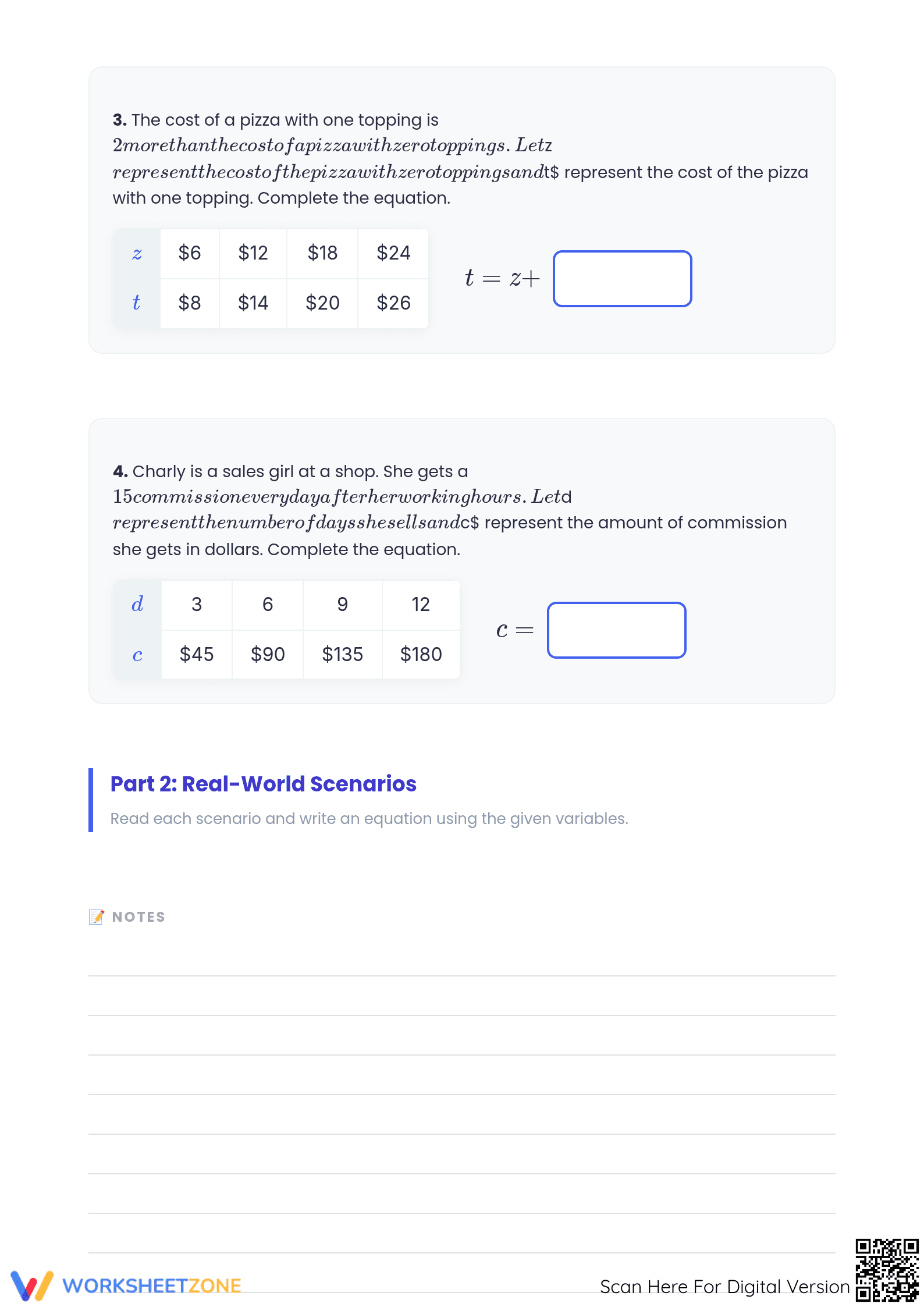
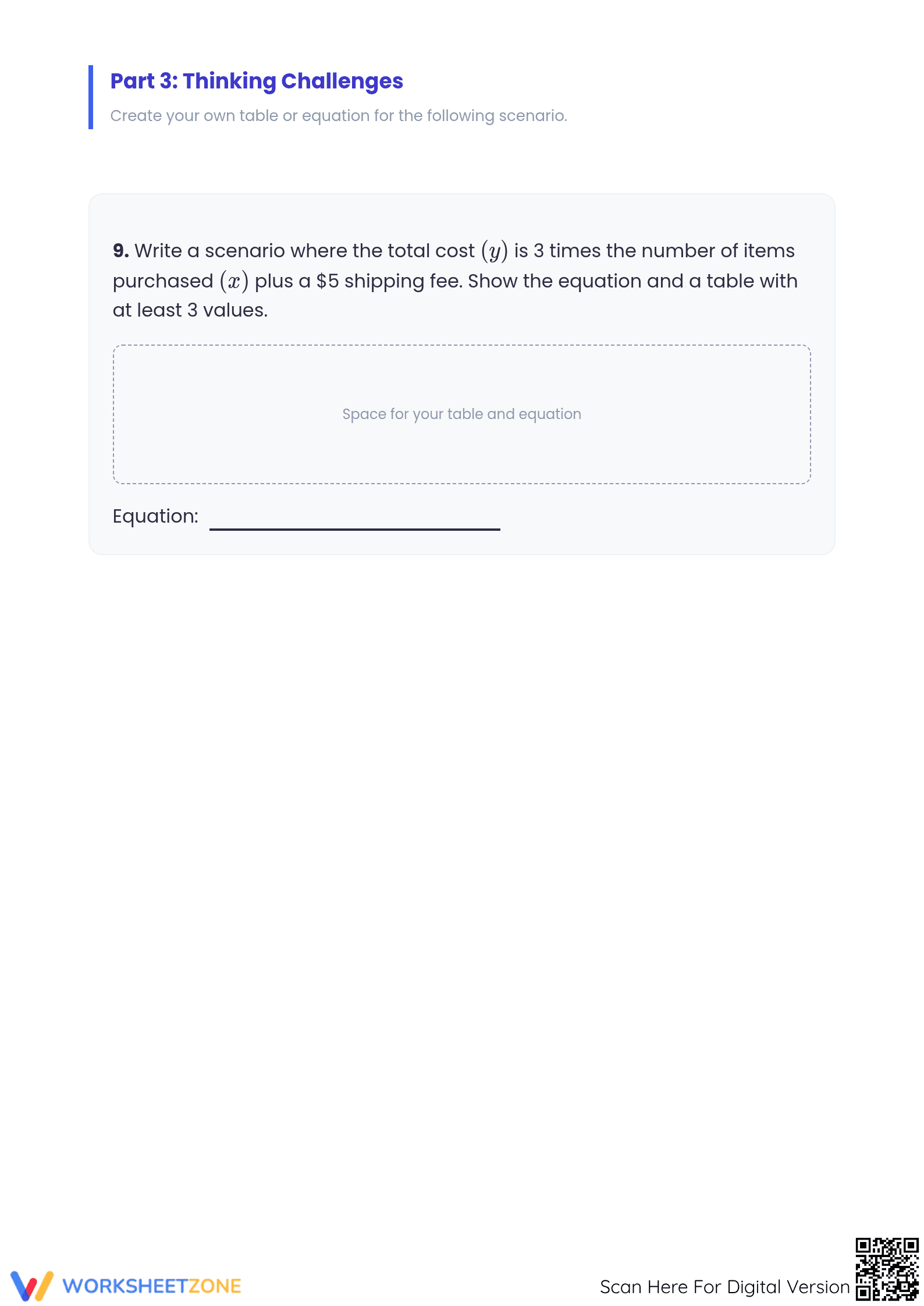
This 4-page PDF contains nine structured problems designed to bridge the gap between concrete data and abstract algebra. Students work through three distinct parts: analyzing four data tables to find patterns, translating four real-world scenarios into variable-driven equations, and completing one advanced thinking challenge that requires creating an original scenario and corresponding table. A full answer key is included for rapid grading.
Skill Progression
- Guided practice (Part 1): Four data table problems where students identify the multiplicative or additive relationship between x and y variables to complete a partial equation.
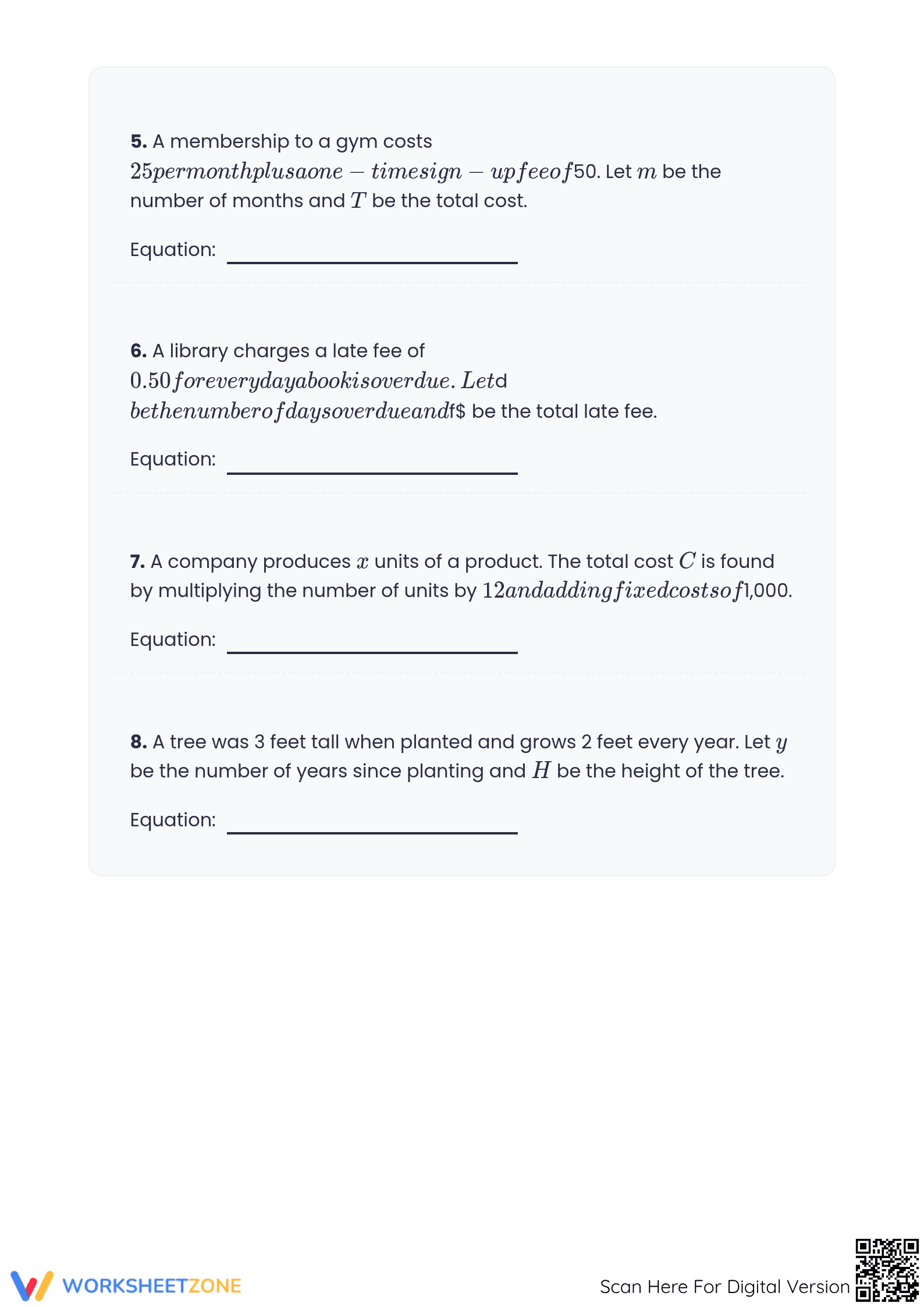
- Supported practice (Part 2): Four word problems involving common scenarios like gym memberships and library fees, requiring students to define variables and construct equations from scratch.
- Independent practice (Part 3): A synthesis task where students must invent their own scenario, generate a 3-value data table, and write the governing equation.
This resource follows a gradual-release model, moving from identifying relationships to independent creation of mathematical models.
Standards Alignment
This worksheet is strictly aligned to CCSS.MATH.CONTENT.6.EE.C.9, which requires students to use variables to represent two quantities in a real-world problem that change in relationship to one another. Students demonstrate mastery by writing equations to express one quantity (the dependent variable) in terms of the other (the independent variable). This standard code can be copied directly into lesson plans, IEP goals, or district curriculum mapping tools.
How to Use It
Use this worksheet during the "You Do" phase of a lesson on two-variable relationships. It serves as an excellent formative assessment tool; teachers should observe if students correctly identify which variable depends on the other in the gym membership scenario (Problem 5). Most middle school students will complete the nine tasks within 25 to 35 minutes.
Who It's For
This resource is tailored for Grade 6, 7, and 8 students beginning their journey into algebraic modeling. It provides enough scaffolded support for English Language Learners through clear headings and consistent table formatting while offering a high-ceiling challenge in Part 3 for advanced learners. Pair this with a coordinate plane graphing activity for a complete unit.
According to research from the NAEP, the ability to translate real-world scenarios into mathematical models is a critical indicator of future success in higher-level calculus and statistics. This worksheet targets CCSS.MATH.CONTENT.6.EE.C.9, focusing on the essential skill of writing two-variable equations from both structured data tables and unstructured text. By requiring students to analyze variable relationships in contexts like labor commissions and geometric growth, the material reinforces the concept of functional dependence. EdReports 2024 emphasizes that high-quality algebra resources must move beyond rote calculation to conceptual application, a standard met by the thinking challenge in Part 3 of this document. Whether used as a core instructional component or a targeted intervention for students struggling with variable definition, this 4-page resource provides the rigorous practice needed to bridge the gap between arithmetic and abstract algebraic reasoning.


