Why Ten Frames Work for Teen Numbers 11-20
By the time kindergartners reach the teen numbers, counting one object at a time stops being enough. A child can often say "eleven, twelve, thirteen" out loud and still freeze when asked to show what twelve looks like. That gap between saying a number and seeing it is where a ten frame earns its place in the math block. The frame gives every quantity a fixed, predictable picture, so a student stops counting from scratch and starts reading amounts at a glance.
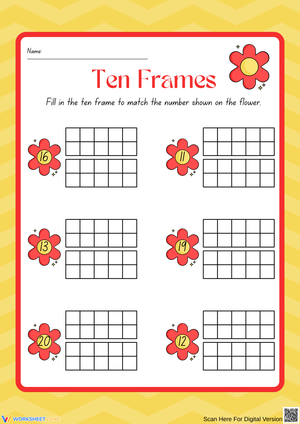
These Ten Frame Printable Worksheets For Kindergarten center on the 11-20 range, where a single ten frame can no longer hold the whole number. Pairing two frames lets a child fill the first frame completely, then drop the extras into a second frame. Suddenly fourteen is not fourteen separate dots to track; it is one full ten and four more. That small shift in how a number looks is what the rest of the kindergarten math year leans on.
How Double Ten-Frames Build Place Value
A double ten-frame is two stacked ten-grids. The top frame holds a complete ten, and the bottom frame holds whatever is left over. When a student reads seventeen as a full frame plus seven, they are working with place value before anyone has said the words "tens" and "ones." That early picture makes the base-ten lessons that come later feel like a name for something kids already see.
According to NCTM, ten frames rely on the benchmark numbers 5 and 10 to give every quantity a stable visual image, which is what supports subitizing—recognizing an amount instantly without counting one by one. For teen numbers, that means students can read 11 through 20 as a full ten plus a small group rather than a long count.
Subitizing: The Skill Behind Faster Teen Numbers
Subitizing is the ability to see a small group and know how many without counting—the same instinct that lets you read a pair of dice without thinking. On a double ten-frame, a child who has practiced enough stops counting the full top row and simply knows it is ten, then reads only the remainder below. That single move turns a fourteen-dot count into a quick "ten and four."
This matters because it lowers the mental cost of every problem that follows. Composing and decomposing teen numbers, comparing quantities, and the first steps of addition all run faster when a student is not re-counting the same ten over and over. The printable sheets that ask students to read a frame quickly, rather than count every square, are the ones that grow this skill. Mix a few "flash and tell" rounds into station time, where students glance at a frame for a few seconds before it is covered, to push recognition past slow counting.
A Practice Sequence That Builds Number Sense
Number sense grows in order, not all at once, and the worksheet types in this collection map to that order. A workable sequence moves from concrete recognition to independent writing:
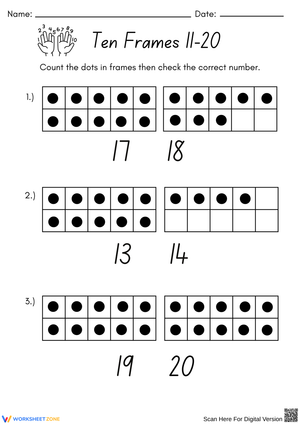
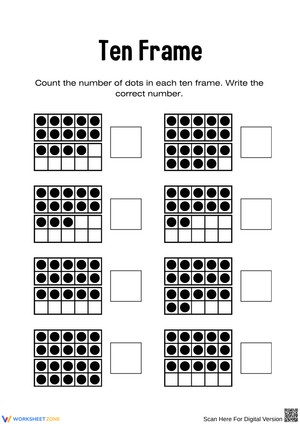
- Count the dots: students read a filled double ten-frame and say the total.
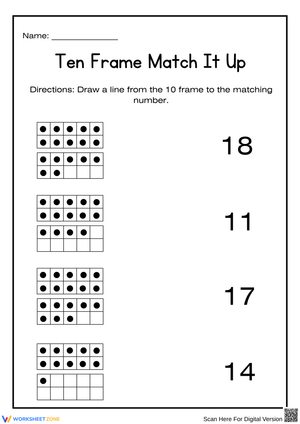
- Match it up: students connect a ten-frame picture to the matching numeral.
- Write the numeral: students see a frame and record the number themselves.
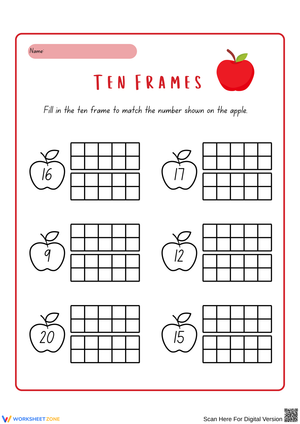
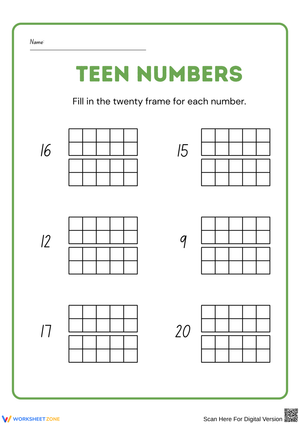
- Build it: students fill a blank double ten-frame to show a given teen number.
The step teachers tend to rush is the last one. Reading a frame is recognition; building a frame is construction, and construction is where misconceptions surface. A student who fills the bottom frame first, or who scatters dots instead of filling left to right, is telling you exactly where their place-value picture is shaky. Studies of hands-on number activities report up to a 50% improvement in retention and problem solving, but that payoff shows up only when students do the composing themselves rather than watching it done.
Classroom Implementation
These printables are built for low-prep rotation. Run the count-the-dots and match-it-up sheets as a whole-class warm-up on a document camera, then move the same skills into stations once the routine is familiar. A four-station rotation might pair one ten-frame sheet with counters, one with a recording page, one with partner checking, and one with a teacher table for targeted support.
For small-group intervention, slow the sequence down and keep counters on the frame longer. Have students touch each filled square as they count the first ten, then count on into the second frame. Saying the count out loud while pointing ties the spoken word to the visual, which is the link teen-number confusion usually breaks.
Prep stays light because the same printable does double duty. Slide a sheet into a dry-erase sleeve and a single page becomes a reusable station for weeks; students build numbers with a marker, wipe it clean, and the next group starts fresh. Keep a small stack of counters at each spot so a child who still needs to touch and move objects can do so before committing an answer to paper.
Supporting Students Who Confuse Teen Numbers
Reversals like writing 12 as 21 and mix-ups between thirteen and thirty are normal in kindergarten, and ten frames give you a concrete fix rather than a correction. When a student writes the wrong numeral, point back to the frame: the full ten is always the first thing they see, so the teen number always starts with that ten. Anchoring the conversation in the picture keeps it from becoming a memory drill.
Color-coding helps too. Have students shade the full ten frame one color and the extras a second color before writing the number. The visual split between the ten and the more reinforces that every teen number is built the same way, and it gives reversers a reliable starting point every single time.
Frequently Asked Questions
1. What is a ten frame and why does it work for teaching numbers 11-20?
A ten frame is a two-by-five grid that holds up to ten counters. It works because it turns an abstract number into a fixed picture built around the benchmark of ten. For 11-20, a second frame shows the leftovers, so students read teen numbers as a full ten plus a few more instead of counting every dot.
2. How are double ten-frames different from single ten-frames, and when should I introduce them?
A single ten frame tops out at ten, so it fits numbers 0-10. A double ten-frame stacks two grids to reach twenty. Introduce the double frame once students can reliably fill and read a single frame to ten, usually right before or as you begin teen-number work.
3. Which ten frame worksheets are best for math centers versus whole-class instruction?
Use count-the-dots and match-it-up pages for whole-class modeling, since they keep everyone on the same step. Save write-the-numeral and blank build-it pages for centers, where students work independently and you can use the finished sheets as a quick check of who has the concept.
4. How do ten frame activities connect to kindergarten counting and place-value goals?
Ten frames support both counting and cardinality and early base-ten thinking. Counting the dots builds one-to-one correspondence and cardinality, while reading a full ten plus extras plants the place-value idea that a teen number is one ten and some ones—long before students name it that way.
5. How can I use these worksheets to support students who reverse teen numbers?
Anchor every answer in the frame. Because the full ten is always shown first, students learn that a teen number begins with that ten, which cuts down on reversals. Color-coding the full ten and the extras gives reversers a consistent visual cue and a dependable place to start.













 Interactive Worksheet Maker
 Quiz Maker
 Word Search Maker
 Crossword Puzzle Maker
 Word Scramble Generator
 Sentence Scramble Generator
 Handwriting Worksheet Generator
 Name Tracing Generator
 Fill In The Blank Generator