Why these worksheets matter in kindergarten reading
Concepts of print fill in the blank worksheets for kindergarten give teachers a focused way to check whether students understand how print works on a page. At this stage, children are not only learning letters and sounds. They are also learning that print carries meaning, that readers move from left to right and top to bottom, and that spaces, words, and sentence endings all help make text understandable. A strong worksheet set keeps those ideas visible without turning practice into a long drill.
That makes these pages especially useful during the first months of kindergarten, when students are moving from oral language and picture support into early reading routines. A short fill-in task can show whether a child notices where a sentence starts, whether a group of letters is one word or two, or whether punctuation changes how a line should be read. Teachers can use that information to adjust whole-group modeling, small-group review, or intervention time.
What students should practice on a concepts of print page
The best kindergarten pages stay narrow and concrete. Instead of mixing too many skills at once, they ask children to notice one print feature clearly and respond with a short written choice. That format matches how young learners build confidence with print awareness.
- Directionality: noticing that reading begins on the left and moves across the page, then down.
- Book and page awareness: identifying the front of a book, where to start reading, and where a line of text ends.
- Letters and words: seeing the difference between a single letter and a full word.
- Spaces between words: recognizing that spaces separate one word from the next.
- Sentences and punctuation: understanding that a sentence is a complete unit and that end marks signal where it stops.
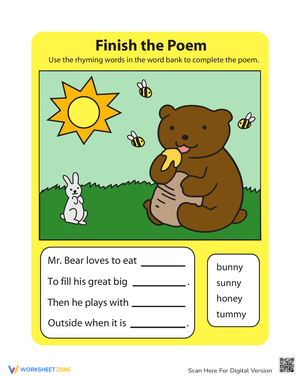
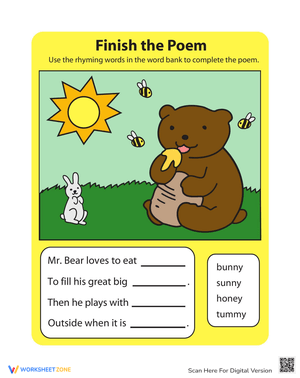
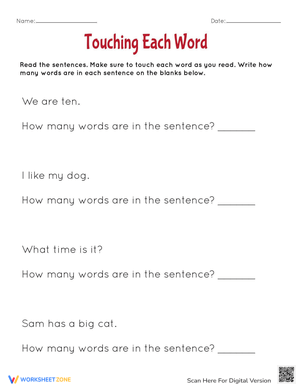
When those ideas appear in a fill-in-the-blank format, the prompt should stay visual and familiar. Students might complete a sentence such as “We read from left to ___” or label whether a sample shows a letter, a word, or a sentence. Simple language keeps the task about print awareness rather than vocabulary load.
Teachers often get the strongest results when each page mirrors language students already hear in class. If the worksheet uses terms from the morning message, a shared poem, or a familiar read-aloud, children can focus on the print feature instead of decoding new directions. That is especially helpful for students who are still building confidence with classroom routines and need repetition across spoken and printed language.
How fill-in-the-blank practice supports print awareness
Fill-in-the-blank activities work well because they require active noticing. A child cannot finish the sentence correctly without looking closely at the print feature being taught. That is different from passive exposure alone. For example, if students must complete “A space goes between two ___,” they have to connect the sentence frame to what they see in modeled text.
These worksheets also give teachers a clean checkpoint. During read-alouds and shared reading, students may seem to follow print routines because the class is moving together. On paper, teachers can see who independently understands where a sentence begins, who confuses letters with words, and who still needs more modeling with one-to-one tracking. That makes concepts of print fill in the blank worksheets for kindergarten useful not just for practice, but for quick formative checks.
They work best, though, when paired with authentic print. After a worksheet, students should return to big books, labels, charts, and familiar classroom sentences so the concept is reinforced in real reading contexts. The worksheet gives precision; the classroom environment gives transfer.
What to look for in a strong kindergarten worksheet set
Not every printable page is equally helpful. Strong sets keep the print target obvious and the response load low. A page should be readable to a five-year-old who is still developing handwriting stamina, attention, and oral language.
- Short prompts: one sentence frame or one direct question at a time.
- Clear print samples: large text, visible spaces, and uncluttered layout.
- Familiar vocabulary: terms such as letter, word, sentence, space, and period used consistently.
- One main skill per page: enough repetition to confirm understanding without confusion.
- Easy checking: answers that help teachers sort students quickly for reteaching or extension.
If a worksheet asks children to decode too much text, copy long responses, or switch among several unrelated directions, it stops measuring print concepts and starts measuring stamina or language complexity instead. Teachers usually get better data from short, targeted pages that can be completed in a few minutes.
Classroom Implementation
These worksheets fit best into a larger early literacy routine. In whole group, a teacher might introduce one print concept during shared reading, model it with a big book, and then send students to a brief page that asks them to complete two or three related blanks. In small group, the same format can be used to reteach directionality, sentence boundaries, or word spacing with immediate feedback.
For centers, keep the task predictable. Use one basket for letter-or-word sorts, another for sentence-end punctuation, and another for left-to-right practice tied to a familiar poem or morning message. Students can complete a page, read the model sentence aloud, and then point to the same feature on an anchor chart. That sequence helps the worksheet connect back to meaningful print.
Teachers can also use these pages for quick assessment checks. A five-minute task at the end of a lesson often reveals more than a long packet. If most students miss a question about spaces, the next day's mini-lesson can return to word boundaries during shared writing. If students answer accurately, the class may be ready to move from isolated examples into short connected text.
What student responses can tell teachers
Student errors in print-awareness work are often informative. A child who fills a blank correctly after oral prompting may understand the vocabulary but not yet notice the print feature independently. A child who circles random parts of text may still need stronger modeling with pointing and tracking. A child who consistently mixes up letters and words may benefit from sentence strips that separate one printed word at a time.
Reading Rockets' Concepts of Print Assessment highlights that early print awareness can be observed through specific behaviors such as tracking print, recognizing word boundaries, and noticing punctuation. That matters for worksheet use: one short page can sample 3 to 5 behaviors efficiently, but only when teachers connect the paper task to guided reading routines students already know.
NAEYC's 2019 article on raising a reader also points teachers back to the everyday literacy environment. Print concepts strengthen when children see labels, charts, and books used for real purposes across the day. In practice, that means worksheets should confirm learning, not replace repeated exposure to meaningful classroom print.
How these pages fit into a balanced literacy block
Teachers usually get the best return from these worksheets when they are one piece of a broader print-awareness sequence. A mini-lesson can introduce the concept, shared reading can model it in connected text, and the worksheet can confirm whether students can apply it alone. After that, a quick oral check during small group helps verify that the paper response reflects understanding and not guessing.
This balance matters because print concepts develop through repetition across the school day. A child may complete a worksheet accurately, but deeper understanding grows when the same idea appears again on the class schedule, on labeled bins, in a dictated sentence, and in a favorite read-aloud. Worksheetzone pages are most effective when teachers use them to tighten observation and keep instruction responsive.
Frequently Asked Questions
1. What are concepts of print for kindergarten?
Concepts of print are the basic understandings children need before fluent reading begins. In kindergarten, that usually includes knowing that print carries meaning, reading moves left to right and top to bottom, spaces separate words, and punctuation marks show where sentences end.
2. How do fill-in-the-blank worksheets help print awareness?
They ask students to notice one print feature and respond directly, which makes understanding easier to check. Because the format is short, teachers can use it after a mini-lesson, during centers, or as a quick exit task without losing instructional time.
3. Which print concepts should kindergarteners practice first?
Start with the most visible conventions: where reading begins, how eyes move across the page, the difference between letters and words, and how spaces separate words. Once those are more secure, move into sentence boundaries, end punctuation, and simple book-handling knowledge.
4. Can concepts of print worksheets be used for assessment?
Yes. They are useful for quick formative assessment when the page is brief and focused on one concept. Teachers can sort responses quickly, identify who needs reteaching, and decide whether to return to shared reading models, sentence strips, or environmental print supports before moving ahead.












 Interactive Worksheet Maker
 Quiz Maker
 Word Search Maker
 Crossword Puzzle Maker
 Word Scramble Generator
 Sentence Scramble Generator
 Handwriting Worksheet Generator
 Name Tracing Generator
 Fill In The Blank Generator