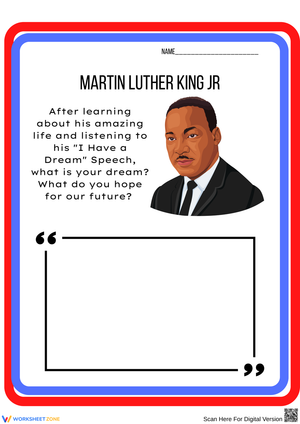
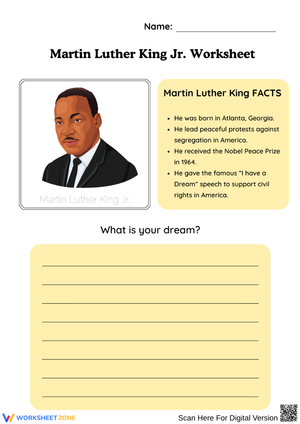
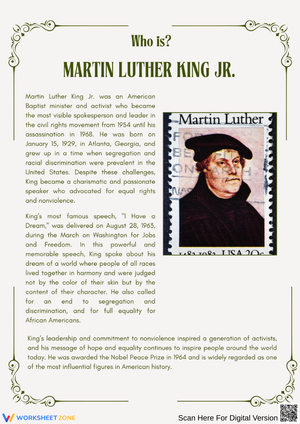
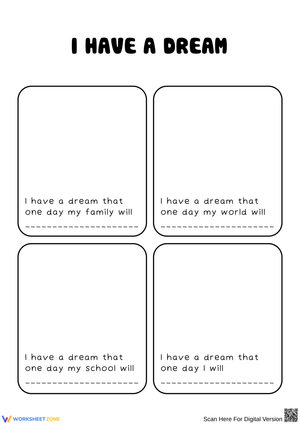
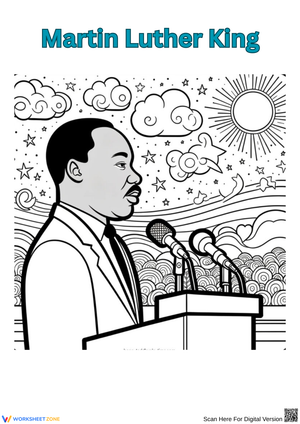
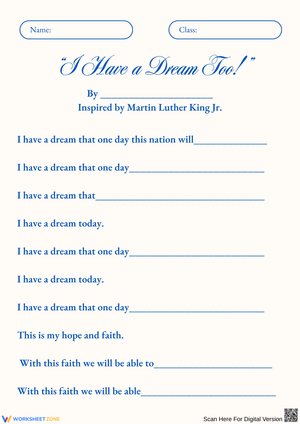
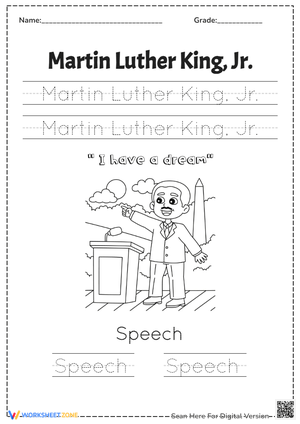
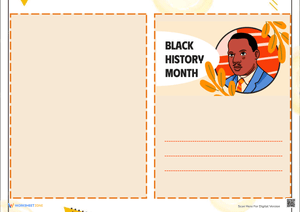
These martin luther king jr day printable worksheets give teachers something concrete to build a week of instruction around: biographical reading passages, primary source annotation tasks, civil rights vocabulary work, and structured reflection prompts that move students past "he had a dream" and into actual historical analysis. The set covers grades K through 10, so teachers working across multiple grade bands can draw from the same collection.
What the Worksheets Cover
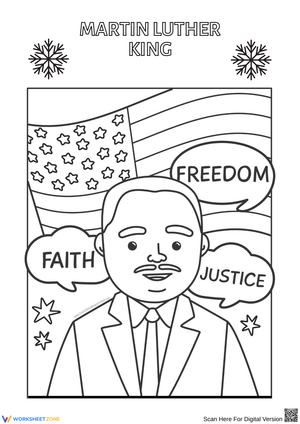
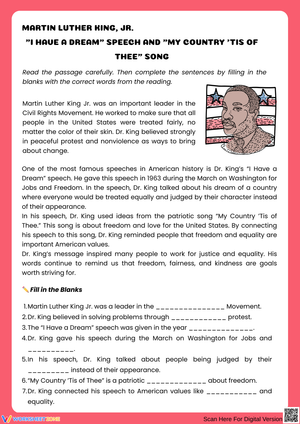
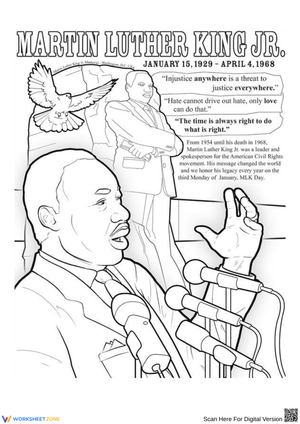
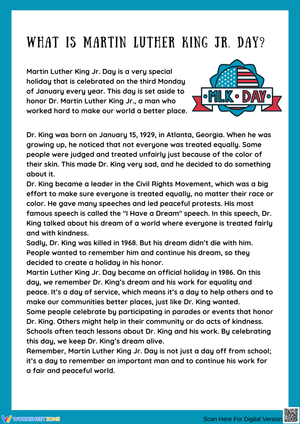
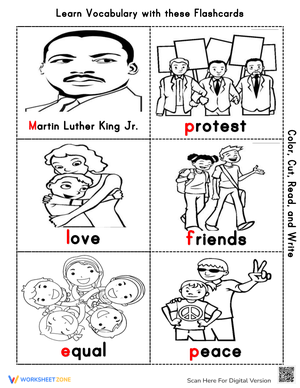
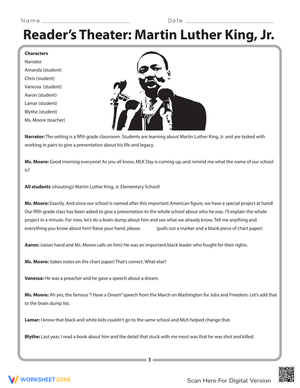
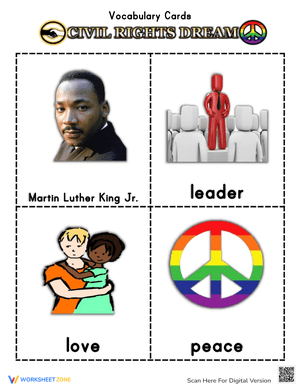
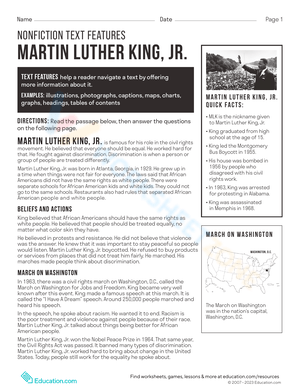
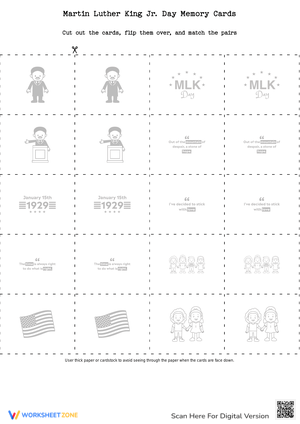
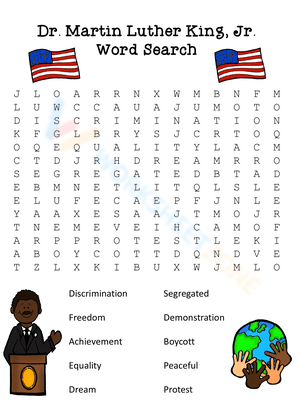
In grades K through 3, the work is biographical. Students read short passages about Dr. King's childhood in Atlanta, his education at Morehouse College, and the Montgomery Bus Boycott, then answer comprehension questions and practice vocabulary through word sorts and matching tasks. Terms like equality, boycott, justice, and protest appear repeatedly across activities so that by the time students reach a longer reading passage, the vocabulary is already familiar.
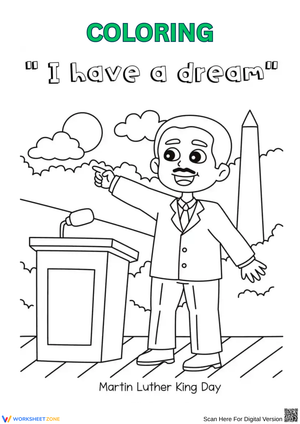
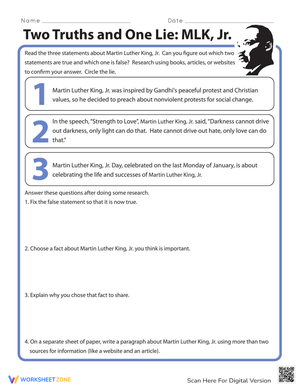
Grades 4 through 8 shift toward primary source work. The "I Have a Dream" speech appears in excerpt form, paired with annotation tasks and graphic organizers for tracking rhetorical devices — anaphora, allusion, extended metaphor — and their function within King's argument. Students underline specific passages, label the device, and write a sentence explaining what that device accomplishes. That final step is where most of the learning happens. The "Letter from Birmingham Jail" worksheets, designed for grades 8 and above, present the original critics' position alongside King's response, so students understand the document as a direct argument rather than a general statement of belief.
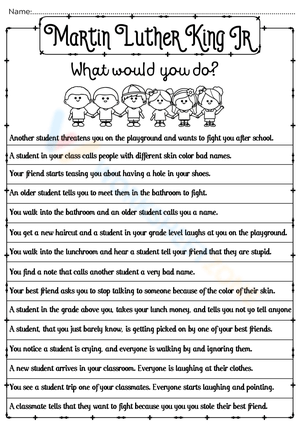
A separate cluster of worksheets addresses the Day of Service theme. Students read about why King tied service to citizenship, brainstorm specific local actions, and complete a planning template that walks them from an idea to a first concrete step.
Why Primary Source Work Fits This Grade Level
"I Have a Dream" is one of the first primary sources many students encounter in structured literary analysis — and it is well-suited to that role. The speech is long enough to have internal structure but short enough to work through in a single period. The language is elevated without being archaic, which gives students productive vocabulary work without the frustration of genuinely unfamiliar syntax. Breaking the speech into labeled excerpts manages cognitive load effectively: students work with one section at a time rather than holding the full speech in working memory while simultaneously tracking rhetorical technique.
The "Letter from Birmingham Jail" is a different instructional challenge. It is an argument built in direct response to named critics, which means comprehension depends on understanding the original accusation King is answering. Worksheets that present that context explicitly — rather than asking students to infer it from the letter alone — produce substantially more accurate analysis. This is the difference between a student who can quote the letter and one who can explain its actual logic.
Mistakes Students Make That These Worksheets Help You Catch
The most consistent error in "I Have a Dream" analysis is reading the speech as purely aspirational. Students who encounter only the final "let freedom ring" sequence — the part that appears in every MLK Day video — miss that the first two-thirds of the speech constitute a pointed indictment of broken promises. When asked to state King's argument without annotating the full text, students almost universally write some version of "he wanted equality for everyone," which identifies a value rather than an argument. Worksheets that require students to work through the "bad check" metaphor in the opening section before moving to the closing passages produce significantly more accurate characterizations of what King was actually claiming.
Younger students run into a different problem: conflating MLK Day with Black History Month. That conflation matters because it removes King from his specific historical moment — the legislative battles of the 1950s and 1960s, the particular laws being challenged, the organizations he led — and places him into a vague thematic category. Biographical timeline worksheets that anchor events to specific years (1955 Montgomery Bus Boycott, 1963 March on Washington, 1964 Civil Rights Act) address this directly. The format forces students to see King's activism as a dated sequence of events rather than a diffuse cultural symbol.
Fitting These Worksheets Into the Week Before the Holiday
January runs to only four instructional days before the Monday holiday, and students are often still resettling after winter break. A workable sequence uses each day for a distinct type of work: day one builds biographical knowledge through a reading passage and timeline activity; day two introduces the vocabulary set before students touch any primary source — skipping this step is not worth it, because students who encounter "I Have a Dream" without prior vocabulary and biographical framing tend to skim rather than annotate; day three reserves the primary source annotation worksheet for focused independent work; day four uses the reflection writing prompt or service-planning template, both of which take roughly 25 minutes and close the week cleanly.
The service-planning worksheet lands especially well on the Friday before the holiday. Students have the weekend to take a small action, and a brief share-out on Tuesday after the holiday gives the sequence a natural close that connects the historical study to something students actually did.
Standard Alignment
The primary source annotation worksheets align to CCSS.ELA-LITERACY.RH.6-8.6 and RH.9-10.6, which ask students to identify an author's point of view and purpose in a historical document and distinguish those from factual claims. The annotation tasks address this standard directly: students evaluate rhetorical choices, not just summarize content. At the elementary level, the biographical worksheets address RI.4.3 and RI.5.3 — the relationship between historical events, individuals, and connecting ideas. The reflection and writing worksheets target W.3-5.1 (opinion writing) or W.6-8.1 (argument writing) depending on grade, with the prompts already framed to match the appropriate standard.
Adjusting the Worksheets for a Range of Learners
For students who struggle with dense historical prose, these martin luther king jr day printable worksheets already reduce demand by presenting excerpts rather than full texts — but teachers can go further by assigning one excerpt rather than the complete worksheet. Pairing any reading task with an audio recording of King delivering the speech gives students who process auditory information more readily a way into the text before they begin written annotation. Hearing the cadence and emphasis of his delivery changes how carefully most students read the passage afterward.
Students who move through the content quickly benefit from a synthesis task rather than additional reading: ask them to compare King's use of biblical allusion in "Letter from Birmingham Jail" with its use in "I Have a Dream," drawing evidence from both texts. That task stays within the existing worksheet materials but requires evaluative comparison rather than comprehension alone. For students who need more support, completing the vocabulary matching and word sort activities before touching any reading passage activates prior knowledge and reduces the cognitive load of encountering unfamiliar terms mid-text.
Frequently Asked Questions
Do these work as standalone activities or only within a full unit?
Each worksheet functions independently. Teachers pull individual activities for sub plans, Monday warm-ups, or the 20 minutes before an assembly — without any surrounding unit. The biographical timeline worksheet, in particular, works as a self-contained 30-minute activity with no prior context required. The multi-day sequence described above improves outcomes on the annotation work, but no individual worksheet depends on it.
What grade levels are the primary source worksheets designed for?
The "I Have a Dream" annotation worksheets are calibrated for grades 5–8. The "Letter from Birmingham Jail" worksheets are built for grades 8–10. The martin luther king jr day printable worksheets for grades K–3 stay at the biographical and vocabulary level — structured primary source analysis begins at grade 5, once students have the reading stamina to work through a dense historical excerpt and enough historical background to understand why it was written.
Are answer keys included?
Yes. Comprehension and vocabulary worksheets include complete answer keys. For annotation and argument-mapping tasks, the keys provide model responses with brief explanatory notes rather than single correct answers — those tasks involve genuine interpretation, and the answer keys are written to reflect that honestly.
Can a social studies teacher use these, or are they built for ELA only?
Both work. The biographical timeline and Day of Service worksheets fit naturally into a social studies or history context. The annotation and rhetorical analysis work is built primarily for ELA, but social studies teachers use those activities regularly when covering the legislative history of the Civil Rights Act and Voting Rights Act — the martin luther king jr day printable worksheets that focus on primary source rhetoric support both disciplinary frameworks without modification.












 Interactive Worksheet Maker
 Quiz Maker
 Word Search Maker
 Crossword Puzzle Maker
 Word Scramble Generator
 Sentence Scramble Generator
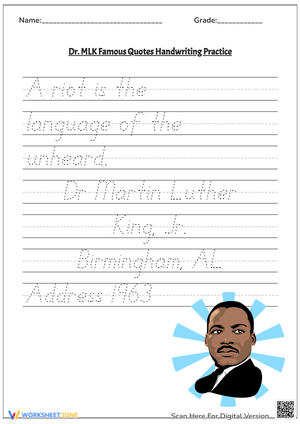
 Handwriting Worksheet Generator
 Name Tracing Generator
 Fill In The Blank Generator