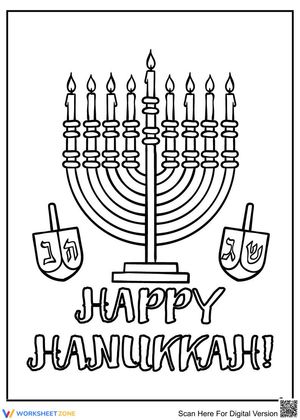
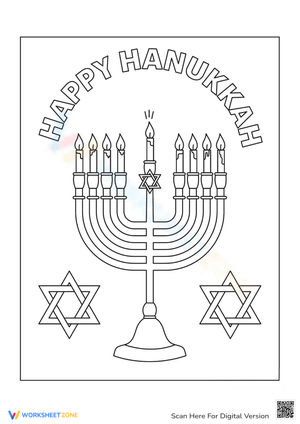
These Hanukkah printable worksheets give elementary and middle school teachers a cross-curricular set of activities built around the history, symbols, and traditions of the eight-day Jewish festival — ready to pull for any subject block during the December instructional weeks. Each worksheet stands alone, so teachers can assign the dreidel probability activity during math centers, drop the Maccabee reading passage into an independent reading block, or hand the menorah symmetry worksheet to a student finishing early. The set requires no background in Jewish studies to use effectively.
The Specific Skills These Worksheets Target
The literacy worksheets give students practice reading historically grounded nonfiction passages and answering text-dependent questions about the Maccabean Revolt, the miracle of the oil, and the rededication of the Second Temple. Vocabulary work centers on terms students genuinely encounter — Hanukkiah, Shamash, Maccabee, sufganiyot, latke — and the activities move from definition-matching to using the words in original sentences. Creative writing worksheets prompt students to write from a first-person historical perspective, which requires synthesis rather than simple recall.
On the math side, the dreidel worksheets are the strongest offering. Students spin, tally, and graph outcomes across multiple trials, then compare their experimental results against the theoretical probability of landing on each Hebrew letter. Younger students count and add menorah candles across the eight nights — a concrete entry point for cumulative addition — while upper-elementary students examine the geometric properties of the Hanukkiah's nine-candle arrangement. Social studies worksheets ask students to locate ancient Jerusalem on a map of the Levant and trace the movements of the Maccabees, connecting the historical narrative to physical geography.
Why This Format Works for Cultural Holiday Content
Holiday content carries a specific instructional risk: it slides into decoration rather than learning. Each worksheet in this set anchors the cultural material to a transferable academic skill. A student completing the reading comprehension worksheet on the miracle of the oil is practicing the same close-reading habits she applies to any nonfiction text — identifying central ideas, citing textual evidence, distinguishing fact from interpretation. The Hanukkah context provides motivation and novelty; the skill is the same one the standards require year-round.
The dreidel probability worksheet illustrates what sets these Hanukkah printable worksheets apart from generic holiday coloring activities. Probability is abstract until students have a physical referent. The dreidel — a four-sided top with equally likely outcomes — gives students a concrete object to manipulate before formal notation appears. Teachers who introduce theoretical probability in December with this worksheet can return to the same logic in the spring when the curriculum reaches statistics formally, and students who remember the dreidel as their referent pick up the abstract version faster.
Mistakes Students Make That These Worksheets Help Surface
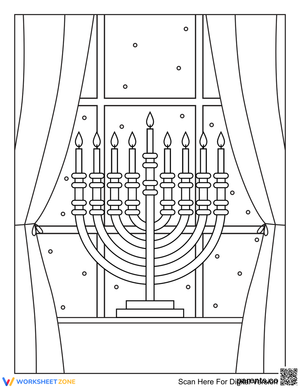
The most common error on menorah counting worksheets is recording eight candles instead of nine. Students hear "eight nights" and anchor on that number, missing the Shamash entirely. When this happens, it is worth pausing to address the distinction between the eight candles that represent the miracle and the helper candle used to light them — not just a vocabulary correction, but a comprehension checkpoint that reveals whether students understood the story structure at all.
On the probability worksheets, the predictable misconception is treating theoretical probability as a guarantee. After thirty spins, a student who landed on Gimmel only four times will often write that the dreidel is "broken" or "unfair." This is precisely the conversation probability instruction needs: the gap between expected and observed outcomes is not error — it is the nature of experimental data. The worksheet's tally section functions best as a whole-class data pool; when results from every student are combined, the class aggregate moves closer to 25% per letter, and students see firsthand why sample size matters.
In vocabulary work, students who have seen "Chanukah" at home reliably question whether "Hanukkah" is spelled correctly on the worksheet. Both transliterations from Hebrew are accepted, and addressing this directly — rather than marking it wrong — opens a brief productive discussion about how Hebrew is romanized into English, which is itself a worthwhile literacy moment.
Building These Worksheets Into Your Instructional Week
The most effective deployment spreads the worksheets across several days rather than clustering them into a single "Hanukkah day." Start the week before the holiday with the historical reading passage and vocabulary work — that background knowledge makes every subsequent activity more meaningful. Run the dreidel probability worksheet during the regular math block once students understand what a dreidel is, and treat it as the day's central activity rather than a bonus. Save the mapping and creative writing worksheets for the back half of the week, when students have accumulated enough context to work independently.
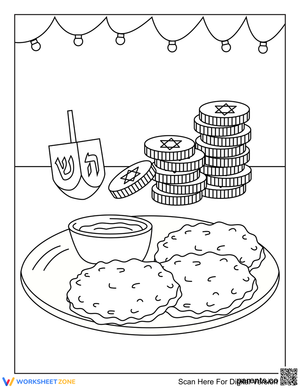
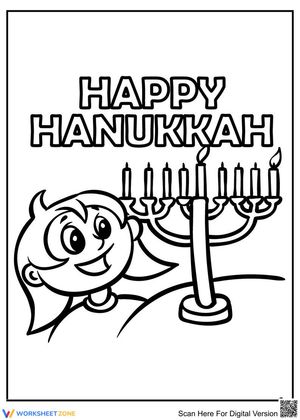
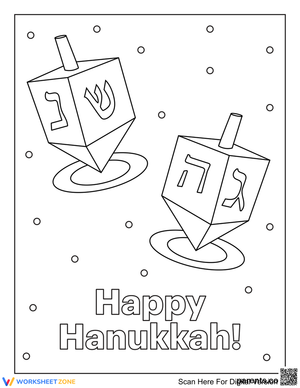
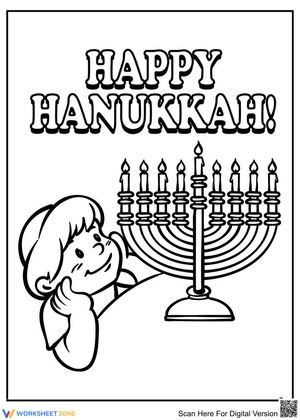
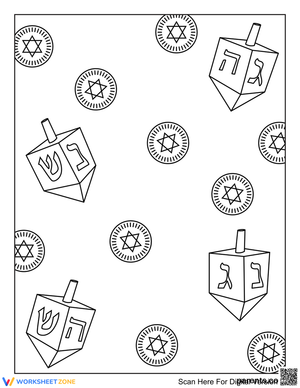
The creative arts worksheets — directed drawing of a Hanukkiah, paper dreidel construction — work well in the 15 minutes before a school break begins, when sustained cognitive work is difficult but structured activity still matters. Hanukkah printable worksheets at the creative arts level hold attention without demanding the extended concentration that wears thin on the last day before a holiday break. For center rotations, the dreidel game with its accompanying data-recording sheet runs as a paired activity; the reading and vocabulary worksheets run independently at a separate station.
Adjusting the Work for a Range of Learners
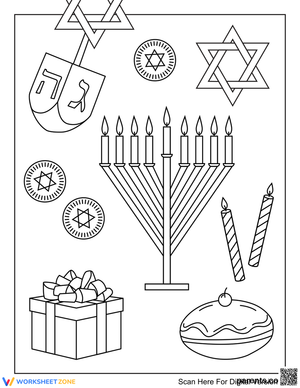
The reading comprehension passages work across a wider ability range when teachers provide a word bank for students who are still building fluency. The passage itself stays the same — the word bank removes the vocabulary barrier without reducing the comprehension demand. For ELL students, the visual vocabulary matching worksheet, which pairs terms with labeled images of the Hanukkiah, dreidel, and traditional foods, requires minimal extended reading while still building the same cultural vocabulary as the rest of the class.
Advanced students get the most from the probability worksheet when the task extends beyond recording outcomes. Ask them to calculate the theoretical probability of landing on Gimmel three times in a row, or to determine how many additional spins would bring the class data closer to the expected distribution. On the menorah geometry worksheet, students with strong spatial reasoning can identify lines of symmetry and calculate the angles between candle positions — a legitimate challenge within the same activity the rest of the class completes at a more foundational level.
Standard Alignment
The reading comprehension worksheets address CCSS.ELA-LITERACY.RI.4.3, which requires students to explain events in a historical text — what happened, why it happened, and how earlier events connect to later ones. At fifth grade, pairing the Maccabean Revolt passage with a second-source perspective meets RI.5.6, which asks students to analyze multiple accounts of the same event. The probability and data worksheets connect to CCSS.MATH.CONTENT.7.SP.C.5 through 7.SP.C.7; used in grades 5 and 6, the dreidel activities serve as concrete early exposure before the formal seventh-grade standard arrives. The social studies and geography worksheets align with NCSS Curriculum Standard I (Culture) and Standard II (Time, Continuity, and Change), fitting naturally into units on world cultures or ancient civilizations that many schools run during the fall or winter semester.
Frequently Asked Questions
Do these worksheets require me to endorse or celebrate a religious holiday?
No. Teaching about a cultural or religious holiday as a historical and social subject is distinct from promoting it as a religious observance. Each worksheet treats Hanukkah as subject matter — its history, language, symbols, and mathematical applications — consistent with how most district curriculum guidelines frame winter holiday instruction. The same approach applies to any cultural celebration studied in a secular academic context.
What grade levels do these worksheets cover?
The set spans grades 2 through 7. Counting, coloring, and basic addition worksheets fit grades 2–3. Reading comprehension and vocabulary work targets grades 3–5. The probability and data worksheets are strongest in grades 5–7, where students have the math foundation to interpret their own collected data. Teachers can pull across the set to match the actual range in their classroom rather than defaulting to a single grade level.
What is the difference between a menorah and a Hanukkiah?
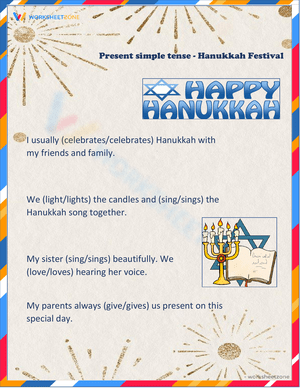
A menorah is the general term for any Jewish candelabra; the seven-branched version was used in the ancient Temple in Jerusalem. A Hanukkiah is specifically the nine-branched candelabra used during Hanukkah — eight candles for the eight nights of the miracle, plus the Shamash that lights the others. The worksheets use Hanukkiah consistently when referring to the holiday candelabra, and the vocabulary activities address this distinction directly so students leave with the precise term rather than the generic one.
Can I use these worksheets if Hanukkah has already passed?
Yes. The historical reading passages, geography mapping, and vocabulary activities are not time-sensitive — they function as cultural and historical literacy content at any point in the school year. The probability worksheets work whenever the math curriculum calls for data collection and graphing, regardless of the month. These Hanukkah printable worksheets covering the geography of the ancient Levant or the history of the Maccabean Revolt fit as naturally into a spring unit on ancient civilizations as they do into a December cultural study.












 Interactive Worksheet Maker
 Quiz Maker
 Word Search Maker
 Crossword Puzzle Maker
 Word Scramble Generator
 Sentence Scramble Generator
 Handwriting Worksheet Generator
 Name Tracing Generator
 Fill In The Blank Generator