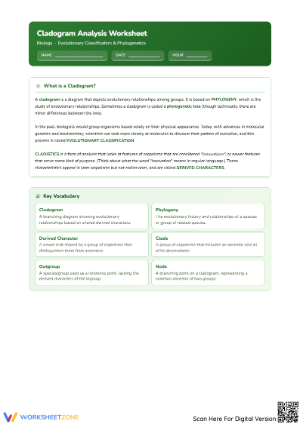
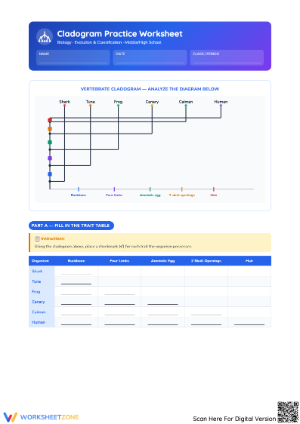
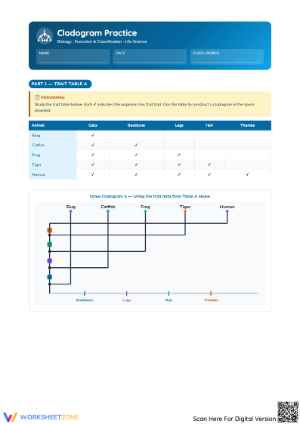
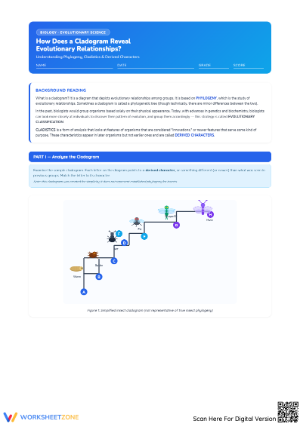
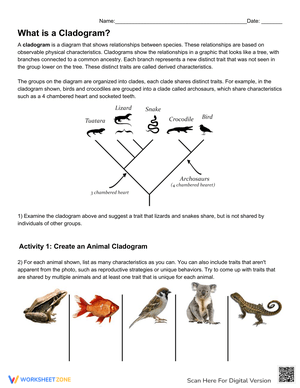
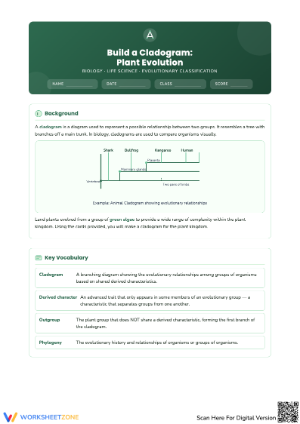
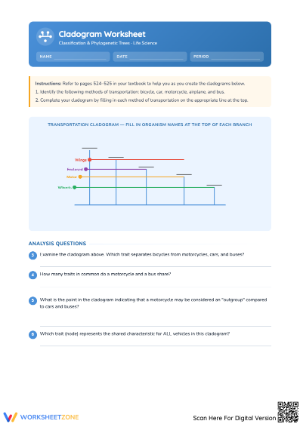
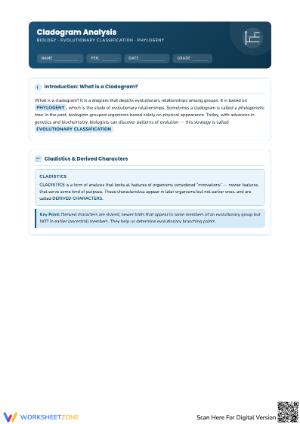
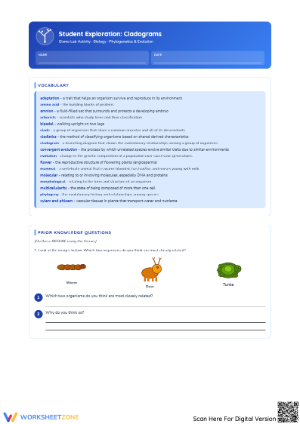
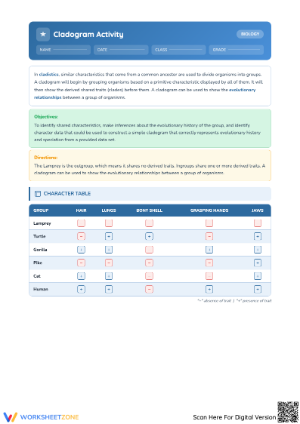
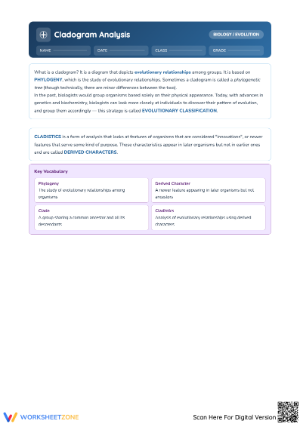
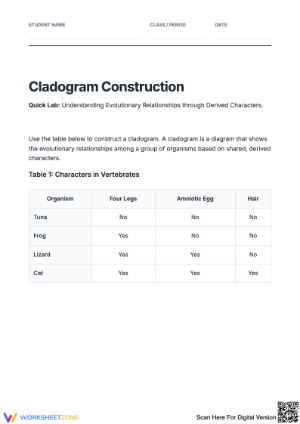
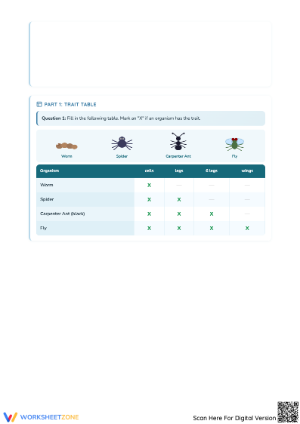
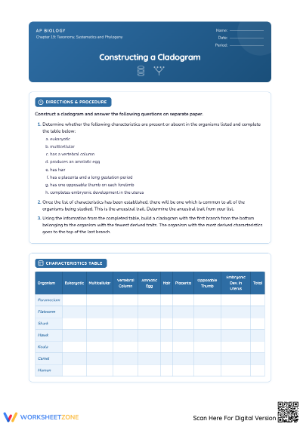
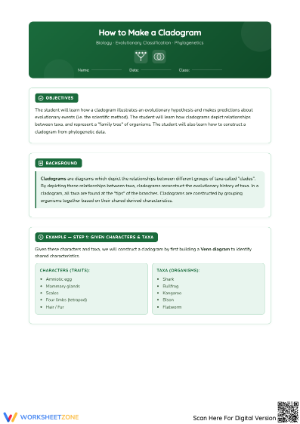
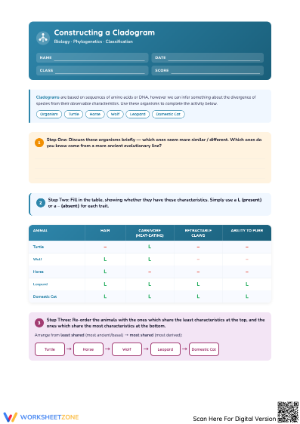
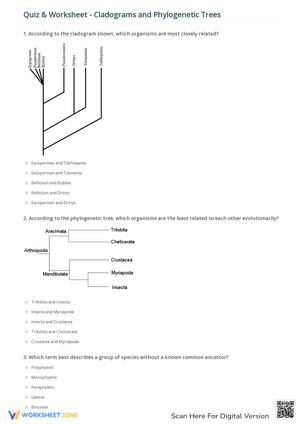
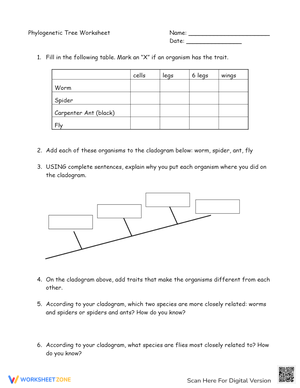
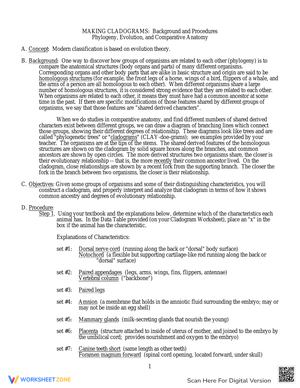
These cladogram printable worksheets for 9th grade address the specific challenge that arises when classification and evolutionary reasoning land in the same ninth-grade unit — students need repeated practice with branching diagrams, but most materials stop at simple labeling rather than asking for the evidence-based reasoning the work actually requires. Each worksheet walks students through a defined task sequence: read a trait table, trace branches, identify derived characteristics, and explain sister group relationships in writing. Answer keys accompany each worksheet, which matters when grading across multiple class sections.
Errors Students Make That These Worksheets Help You Catch
The most persistent misconception in ninth-grade cladogram work is that "most closely related" means "most physically similar." A student reading or drawing a cladogram will often select the whale and the fish as closest relatives because both live in water, even when the trait table shows the whale and the cow sharing fur, live birth, and mammary glands. This is not careless work — it reflects a deeply intuitive but wrong heuristic, and it surfaces in student writing repeatedly until they have practiced reading branching points systematically rather than scanning for visual resemblance.
A second common mistake involves confusing the position of an organism on the diagram with the recency of its shared ancestor. Students look at where an organism sits at the tip of a branch and assume it is most closely related to whatever organism sits next to it, rather than tracing back to the node. Questions that require students to circle the most recent common ancestor of two named organisms and then write one sentence of justification catch this error before it solidifies into a persistent misreading habit.
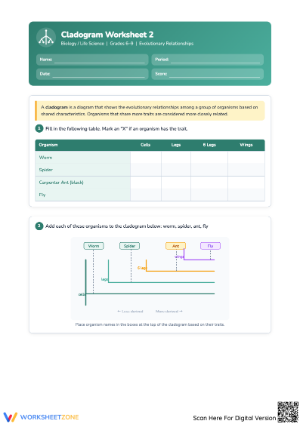
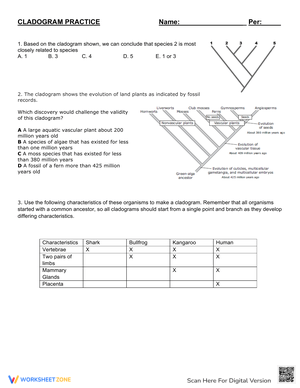
A third pattern appears when students encounter derived traits that seem to conflict — a trait present in two non-adjacent groups but absent in the group between them. Rather than consulting the trait table methodically, many students try to construct the cladogram from memory or visual impression, which produces incorrect branching patterns. Each worksheet requires students to reference the table before drawing or annotating any branch, which builds the table-to-diagram habit that reading from appearance alone never develops.
The Specific Skills Each Worksheet Targets
Cladogram printable worksheets for 9th grade biology standards ask for introductory evolutionary analysis, not simple diagram labeling. The skills covered across the set include:
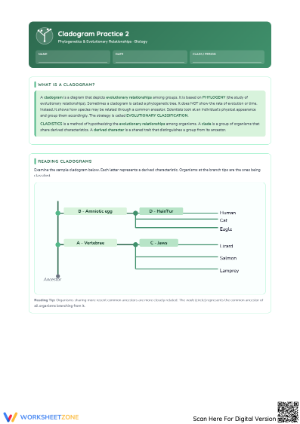
- Reading branching points: Students identify where lineages diverge and explain what that split implies about common ancestry.
- Tracking derived characteristics: Students mark when a new trait first appears on a branch and determine which organisms inherit it.
- Identifying sister groups: Students compare adjacent branches to determine which organisms share the most recent common ancestor.
- Sequencing trait appearance: Students explain the order in which derived traits accumulate moving from the base of the cladogram upward.
- Evidence-based written response: Students complete short-answer prompts that require citing specific traits and branching points rather than general impressions.
The written response tasks are where the most instructional value lives. A student who writes, "Organism A is more closely related to Organism B than to Organism C because they share the derived trait of four-chambered hearts and a more recent branching point," has moved from diagram-reading into biological reasoning. The short-answer items on each worksheet are built to produce that kind of specific, evidence-grounded answer rather than "they look alike."
Working These Worksheets Into Your Biology Unit From Day One
Cladogram lessons land most effectively when each worksheet is embedded in a short sequence rather than assigned as a stand-alone activity. On the first day of the cladogram sub-unit, use the simplest worksheet in the set to introduce the four terms students need — derived trait, common ancestor, branch point, sister group. Students who walk into a cladogram task without those terms spend the period decoding vocabulary instead of reading the diagram. A five-minute vocabulary review before distributing the worksheet removes that obstacle entirely.
Mid-unit, assign a worksheet that gives students a completed trait table and a blank cladogram to fill in. This is where the trait-confusion errors surface, and catching them here — before a quiz — saves significant reteaching time. The last ten minutes of class are usually enough to collect the short-answer section and scan for the "most similar equals most related" error. If more than a third of responses show it, address that misconception directly the next morning before moving forward.
Near the end of the unit, these worksheets function well as review tools that connect classification with evidence for evolution. Assign one as a bell ringer or station activity, have students compare answers with a partner, then debrief as a class on any branching points where interpretations differed. That brief discussion typically surfaces stronger reasoning than a silently completed review task ever does.
Standard Alignment
These worksheets align with NGSS HS-LS4-1, which calls on students to communicate scientific information showing that common ancestry and biological evolution are supported by multiple lines of empirical evidence. Cladograms serve as that evidence in a visual, comparative format, making this standard a direct instructional fit. The derived trait analysis tasks on each worksheet also support HS-LS4-2, which asks students to construct explanations based on evidence for how natural selection leads to population change over time. In most ninth-grade biology courses, both standards appear in the introductory evolution unit — typically placed in fall or early spring — which is the natural instructional placement for this set.
Adjusting the Worksheets for Mixed-Readiness Biology Classes
For students who need additional support entering the task, reduce the organism count to four or five and pre-complete the leftmost portion of the cladogram so they are finishing a diagram rather than building one from scratch. Limiting the trait list to three or four clearly observable characteristics — backbone, fur, live birth — reduces working memory demand without removing the reasoning expectation. The goal is to preserve the interpretive task while eliminating the visual overload that causes some students to disengage before they start.
On-level students work with a full trait table, a blank cladogram, and the standard short-answer prompts included in each worksheet. For enrichment, introduce one organism whose trait combination challenges an obvious placement — a dolphin alongside a fish and a cow, for instance. Asking students to write a paragraph defending the branching decision using every relevant derived trait in the table turns the worksheet into a genuine evidence argument. Cladogram printable worksheets for 9th grade that include this kind of extension prompt work especially well when some students finish the core task quickly and need something that requires actual deliberation rather than speed.
Response mode is an easy adjustment lever. Students who find extended writing difficult can annotate directly on the diagram — circling nodes, labeling derived traits on branches, drawing arrows to the most recent common ancestor. Students who write more fluently produce the full sentence-frame explanations. Both modes reveal understanding if the prompts are written clearly enough to demand evidence rather than just a placement decision.
Frequently Asked Questions
What prior knowledge do students need before starting these worksheets?
Students need working definitions of four terms: derived trait, common ancestor, branch point, and sister group. They do not need to memorize taxonomy levels or know detailed organism histories. A five-minute vocabulary review before the first cladogram lesson is usually sufficient. Students who have already encountered a basic phylogenetic tree in a classification lesson can begin the simpler worksheets in the set immediately.
How do students determine which organisms are most closely related on a cladogram?
They trace back to the most recent shared branching point. Two organisms whose lineages split more recently share a more recent common ancestor and are therefore more closely related — regardless of how similar they appear in size, habitat, or behavior. This is the core reasoning the short-answer prompts are built to elicit, and it is exactly where the "they look alike" shortcut needs to be corrected in student work.
Do these worksheets work as formative assessment, or only as independent practice?
Both. For formative purposes, collect the short-answer section at the end of class and review student explanations before the next lesson. Written responses show whether students are reasoning about ancestry and derived traits or defaulting to appearance-based thinking. For practice, the full worksheet — trait table, diagram, and questions together — gives students the complete sequence needed to build fluency before a quiz or unit test.
Can these resources connect cladogram analysis to broader evolution concepts?
Yes, and ninth-grade biology almost requires it. Because cladogram printable worksheets for 9th grade are positioned inside the same unit where students first encounter natural selection and common descent, the diagram tasks reinforce the idea that evolutionary relationships are inferred from evidence rather than assumed from appearance. A well-placed extension question — "What would change on this diagram if we discovered that Organism X lacked this derived trait?" — pushes students from reading evidence to evaluating it, which is where the deeper conceptual work actually lives.












 Interactive Worksheet Maker
 Quiz Maker
 Word Search Maker
 Crossword Puzzle Maker
 Word Scramble Generator
 Sentence Scramble Generator
 Handwriting Worksheet Generator
 Name Tracing Generator
 Fill In The Blank Generator