Christopher Columbus Worksheets for 6th Grade
These Christopher Columbus worksheets for 6th grade give teachers a structured way to move students past surface-level biography and into the kind of historical thinking that belongs at this level — cause and consequence, geographic context, and the experiences of multiple groups, not just the explorers. The set covers the four voyages, Spain's sponsorship, Caribbean landfalls, and the chain of events that followed first contact.
What's Inside the Set
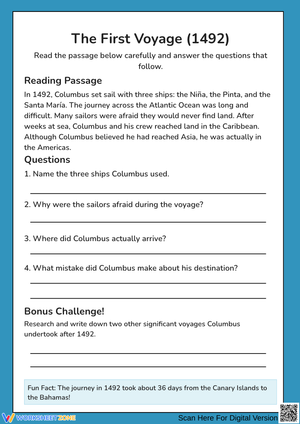
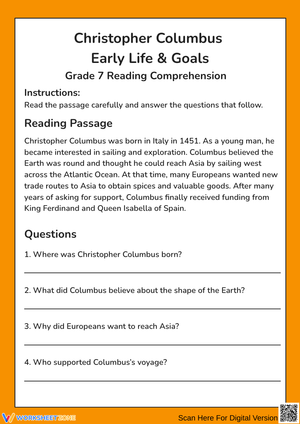
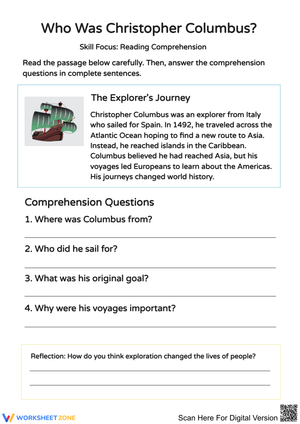
Each worksheet targets a specific skill rather than trying to cover everything at once. One worksheet centers on a short reading passage about Columbus's 1492 departure and the Caribbean landfall, with comprehension questions that ask students to identify Spain's motivations, the route taken, and the outcome of that first voyage. A second worksheet presents a timeline frame across all four expeditions — students sequence events, label years, and annotate what changed between voyages. That separation matters: without a timeline task, many 6th graders treat the four voyages as a single blurred event.
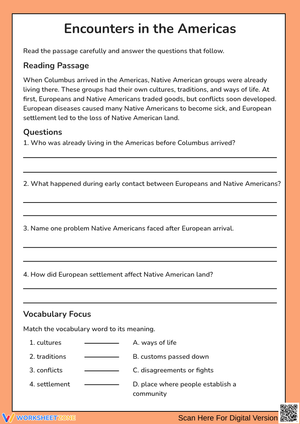
Map practice makes up another worksheet in the set. Students label Spain, the Atlantic Ocean, and the Caribbean island groups, then trace the approximate route of the first voyage. This is not decorative geography — it directly supports the historical reasoning that follows, because students who can point to where Columbus actually landed stop repeating the common error about North America. The remaining worksheets include vocabulary work (expedition, navigation, colony, Columbian Exchange, Indigenous) and an evidence-based short-response prompt that asks students to identify one consequence for Spain and one consequence for Indigenous peoples, using details from the reading to support each claim.
Standard Alignment
These worksheets align with CCSS.ELA-LITERACY.RH.6-8.1, which requires students to cite textual evidence to support analysis of primary and secondary sources. The evidence-based short-response prompt is the direct application: students must identify a consequence and cite a detail from the reading, not simply state an opinion. The set also supports CCSS.ELA-LITERACY.RH.6-8.4 through the vocabulary worksheet, which asks students to determine the meaning of domain-specific words as they appear in a historical context. In NCSS terms, the full set maps to the Expansion and Reform theme and to geographic and historical thinking standards at the middle school level.
Common Student Mistakes Teachers Should Anticipate and Address
The most persistent error in student work on this topic is geographic. Students regularly write that Columbus "discovered America" or "reached North America in 1492," and many believe this sincerely because they have heard it. The map worksheet addresses this directly — once students trace the first voyage to the Caribbean and see where the North American mainland actually sits in relation to those landfalls, the misconception becomes harder to sustain. Still, watch for it in written responses even after the map work. Some students understand the map task and then revert to the familiar language in their writing.
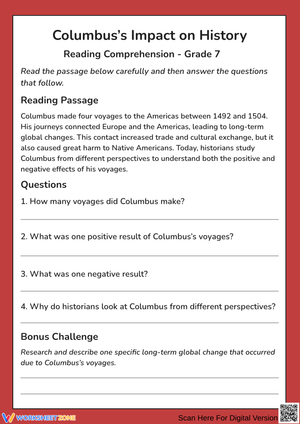
A second error is timeline collapse. Students who haven't done explicit sequencing work will often answer questions about Columbus's voyages as though they were a single event, describing things that occurred on the third or fourth expedition as part of 1492. The timeline worksheet exists precisely to interrupt that pattern. When you review it as a class, ask students to point to one thing that changed between the first and second voyage — that question forces them to treat the expeditions as distinct rather than continuous.
A third issue appears in the short-response prompt: students who can name consequences will often assign them to the wrong group. They will write that Indigenous peoples "benefited from new trade" or that Spain "suffered losses" without evidence for either claim. The prompt is designed to require a cited detail alongside each consequence, which pushes students toward precision and away from assumption.
How to Build These Worksheets Into Your Lesson Plans
The reading and comprehension worksheet works well as a Monday opener during a Columbus or Age of Exploration unit — 15 to 20 minutes gives students enough time to read and answer without rushing. The timeline and map worksheets fit naturally into a direct-instruction day as guided practice or into a station rotation where students work in pairs. Pairing those two worksheets in a single class period is workable if you debrief briefly after each one; skipping the debrief is where students leave with uncorrected errors.
Save the vocabulary worksheet for the day before the short-response prompt. Students who complete vocabulary review the day prior write noticeably tighter responses — the terms are active in their working memory rather than theoretical. The evidence-based prompt itself works as independent practice, a formative exit task, or a sub plan if you need one mid-unit. It requires no additional setup: the instructions are self-contained and the reading from the first worksheet provides enough content for students to work from.
One classroom routine that works well with this set: add a "fact / impact / perspective" box at the bottom of each completed worksheet. Students write one factual detail, one impact of the voyages, and one group whose perspective is missing from the discussion. It takes about three minutes and keeps the larger frame visible across the unit, so the analysis skills practiced on each individual worksheet accumulate rather than sit in isolation.
Adjusting the Worksheets for a Range of Learners
For students who need more support, the reading passage worksheet can be completed with a partner or with the vocabulary list visible alongside it. The map task is accessible to most learners because it involves visual and spatial reasoning rather than extended reading — it often serves as a confidence-building entry point for students who freeze on text-heavy tasks. For those students, starting with the map and then moving to reading reverses the standard sequence in a way that actually improves engagement.
For students ready for greater depth, the short-response prompt can be extended with a second source — a brief excerpt from a secondary summary of Taíno experiences, for instance — and revised to require students to compare the perspective in that source with the perspective implied in the textbook-style reading. That revision moves the worksheet from explanation to source analysis, which is appropriate for students already comfortable with the basic content. No new materials are needed; the adjustment is in the question itself.
Frequently Asked Questions
Do these worksheets present multiple perspectives on Columbus and the voyages?
Yes. The short-response prompt specifically asks students to identify one consequence for Spain and one consequence for Indigenous peoples, requiring them to work across perspectives rather than treat the voyages as a single-group story. The "fact / impact / perspective" classroom routine described above reinforces that frame across the full set.
Can these worksheets work as a sub plan or for independent work?
The evidence-based short-response worksheet is the most self-contained and works well as independent work or a sub plan. The reading comprehension worksheet also functions independently. The map and timeline worksheets benefit from a brief teacher-led debrief, but students can complete them independently without difficulty — the value is in the follow-up conversation, not in requiring teacher presence during the task itself.
How long does each worksheet take to complete?
The reading and comprehension worksheet runs about 15 to 20 minutes for most 6th graders. The vocabulary worksheet takes 10 to 15 minutes. The map and timeline worksheets are each roughly 15 minutes. The evidence-based short-response prompt typically takes 15 to 20 minutes, depending on how much writing practice students have had with citation-based responses. All five worksheets together fit comfortably across a standard exploration unit without consuming the full instructional time in any single class period.
Clear All