Roles of the President Worksheets Printable for 5th Grade for Clear Civics Review
Roles of the president worksheets printable for 5th grade give teachers a focused entry into executive branch vocabulary at the point in a civics unit when students are ready to move past "the president is the leader" and start naming what that leadership actually involves. The set works for whole-group instruction, partner tasks, center rotations, and the reteach block most teachers build in before a quiz on the branches of government.
What the Set Covers
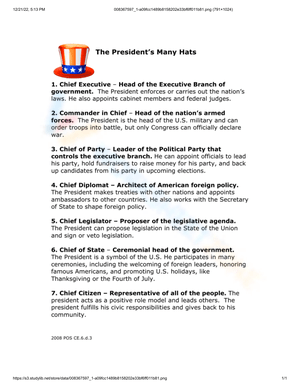
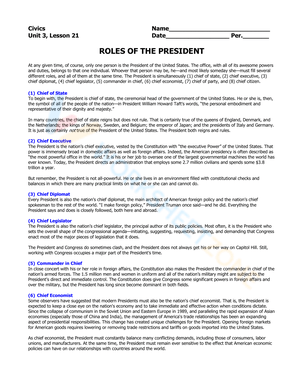
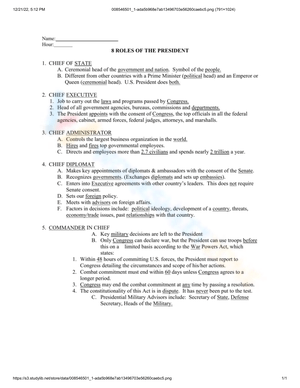
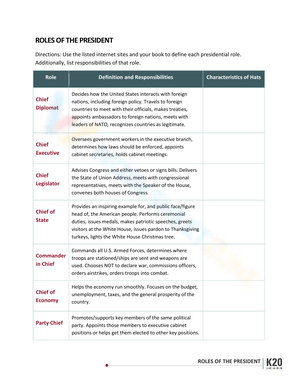
The four roles grade 5 students need first are chief executive, commander in chief, chief diplomat, and head of state. Each one is concrete enough to connect to an example — directing how federal agencies carry out the law, overseeing military operations, negotiating with foreign governments, representing the country at state ceremonies — and distinct enough that students have to think before they sort. Each worksheet asks students to do more than reproduce definitions: they match role names to short scenario descriptions, identify which role fits a given situation, and write a sentence or two explaining their reasoning.
- Chief executive: directs the executive branch and carries out federal law.
- Commander in chief: holds authority over the armed forces.
- Chief diplomat: manages relationships with foreign nations.
- Head of state: represents the United States at official functions and ceremonies.
One worksheet in the set connects all four roles to Article II of the Constitution, where executive power is formally established. That anchor matters for grade 5 because it shows students that the roles come from a governing document — not from whoever happens to hold the office at a given moment.
Student Misconceptions That Surface Consistently
The most predictable mistake is treating a role and a power as the same category. Ask students to name a presidential role and many will write "signing a bill" — which is a specific constitutional power, not a role label. Ask for an example of what the president does and they will write "chief executive" — which names the role, not an action. The confusion is persistent, partly because the topic is often introduced with both categories mixed together on the same anchor chart. A worksheet that puts role names in one column and specific presidential actions in another makes the distinction visible in a way that class discussion alone rarely achieves.
A second pattern: students who learn that the president is commander in chief sometimes extend that role to cover foreign diplomacy. A student writing about a treaty negotiation or a state visit will label it as commander in chief work rather than chief diplomat work. The logic is understandable — both roles touch other countries — but conflating them produces exactly the kind of vague government writing that loses points on assessments. A sorting task that separates military decisions from diplomatic decisions addresses this directly.
There is also a sequencing problem that becomes visible when roles, powers, and checks and balances get taught at the same time. Students asked to explain a presidential veto before they have a stable picture of the executive branch tend to produce answers that float free of any role or constitutional grounding. Teaching roles first, then specific powers, then checks and balances gives students a mental framework that each later layer of instruction can attach to. The worksheets support this sequence by keeping role vocabulary separate from power vocabulary throughout the set.
Working These Worksheets Into a Government Unit
In a 45-minute social studies block, a reliable structure looks like this: five minutes reviewing the three branches with a quick visual, eight to ten minutes of whole-class modeling using two of the roles as examples, then twelve to fifteen minutes of independent or partner work on the worksheet. Close with three minutes where students defend one answer aloud using role vocabulary. That last piece is easy to cut when time runs short — but it is exactly the step that converts practice into language students can retrieve on a test.
Teachers can also assign roles of the president worksheets printable for 5th grade as a pre-assessment at the start of a branches unit to find out what students already know. If a class can match all four roles correctly but cannot explain how chief executive connects to carrying out laws, that gap tells you exactly where direct instruction needs to focus. If students cannot yet place the president inside the executive branch, that signals a need for more foundational instruction before moving into role-level vocabulary work.
For the week before a government unit test, one worksheet used as a morning warm-up — three to five items, five minutes, checked against the class — does more to consolidate vocabulary than a full period of reteaching. Repeated low-stakes retrieval is what shifts terminology from recognition into recall.
Matching the Worksheets to Where Your Students Are
Students who are still building vocabulary benefit from working through the matching worksheet before attempting any sorting or written-response task. Give them the four role names with brief definitions visible and ask them to connect each one to a single scenario. Once they do this consistently without needing to look at the definitions, they are ready for tasks where that reference is removed.
For students who are ready for more, the stronger challenge is not additional role labels but deeper reasoning about the four they already know. Ask them to compare chief executive and commander in chief — both involve directing large groups of people toward a specific outcome — and explain in three or four sentences what makes those two roles distinct rather than interchangeable. That kind of writing reveals conceptual understanding in a way that matching tasks cannot.
Roles of the president worksheets printable for 5th grade also work well in a targeted small-group setting after a quiz where students struggled with executive branch questions. Pulling three or four students to work through a matching or sorting worksheet together — with the teacher asking follow-up questions as they go — takes about ten minutes and often resolves the role-versus-power confusion faster than re-teaching the concept to the whole class.
Standard Alignment
These worksheets align to CCSS.ELA-LITERACY.RI.5.3 when students read a short civics passage and identify which presidential role connects to the action being described — drawing that inference requires the text-to-concept reasoning the standard targets at grade 5. For social studies, the most direct fit is C3 Framework standard D2.Civ.5.3-5, which asks students to explain the origins, functions, and structure of government systems established by the U.S. Constitution. Understanding that Article II creates the executive branch and assigns specific roles to the presidency is what that standard looks like at the classroom level. Teachers in states with NCSS-aligned frameworks can also connect this work to Theme V: Individuals, Groups, and Institutions, which addresses how individuals in formal civic roles carry out responsibilities within larger systems of government.
Frequently Asked Questions
Do 5th graders need to know more than four presidential roles?
Four roles — chief executive, commander in chief, chief diplomat, and head of state — cover the scope most grade 5 standards require. Some curricula include chief legislator or chief of party, but those roles carry political context that can muddy the foundational lesson. Building fluency with four roles first, and adding more only if a unit extends into advanced government study, produces more accurate student writing and better test performance.
How do the worksheets handle the difference between a presidential role and a presidential power?
Each worksheet keeps the two categories visually and conceptually separate. Roles describe the kind of job the president is performing; powers name specific constitutionally authorized actions. Matching and sorting formats make that boundary explicit, and short-answer prompts ask students to classify a given situation as a role, a power, or both. That format surfaces misconceptions early and gives teachers usable formative data before the unit test rather than after it.
What background knowledge do students need before using these worksheets?
The roles of the president worksheets printable for 5th grade in this set assume students have a basic introduction to the three branches — enough to know that the president belongs to the executive branch — but they do not require prior knowledge of Article II or specific constitutional powers. A student who can name the three branches and place the president in the correct one is ready to begin the first worksheet in the set.
Clear All