Rosa Parks Worksheets Printable for 4th Grade
These rosa parks worksheets printable for 4th grade cover biography, cause-and-effect reasoning, civic vocabulary, and perspective-taking writing — the exact skill mix that 4th grade social studies standards target when students begin studying individual historical actors. Each worksheet stands alone, so teachers can pull one for a morning warm-up or deploy the full set across a week-long Civil Rights focus.
What Students Practice
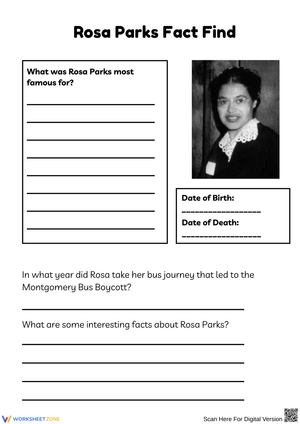
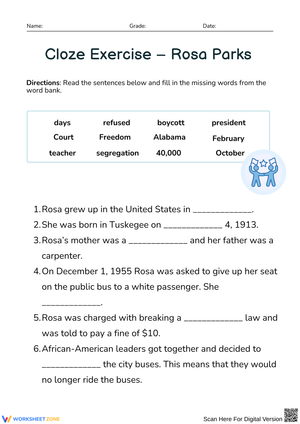
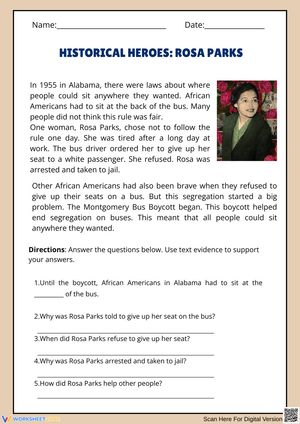
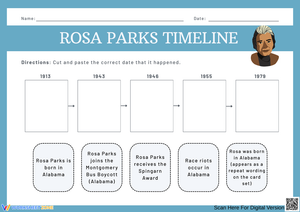
The set includes a biography reading passage with text-based comprehension questions, a chronological sequencing activity running from Parks's early childhood in Tuskegee through the Browder v. Gayle Supreme Court ruling, and a cause-and-effect graphic organizer that asks students to trace the chain from Parks's December 1955 arrest to the 381-day boycott to the eventual federal court decision. Civic vocabulary is woven throughout — students encounter terms like segregation, boycott, unconstitutional, and NAACP in context before working with them explicitly in a dedicated vocabulary worksheet. Two perspective-taking writing prompts complete the set: one asks students to write a journal entry from the viewpoint of a Montgomery community member walking to work during the boycott, and one asks them to write directly to Rosa Parks about what her decision meant to them.
Errors Students Make That These Worksheets Help You Catch
The most stubborn misconception 4th graders bring to this topic is what might be called the "tired feet" myth — the assumption that Parks refused to move because she was physically exhausted from a long workday. Parks herself addressed this directly: it was not her feet that were tired. When this belief goes uncorrected, students frame her act as a spontaneous, emotional moment rather than a deliberate, strategic one. The biography worksheet surfaces this error by asking students to identify evidence that Parks was already an experienced activist before December 1955 — she served as secretary of the Montgomery NAACP chapter and had completed training at the Highlander Folk School for social justice organizing. That evidence reframes the bus arrest as a prepared act, not a tired woman's impulse.
A second consistent error is timeline compression. Students tend to assume the boycott ended quickly — days, maybe a week or two. When they encounter the number 381, it doesn't register as more than a calendar year. The chronological sequencing worksheet asks students to place key dates on a timeline — the boycott's start on December 5, 1955, the Supreme Court's November 1956 decision in Browder v. Gayle, and the boycott's official end on December 20, 1956 — and calculate the duration themselves. Doing that arithmetic makes the commitment concrete in a way that reading a sentence about it does not.
How to Work These Into Your Social Studies Planning
The biography reading passage runs well as Monday morning work during the opening week of a Civil Rights unit. It establishes enough context that the cause-and-effect graphic organizer, introduced mid-week, doesn't require constant background explanation. With the graphic organizer, model the first cause-and-effect pair with the whole class before releasing students to work independently — 4th graders doing this kind of multi-step historical analysis for the first time tend to stall at blank boxes if they haven't seen a completed example first. The vocabulary worksheet fits cleanly into a literacy center rotation. Writing prompts belong at the end of the week, or in the period immediately after a class read-aloud; students write with more specific detail once the historical context has had time to settle.
- Biography reading passage — Monday morning work or a reading comprehension center at the unit's start
- Vocabulary worksheet — literacy center rotation, or paired with the reading passage as a pre-teaching activity
- Cause-and-effect graphic organizer — mid-week whole-group lesson, then independent practice
- Perspective-taking writing prompts — end of week or after a class read-aloud, as a near-summative task
Standard Alignment
These worksheets align to NCSS Theme 2 (Time, Continuity, and Change) and Theme 6 (Power, Authority, and Governance). Theme 2 is the active fit here: students are not simply recalling a sequence of events but ordering them and explaining how one caused the next across a span of more than a calendar year. Theme 6 addresses the civic layer — students examine how segregation laws functioned, how Parks challenged them through deliberate action, and how the Browder v. Gayle decision changed public policy. For ELA integration, the reading passage and writing prompts align to CCSS RI.4.3 (explaining how events in an informational text are connected through cause-and-effect relationships) and W.4.3 (writing narratives from a defined point of view with specific supporting evidence). State-level social studies frameworks across the Southeast, Midwest, and Mid-Atlantic that place biography study and civic participation at the 4th grade level treat rosa parks worksheets printable for 4th grade content as a direct match to those standards.
Adapting the Set for a Range of Learners
Teachers using rosa parks worksheets printable for 4th grade resources with a mixed-ability class have a few practical ways to adjust the demands without replacing the core materials. Students reading significantly below grade level benefit from pairing the biography passage with a projected picture timeline — having the visual sequence visible while processing the text reduces cognitive load enough that the comprehension questions become about understanding the content rather than untangling the structure. The cause-and-effect graphic organizer gives these students more support than an open-ended written response would, because the boxes define what kind of thinking goes where. For students who move through the core worksheets quickly, extend the writing prompts: instead of a journal entry, ask them to write a persuasive letter arguing that the boycott's nonviolent strategy was effective, with specific text evidence required. Students with strong analytical instincts often independently notice the tension between Parks as "spontaneous hero" and Parks as trained strategist — and writing into that tension produces more argued, evidence-driven work than a simple narrative summary does.
Frequently Asked Questions
Are these worksheets appropriate for 3rd graders or 5th graders, or are they strictly calibrated for 4th grade?
The reading passages and task demands are built for 4th grade, but the set is flexible in practice. Third graders with strong reading skills handle the biography passage and vocabulary worksheet with teacher support during a read-aloud. Fifth graders get the most value from the writing prompts and cause-and-effect analysis, especially when their study of the Civil Rights Movement extends beyond a single figure. Teachers pulling from a rosa parks worksheets printable for 4th grade set for another grade level usually adjust the writing expectations — a more developed argument for 5th grade, a sentence frame for 3rd — rather than replacing the core reading materials.
Can individual worksheets serve as assessment tools rather than practice activities?
The cause-and-effect graphic organizer and the vocabulary worksheet work well as formative checks — they reveal quickly whether students can sequence events accurately and apply civic terms in context. The perspective-taking writing prompt is better suited as a summative task because it requires students to draw on everything they have learned and produce original writing from a specific historical viewpoint. If using it for a grade, establish a rubric before students begin that focuses on use of text evidence, accuracy of historical detail, and coherence of point of view.
How do these fit into a single-period Black History Month lesson rather than a full unit?
Each worksheet works independently, so a teacher running a single-period Black History Month spotlight can use the biography passage and one writing prompt without the sequencing or graphic organizer worksheets. The standalone pairing works well as a read-and-write block: students annotate the passage in the first half of the period and write their response in the second. Teachers building a longer Civil Rights unit get more instructional return from the set used in sequence, because vocabulary and background context established in earlier worksheets carry directly into the analytical demands of later ones.
Clear All