These 12th grade others math worksheets printable give seniors structured practice in the topics that rarely get enough dedicated time in the standard senior year sequence: statistics and data analysis, probability, discrete mathematics, symbolic logic, and personal finance. Each worksheet targets a distinct skill area, so a teacher running a bridge course, a senior elective, or the final stretch of pre-calculus can pull one worksheet without reorganizing an entire unit. The range also makes the set useful for placement exam review — students encounter question types from all five categories on college entrance and placement tests.
What Each Worksheet Covers
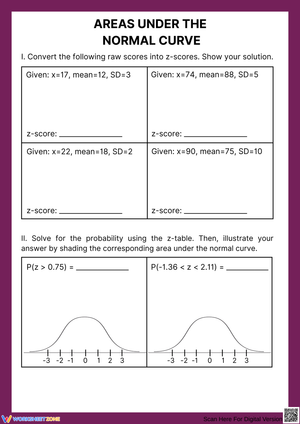
The statistics worksheets move past mean and median into standard deviation, normal distribution interpretation, and data-claim analysis. Problems draw from contexts students recognize — polling results, health research summaries, sports performance data — because students engage more readily when the numbers come from somewhere real. The probability worksheets begin with fundamental counting principles and build through permutations, combinations, and conditional probability to expected value. Students practice both calculation and interpretation, writing conclusions in plain language rather than just circling an answer.
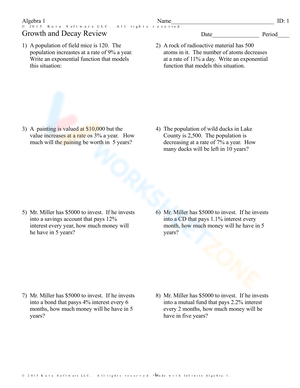
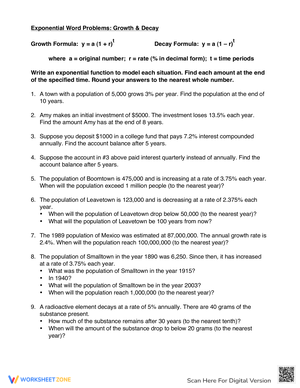
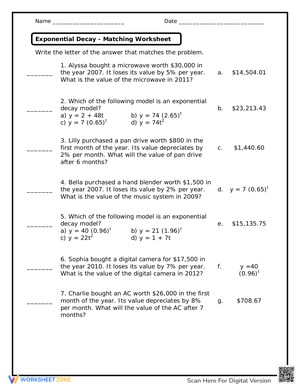
Discrete math worksheets cover set operations, three-set Venn diagrams, and the foundational vocabulary of graph theory: vertices, edges, paths, and connectivity. Truth tables and symbolic logic get their own worksheets, building from simple connectives through compound statements to the identification of valid argument forms such as modus ponens and modus tollens. The financial math worksheets address compound interest (including monthly and quarterly compounding), loan amortization, and budget construction. The numbers are realistic — a $12,000 car loan at 6.9% over 48 months, not a hypothetical round-number scenario — which gives students a chance to see how the formulas connect to decisions they will actually face.
Fitting These Worksheets Into Your Senior Year Lesson Plans
Senior year schedules are crowded, and these topics rarely own a dedicated block. The most effective approach is distributing them across the term rather than stacking them into a single unit. A weekly statistics warm-up — ten minutes at the start of class on Thursdays, for instance — keeps data interpretation skills active without eating into primary instruction time. Logic and truth table worksheets are naturally self-contained and work well during the last 10–12 minutes of a period when there isn't enough time to start something new but students need to stay engaged.
Teachers building a standalone senior elective or a life-skills math course get more flexibility. Ordering worksheets by cognitive demand rather than subject tends to work better than a strict topic-by-topic sequence: financial math first because students bring prior context about money, then probability, then discrete math, then formal logic. The 12th grade others math worksheets printable are also well-suited to small-group sessions where one student talks through their process aloud — particularly in probability, where the reasoning behind each step matters more than the arithmetic.
Errors Students Make That Are Worth Anticipating
Probability produces the most consistent error patterns. Students who know the multiplication rule for independent events — P(A and B) = P(A) × P(B) — apply it reflexively even when events are dependent. Ask students to find the probability of drawing two red cards without replacement from a standard deck, and many calculate (26/52) × (26/52) rather than (26/52) × (25/51). The denominator doesn't change in their minds because they haven't tracked what "without replacement" actually does to the remaining sample space.
Standard deviation trips students up at the final step. The variance calculation is complex enough that students feel finished when they land on a number. A significant share of student work in this area shows variance reported as the standard deviation — the square root step simply never happened. Building each worksheet to require students to label variance and standard deviation as separate steps catches this before it becomes a habit.
In the logic worksheets, affirming the consequent is the most persistent misconception. Students read "If P, then Q. Q is true. Therefore P is true." and mark the argument valid at surprisingly high rates — this isn't careless, it reflects a genuine gap in understanding how conditional statements work directionally. In financial math, compound interest generates a specific misapplication: students enter the annual rate without adjusting for the compounding period. For monthly compounding, they write A = 10000(1 + 0.06)^(12 × 5) rather than A = 10000(1 + 0.06/12)^(12 × 5). The resulting answer is several hundred dollars off — a difference that means something when the context is a real loan.
Standard Alignment
The statistics and probability worksheets align directly with the CCSS High School Statistics and Probability domain. HSS.ID.A.4 targets using mean and standard deviation to fit a normal distribution and estimate population percentages — the same skill students practice when they interpret z-scores and shaded regions on bell curves. HSS.CP.A.3 and HSS.CP.B.8 address conditional probability and the general multiplication rule, covering both the independent and dependent event problems the probability worksheets build toward. HSS.MD.B.5 connects to expected value problems that ask students to evaluate decisions under uncertainty.
Discrete mathematics has no dedicated CCSS strand, which is part of why it disappears from most senior-year curricula — and why these worksheets address a real gap. The logic and set-theory worksheets tie most directly to Mathematical Practice Standard MP.3 (construct viable arguments and critique the reasoning of others), a process standard that cuts across all content areas. Financial literacy alignment varies by state: many states have adopted standalone financial literacy graduation requirements in recent years, and the compound interest, credit, and budgeting worksheets map onto those state-level standards even where CCSS does not address them explicitly.
Adapting These Worksheets for Mixed-Level Senior Classes
Students arriving in senior year with gaps in Algebra II — particularly in working with exponents and rational expressions — will hit a wall on the financial math worksheets if handed them cold. Providing a reference sheet with the relevant formulas (compound interest, future value of an annuity) is usually enough; the problems don't require algebraic manipulation beyond that, but the formulas are unfamiliar enough that students freeze trying to reconstruct them from memory. Starting these students with truth tables and logic worksheets often works well as an entry point, since that content rewards careful step-by-step thinking and doesn't depend on prior math coursework.
Students who have already completed AP Statistics will recognize the statistics vocabulary immediately. For them, the more productive challenge is the open-ended writing tasks — most worksheets in this strand include at least one question asking students to draft and evaluate a statistical claim, which demands analytical thinking the procedural problems don't require. The 12th grade others math worksheets printable in the discrete mathematics strand tend to offer the most genuine challenge even for strong students, because formal logic and graph theory rarely appear anywhere in the standard K–12 sequence regardless of track.
Frequently Asked Questions
Do students need a calculus or AP Statistics background to use these worksheets?
No. The statistics worksheets assume familiarity with basic descriptive statistics — mean, median, and some exposure to standard deviation — which most seniors have encountered by the end of junior year. Probability builds from counting principles rather than calculus-based distributions. Students in a non-AP senior math course, a college-and-career-readiness elective, or an independent study course work through this material without any calculus background.
How much do these probability worksheets overlap with AP Statistics content?
There is vocabulary overlap — conditional probability, expected value, normal distribution — but the treatment differs. AP Statistics covers hypothesis testing through p-values, significance levels, and test statistics. These worksheets introduce those ideas conceptually without the full inferential statistics apparatus. Teachers running an AP course can use the 12th grade others math worksheets printable for extra reps on foundational probability or as review before the exam, though they are not a substitute for AP-level instruction.
Can the financial math worksheets be used outside of a designated math class?
Yes. These worksheets work in advisory periods, senior seminar courses, and college-and-career-readiness electives. The entry point is always the real-world situation — reading a loan disclosure, comparing two savings accounts, analyzing a monthly budget — and the math is embedded in that context rather than presented as an abstract exercise. Students who regularly ask "when will I use this?" tend to engage with these without much prompting because the answer is obvious from the worksheet itself.
Are answer keys included?
Yes. Each worksheet comes with a full answer key that shows the complete solution process, not just final answers. For multi-step problems in probability and financial math especially, seeing the intermediate steps is often more informative than checking whether the last number is correct — that's where the reasoning errors actually show up.