12th Grade Graphing Polar Coordinates Worksheets PDF
These 12th grade graphing polar coordinates worksheets give precalculus teachers a structured way to move students from basic point plotting into the more demanding work of equivalent representations, negative radius values, and simple polar equation graphs — all within a single unit sequence. The set spans introductory grid practice through mixed review, so teachers can choose the right worksheet for each stage of instruction rather than adapting one general-purpose page to every lesson.
The Specific Skills Targeted
Polar coordinate work in Grade 12 covers more ground than most students expect when they first see a polar grid. Each worksheet in the set targets a distinct layer of that skill progression:
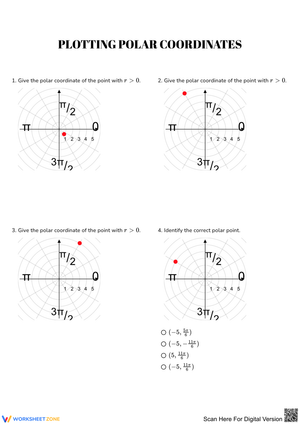
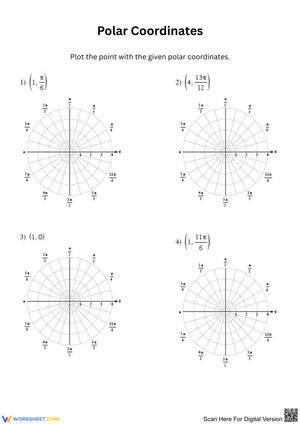
- Plotting ordered pairs (r, θ) on a labeled polar grid using degree measures, with angle increments of 15° and 30° depending on the worksheet.
- Graphing points where r is negative — locating the point in the direction opposite the given angle rather than along it.
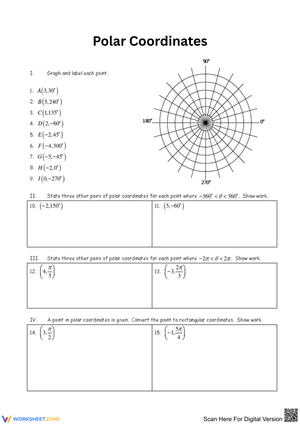
- Writing two or more valid polar names for a single location, including forms that differ by 360° and forms that use a negative radius with an adjusted angle.
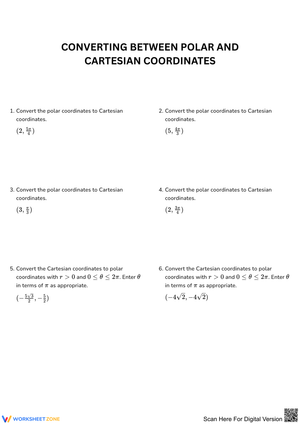
- Converting between polar and rectangular coordinates in both directions, with exact values and simplified radical forms expected on later worksheets.
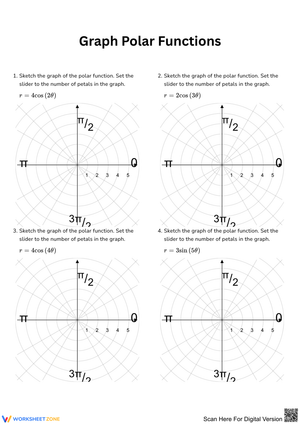
- Sketching simple polar curves — circles of the form r = a, limaçons, and four-petal roses — by plotting enough points to confirm curve shape.
- Error analysis items where students identify and correct a misplotted point or a flawed conversion, explaining the mistake in writing.
That last skill type is worth selecting deliberately. Error analysis asks students to articulate reasoning rather than just produce an answer, and the written explanation often reveals whether they understand the structure of the coordinate system or have been following a memorized sequence of steps.
Standard Alignment
These worksheets align to the precalculus expectations associated with the Trigonometric Functions and Polar Coordinates domain in state-level Grade 12 mathematics standards, which broadly correspond to the content framing in CCSS-adjacent courses under HSF and HSG standards addressing trigonometric relationships and coordinate system fluency. More specifically, conversion between polar and rectangular forms and graphing polar curves addresses the cross-representation reasoning built into standards that require students to interpret expressions and functions in multiple coordinate forms. Teachers in states using a dedicated precalculus standards document will find the skill sequence matches typical pacing for the polar unit, which generally falls in the third or fourth quarter of the course.
Frequent Student Errors Worth Watching For
The most consistent error in student work with polar coordinates is the negative radius reversal. Students who understand the concept in isolation will still default to the wrong direction mid-problem, especially when the worksheet mixes positive and negative radius values in rapid sequence. A student plots (3, 120°) correctly, then plots (-3, 120°) in exactly the same spot — not because they forgot the rule, but because the angle is so visually prominent that the sign of r doesn't register as a location decision. Having students lightly draw the full angle ray and explicitly label "opposite direction" before placing the point slows this error down considerably on early worksheets.
The second pattern that surfaces regularly involves equivalent representations. Students who can write (r, θ + 360°) as a valid alternate name often stop there. They do not recognize that (-r, θ + 180°) also names the same point, and when an assessment asks for two alternate names, they produce two coterminal forms and consider the task complete. The worksheets address this by requiring both types of alternate names on specific items, with answer key notes flagging partial-credit responses that show only one family of equivalents.
A subtler error appears during rectangular conversion: students who correctly recall x = r cos θ and y = r sin θ will misapply the inverse — computing θ = arctan(y/x) without checking the quadrant, then placing the angle in Quadrant I even when the original point was in Quadrant III. This one is hard to catch without seeing the student's work because the numerical answer looks plausible. The conversion worksheets include a required quadrant check step for this reason.
Building These Worksheets Into Lesson Plans
A three-part lesson structure works well across most of these worksheets. Open with a five-minute plotting warm-up using four to six points — no negative radius values yet if the class is still in early instruction. Use that time to circulate and identify students who are reading angle direction incorrectly; those students need a quick redirect before moving forward, because the error compounds fast. The main portion of the lesson uses a longer worksheet for guided or partner practice, with the conversion section handled after graphing is stable. Close with a two- or three-item exit ticket pulled from the worksheet's final section — one plotted point, one alternate name, and one conversion problem is enough to give a clear read on where each student stands.
For the days when graphing polar curves is the focus, a station rotation keeps momentum better than a single long worksheet. One station handles curve plotting from a table of values, a second handles identifying a curve type from its equation form, and a third uses matching tasks — students pair equations to their graphs on a printed polar grid. Each station runs about ten minutes. The physical act of moving between stations also resets attention during a concept that can feel abstract and tiring.
Homework pages in this set are designed conservatively — eight to ten items rather than twenty — because polar coordinates reward careful attention to each problem over rapid repetition. A student who works through eight problems deliberately, checking radius sign and angle direction on every item, consolidates more than one who rushes through twenty and reinforces errors along the way.
Adjusting the Worksheets for a Range of Learners
For students still building confidence with angle measure, the introductory worksheets include a labeled reference ring showing 30°, 45°, 60°, 90°, and their equivalents around the full circle. That reference shrinks the working memory load during early practice, which is appropriate — the goal at that stage is fluency with the polar grid structure itself, not simultaneous recall of all standard angles. As students stabilize, the reference can be removed.
Students who are ready to move faster can shift to worksheets that include radians alongside degrees. Rather than converting every angle first, these students work directly in radian form, which is the better preparation for calculus. A few worksheet items also extend to three-petal and five-petal rose curves, where predicting petal count from the equation becomes part of the task.
For students who struggle with the plotting mechanics but understand the conceptual structure, the error analysis items are often a better fit than additional graphing problems. Those students can explain what went wrong in a misplotted point accurately, and building from that strength tends to transfer back to plotting more reliably than repeated procedural drill does.
Frequently Asked Questions
Do these worksheets use degrees, radians, or both?
The introductory and on-level plotting worksheets use degrees. Later conversion and curve-graphing worksheets introduce radian forms for teachers whose course pacing includes both. The answer keys are written for whichever form the worksheet uses, so there is no ambiguity during checking.
How do these worksheets handle the ambiguity of multiple correct answers?
Items that have more than one valid answer are marked in the key, and the acceptable answer set is listed explicitly. On free-response conversion items where quadrant placement affects the angle value, the key walks through the quadrant check step so teachers can see exactly where a student's work diverged from the correct path.
Are these worksheets appropriate for students who have not yet studied radians?
Yes. The degree-only worksheets stand completely on their own and do not require radian fluency. Teachers can use the full degree sequence first, then revisit selected worksheets with radian forms once that content has been introduced.
Clear All