Addition PDF Worksheets for 11th Grade: Printable Math Review for High School Classrooms
These addition pdf worksheets for 11th grade address something teachers in high school math recognize immediately: at this level, addition is rarely a standalone skill. It surfaces mid-problem inside polynomial operations, radical simplification, complex number arithmetic, and matrix work—usually without being labeled as "addition" at all. Each worksheet in the set isolates one of those embedded steps so students can practice it directly before it appears inside something longer and more complicated.
What the Set Covers
The skill range spans the standard Grade 11 algebra sequence. Students adding polynomials underline like terms before combining—a habit that matters more than it seems when expressions carry four or five terms and mixed exponents. Radical addition worksheets require students to confirm shared radicands before writing the combined expression rather than applying a rule by reflex. The complex number worksheets organize real and imaginary components into separate columns, which substantially reduces the sign errors that appear when students try to track both parts inside a single line of work. Matrix addition worksheets address cell-by-cell correspondence, a structural concept students absorb faster when it is isolated from multiplication and determinants.
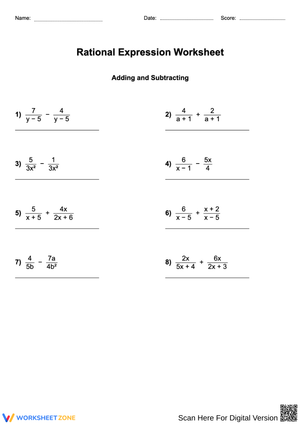
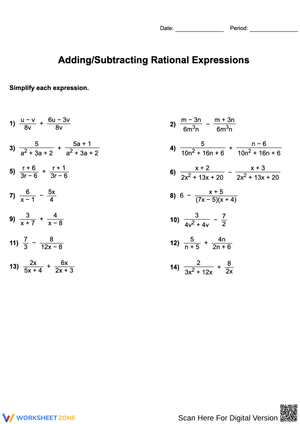
The set also covers adding rational expressions after establishing a common denominator. In that skill, the denominator work is where most errors actually live—once students reach the addition itself, they are often accurate. A worksheet that slows each phase down and makes the sequence visible is worth having in any course where rational expressions appear before a unit assessment.
Frequent Student Errors Worth Watching For
The most consistent error across all addition types at Grade 11 is combining unlike terms because they share a surface feature. A student who adds 4x² + 7x² without any trouble will often write 4x² + 7x = 11x², collapsing the terms because the variable looks close enough. The same logic produces √5 + √3 = √8 in radical work—radicands treated as coefficients and simply summed. These worksheets surface that error clearly because the problem type is controlled. When several students miss the same item, it signals a concept gap, not careless arithmetic.
Complex number addition carries its own failure mode. Students usually handle the real parts accurately but drop or flip the sign on the imaginary component when a negative is embedded inside parentheses. In a problem like (6 + 2i) + (3 - 9i), many students write 9 + 7i rather than 9 - 7i—they treat both imaginary coefficients as positive and add the absolute values. That specific error appears persistently enough in student work that it is worth a short annotation step before assigning the worksheet independently: ask students to circle the sign attached to each imaginary term before they add anything.
How to Build These Worksheets Into Your Lesson Plans
The most efficient pattern is to assign one worksheet per skill category as a cold diagnostic—give it before any formal review, at the opening of a new sub-topic. What you see in that first round tells you which students need a reteaching loop and which are ready to move into mixed practice. Then return to a second worksheet in the same category three to four days later as a spaced retrieval check. That two-pass routine runs roughly 15 minutes total across two class days and produces cleaner readiness data than a single item buried in a unit test.
Station rotations are another natural fit. Because each worksheet carries complete directions and a clean answer key, students at an independent station can self-check without waiting. That frees the teacher for the small-group station where direct instruction is actually needed. Addition pdf worksheets for 11th grade in this format also work as sub plans without extra preparation—the directions are explicit, the answer key is included, and the layout stays stable whether the worksheet is printed or projected.
Standard Alignment
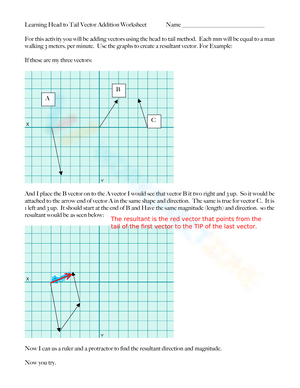
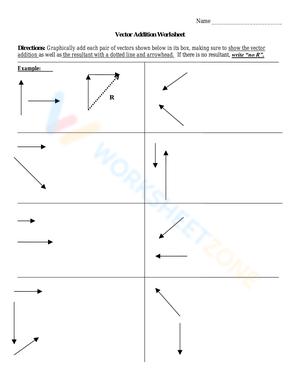
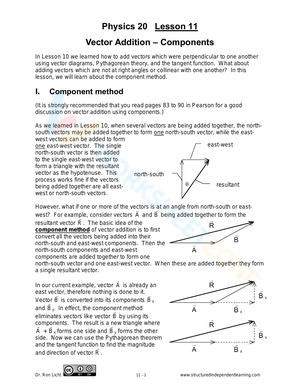
Several worksheets align directly to high school CCSS standards. Polynomial addition practice connects to HSA-APR.A.1, which addresses operations on polynomials including addition and subtraction. In most 11th-grade courses, this standard appears in the opening weeks of an algebra or precalculus unit—often treated as a quick review—but when student data shows fluency gaps, these worksheets slow the pace down productively. Complex number addition aligns to HSN-CN.A.2, which explicitly includes adding complex numbers in standard form. Vector and matrix addition fall under the HSN-VM domain, specifically HSN-VM.B.4 for vector addition and HSN-VM.C.8 for matrix operations. Not all state curricula reach those standards in Grade 11, but for courses that do, targeted worksheet practice on those operations is scarce enough that having the resource ready saves real planning time.
Adjusting the Set for a Range of Learners
Grade 11 classes routinely span two or three years of algebraic readiness in the same room. The most practical way to manage that without rebuilding the entire assignment is to sort the worksheets by structural complexity rather than by topic. Students who need direct review work with expressions that have clearly visible like terms and no embedded negatives. On-level students tackle standard algebraic forms—polynomials, radicals, complex numbers—in problems that require two or three organized steps. Students ready for a stronger challenge work with multi-part expressions that mix types or require simplification after combining.
- Intervention and resource settings: Use worksheets with worked examples at the top and wider spacing between problems. Fewer items per worksheet, one skill type, no mixed formats.
- On-level groups: Assign standard addition worksheets across the core algebra topics, rotating the skill focus across the week.
- Advanced students: Extend with multi-step expressions that embed addition inside a larger simplification task—for example, adding two polynomial expressions and then factoring the result.
Addition pdf worksheets for 11th grade also serve SPED and co-taught classes well because the format is consistent and predictable. When the layout and direction structure stay the same across worksheets, students spend less mental effort reading the task and more effort doing the math—a concrete advantage for students who process print-heavy material slowly.
Frequently Asked Questions
What types of addition show up on Grade 11 math worksheets?
At this level, basic computation is not the focus. The worksheets cover polynomial addition, radical expressions with matching radicands, complex numbers in standard form, rational expressions with common denominators, and—in courses that reach those standards—vectors and matrices. Each involves addition as a step inside a larger algebraic framework rather than as a terminal operation.
Are these worksheets appropriate for intervention or resource room use?
Yes, and that is one of their most practical applications. The controlled format—one skill type per worksheet, explicit directions, clean layout—suits settings where students need consistent structure and reduced working memory demand. Teachers can pull a single worksheet for a 10-minute skill block without significantly adapting the material first.
Do the worksheets include answer keys?
Answer keys are included with the set. That feature matters most for station work, homework review, and sub plans. When students self-check at the end of a worksheet, the errors that remain are the most informative ones—because those are the mistakes students could not resolve on their own.
How do these fit into a course that moves quickly through algebra review?
The most productive role for addition pdf worksheets for 11th grade in a fast-paced course is the cold diagnostic: assign one worksheet before review begins to identify which students need direct attention and which can move on. That 8-to-10-minute check at the start of a topic tells you more about student readiness than a written pre-assessment, and it takes no grading time when students self-check against the key.
Clear All