


























Views
Downloads

Grade 4 Area of a Parallelogram — Printable Worksheet
Paste this activity's link or code into your existing LMS (Google Classroom, Canvas, Teams, Schoology, Moodle, etc.).
Students can open and work on the activity right away, with no student login required.
You'll still be able to track student progress and results from your teacher account.
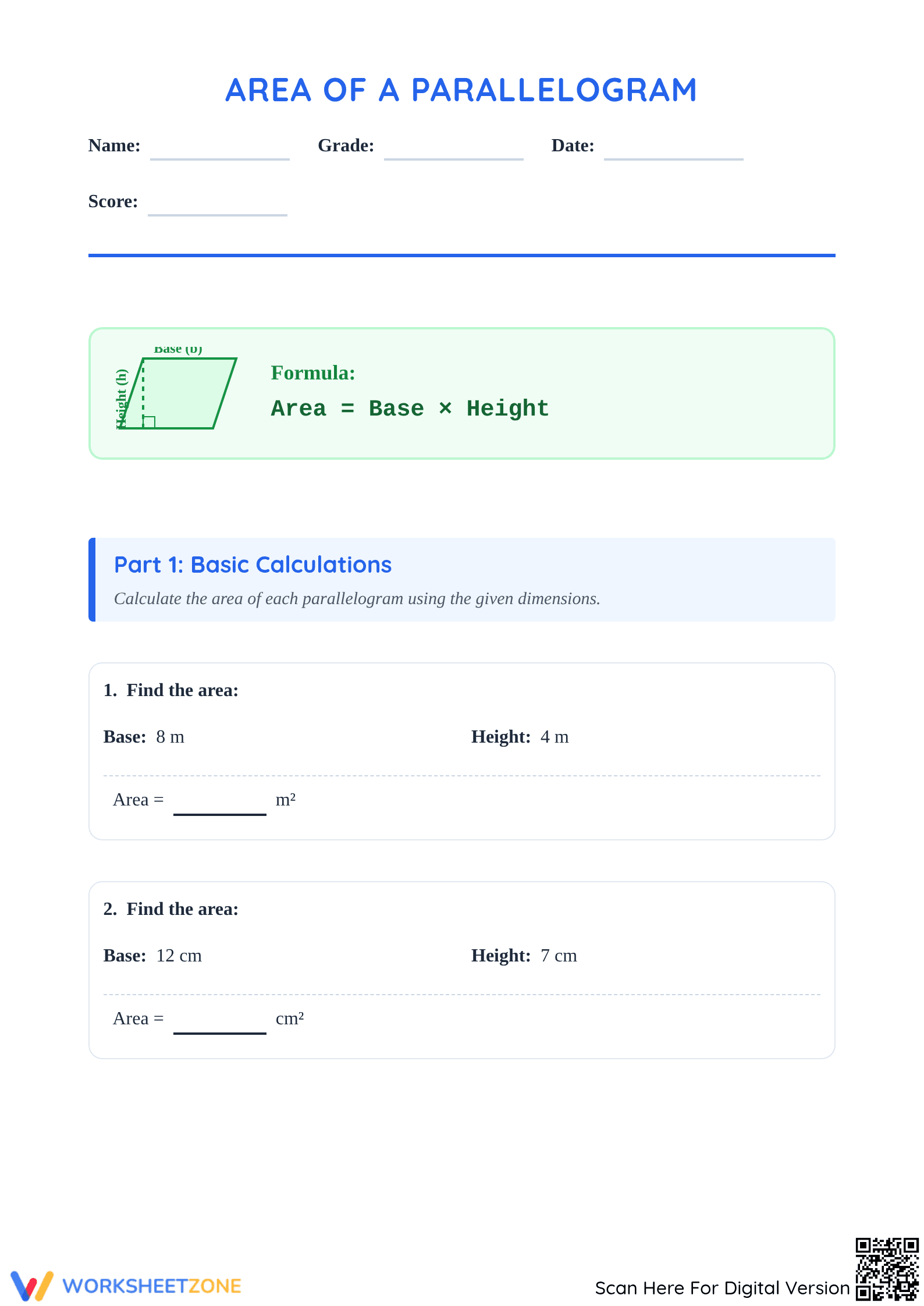
Calculating the area of a parallelogram is a fundamental geometric skill that bridges the gap between basic rectangular measurement and advanced spatial reasoning. This four-page worksheet guides Grade 4 students through the essential formula, ensuring they identify base and height to find area accurately. By practicing with diverse units, learners solidify their understanding of two-dimensional shapes.
At a Glance
- Grade: 4 · Subject: Math
- Standard:
CCSS.MATH.CONTENT.4.MD.A.3— Apply area formulas for rectangles to solve real-world mathematical problems- Skill Focus: Area of a Parallelogram
- Format: 4 pages · 12 problems · Answer key included · PDF
- Best For: Independent geometry practice and skill reinforcement
- Time: 25–40 minutes
What's Inside
This downloadable PDF packet contains four pages of content designed to build geometric mastery. Students solve 12 problems, starting with basic calculations and progressing to multi-digit dimensions and word problems. The worksheet features a clear formula reference and dedicated workspace for each calculation. A comprehensive answer key is included for rapid grading.
Zero-Prep Workflow
The zero-prep workflow follows three steps: first, print the four-page packet (1 minute); second, distribute the materials for student work (1 minute); and third, review using the answer key (5 minutes). With a total teacher prep time of under two minutes, this resource is an ideal solution for substitute plans or morning work.
Standards Alignment
The worksheet is aligned to CCSS.MATH.CONTENT.4.MD.A.3, focusing on applying area formulas to solve mathematical problems. It extends rectangular area concepts by introducing the base-times-height relationship. This standard code can be copied directly into lesson plans, IEP goals, or district curriculum mapping tools to ensure instructional consistency.
How to Use It
Utilize this resource for independent practice after introducing parallelogram properties. Encourage students to label the base and height in each diagram before calculating to prevent errors. As a formative assessment, observe how students handle different units of measurement. The activity typically takes between 25 and 40 minutes to complete.
Who It's For
This worksheet is for Grade 4 students expanding their knowledge of area, though it also serves as a review for Grade 5 learners. The formula reminder provides support, while the word problems challenge high-achieving pupils. It pairs naturally with an anchor chart or direct instruction lesson on quadrilaterals.
The primary standard addressed in this resource is CCSS.MATH.CONTENT.4.MD.A.3, which requires students to apply the area and perimeter formulas for rectangles in real-world and mathematical problems. While parallelograms are often introduced in later grades, this worksheet scaffolds the concept by demonstrating how the rectangular area formula (length times width) translates directly to the parallelogram formula (base times height). This instructional bridge is supported by research from Fisher & Frey (2014) on the gradual release of responsibility, where students move from basic calculations to complex word problems. By providing twelve structured tasks that utilize various units of measurement—including meters, centimeters, and inches—this worksheet ensures that learners develop a flexible understanding of geometric properties. The inclusion of multi-step word problems further aligns with the NAEP 2024 framework for mathematical literacy, emphasizing the application of geometric formulas to solve practical, real-life scenarios effectively.


