




























Views
Downloads

Area of a Parallelogram Worksheet | Essential Grade 6 Math

Paste this activity's link or code into your existing LMS (Google Classroom, Canvas, Teams, Schoology, Moodle, etc.).
Students can open and work on the activity right away, with no student login required.
You'll still be able to track student progress and results from your teacher account.
This comprehensive Grade 6 geometry worksheet provides targeted practice for finding the area of a parallelogram. Students progress through 14 structured problems, moving from basic formula application to solving for missing dimensions and real-world word problems. By mastering this essential skill, learners build a strong foundation for more complex spatial reasoning and geometric measurement.
At a Glance
- Grade: 6 · Subject: Math
- Standard:
CCSS.MATH.CONTENT.6.G.A.1— Find the area of special quadrilaterals by composing into rectangles or decomposing into triangles- Skill Focus: Area of Parallelograms (Base x Height)
- Format: 3 pages · 14 problems · Answer key included · PDF
- Best For: Small group instruction and independent practice
- Time: 25–35 minutes
What's Inside
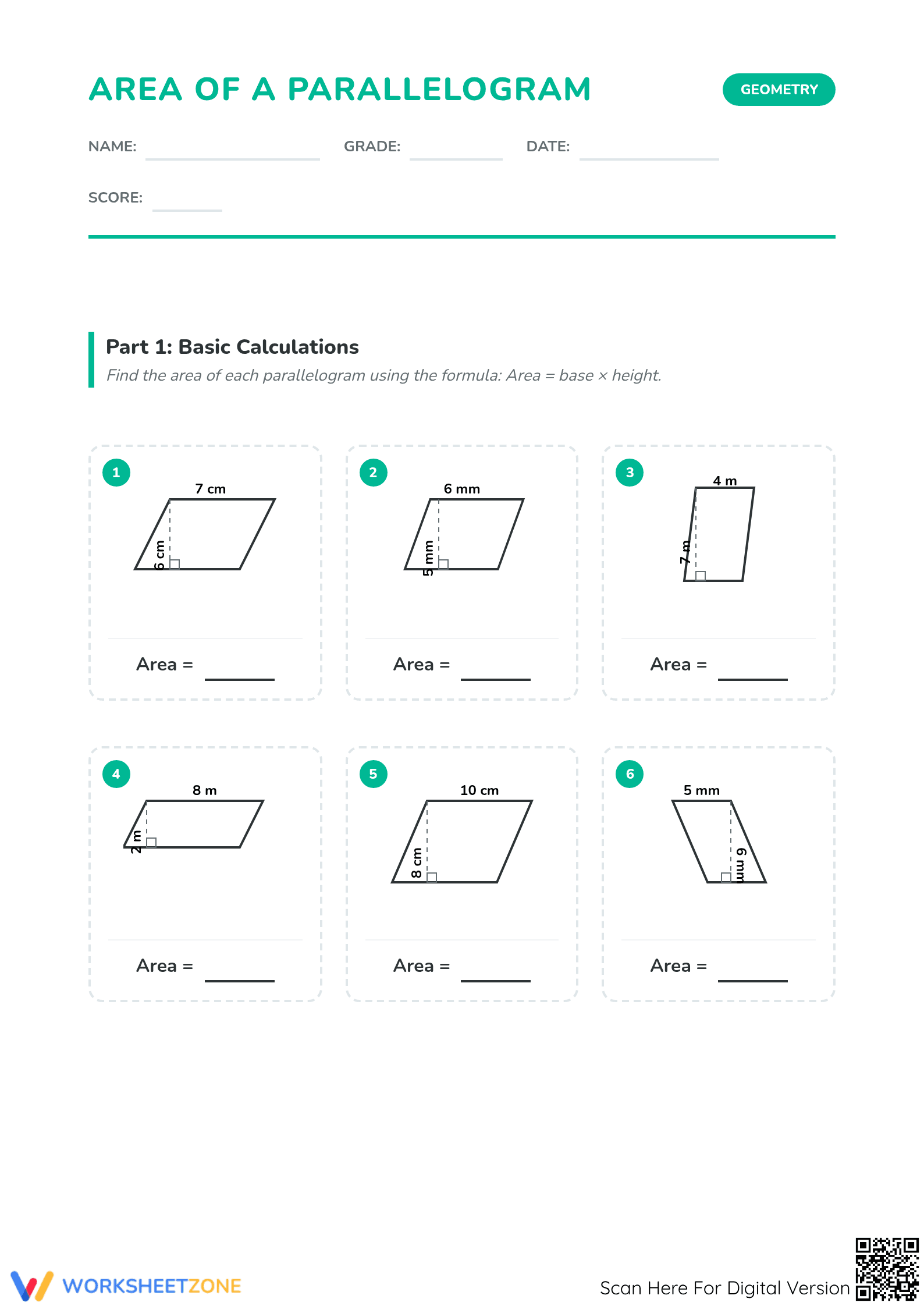
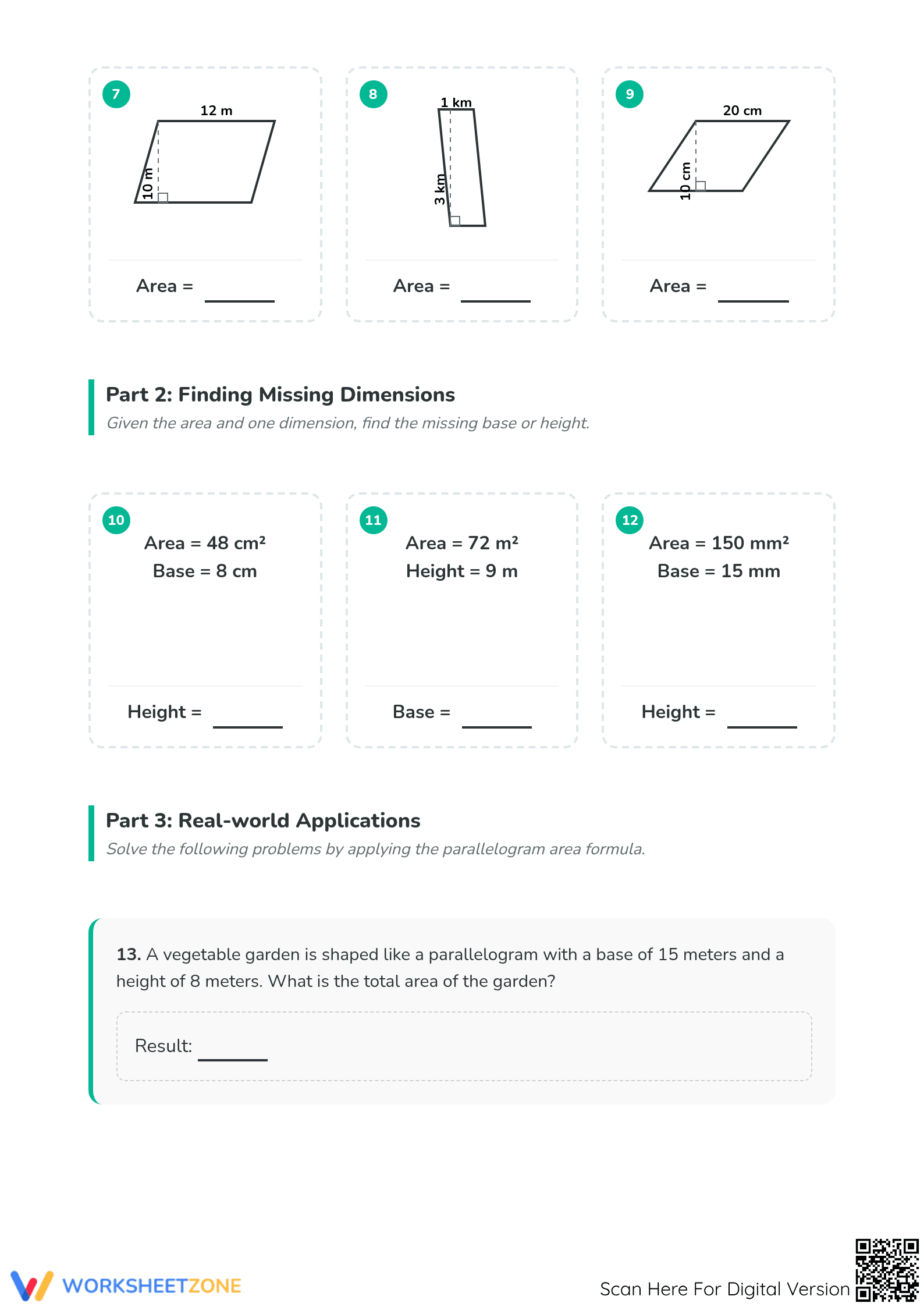
This 3-page PDF resource is organized into three distinct parts to support varied instructional needs. Part 1 features nine geometric figures where students identify the base and height to calculate the area using the provided formula. Part 2 challenges students to find missing dimensions given the total area. Part 3 concludes with multi-step real-world word problems. A full answer key is included for quick grading.
Skill Progression
- Guided Practice: Nine visual problems provide clear diagrams with labeled base and height measurements, allowing students to apply the area formula in a supported environment.
- Supported Practice: Three problems require students to find a missing dimension (base or height) when the total area is already known, bridging arithmetic and algebraic thinking.
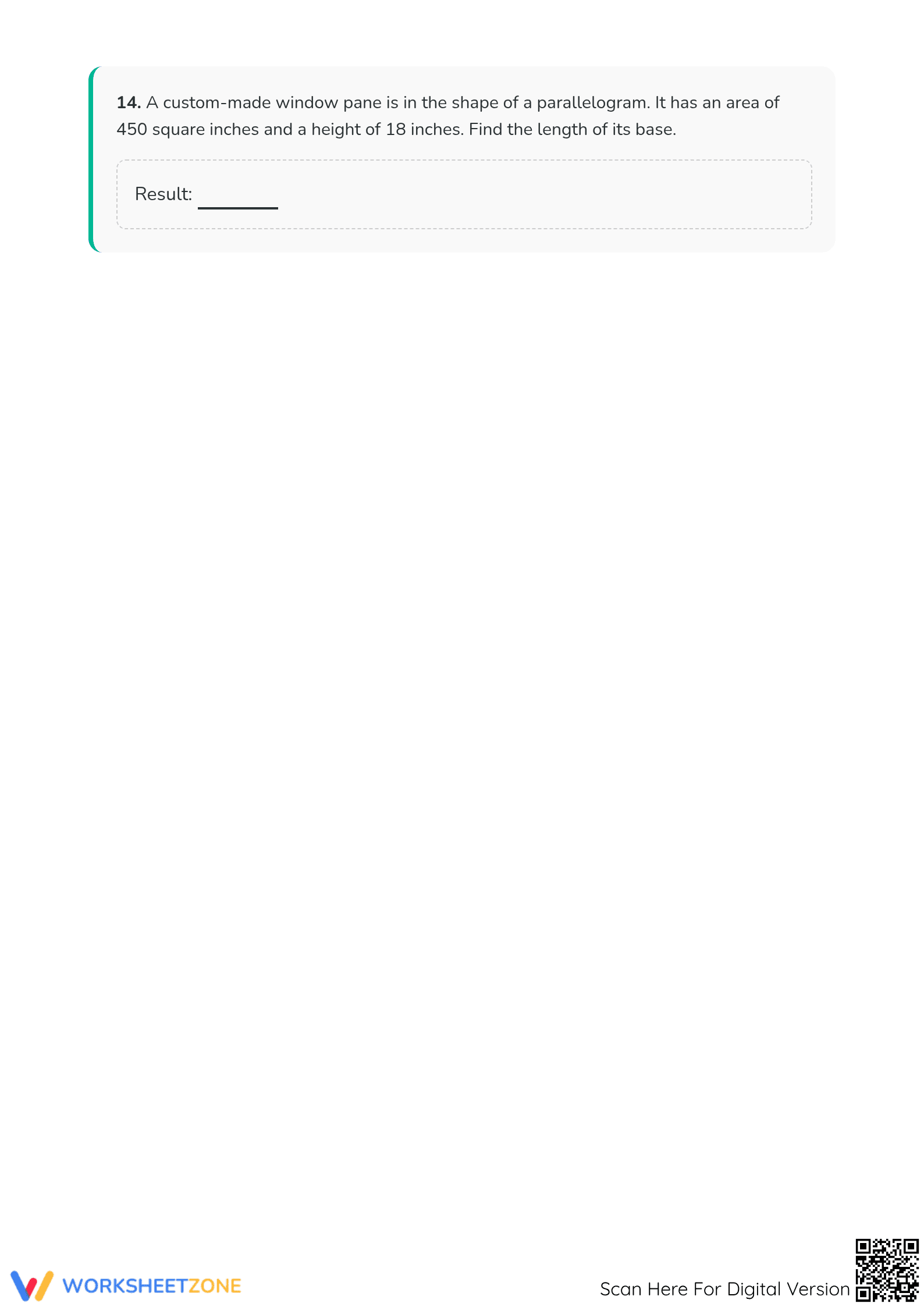
- Independent Practice: Two real-world word problems challenge students to extract numerical data from text and solve complex geometric scenarios without visual cues.
This structure follows a gradual release model, ensuring students build confidence before tackling independent application tasks.
Standards Alignment
The primary focus of this resource is CCSS.MATH.CONTENT.6.G.A.1, which requires students to find the area of special quadrilaterals, including parallelograms, in mathematical and real-world contexts. It also supports understanding the relationship between base and height as perpendicular dimensions. Both standard codes can be copied directly into lesson plans, IEP goals, or district curriculum mapping tools.
How to Use It
Use this worksheet during the guided practice phase of your geometry unit. After introducing the area formula, have students complete the first page in pairs to check their work. Alternatively, use Part 3 as a formative assessment to observe how students translate verbal descriptions into mathematical equations. Expect most students to complete the entire set within 30 minutes of focused classroom work.
Who It's For
This resource is designed for Grade 6 students but serves as an excellent review for Grade 7 learners or a challenge for advanced 5th graders. It is particularly effective for students requiring visual scaffolds, as the initial diagrams use clear dashed lines to indicate height. Pair this with a physical geoboard or grid paper for a hands-on learning experience.
The CCSS.MATH.CONTENT.6.G.A.1 standard emphasizes finding the area of special quadrilaterals through composition and decomposition, a process that bridges basic measurement and formal algebra. This worksheet targets the specific student action of applying the parallelogram area formula (Area = base × height) across 14 varied problems. According to the RAND AIRS 2024 report on mathematical instructional materials, high-quality math resources must provide a balanced progression from procedural fluency to conceptual application to ensure long-term retention of geometric principles. By including both visual diagrams and text-heavy word problems, this resource ensures that students can navigate different representational forms of the same mathematical concept. This dual-coding approach is essential for building robust spatial reasoning skills in middle school. Educators can utilize the included answer key to provide immediate feedback, which is a critical component of formative assessment in Grade 6 mathematics classrooms.


