


























Views
Downloads

Essential Coordinate Geometry & Set Theory | Grade 9 Math
Paste this activity's link or code into your existing LMS (Google Classroom, Canvas, Teams, Schoology, Moodle, etc.).
Students can open and work on the activity right away, with no student login required.
You'll still be able to track student progress and results from your teacher account.
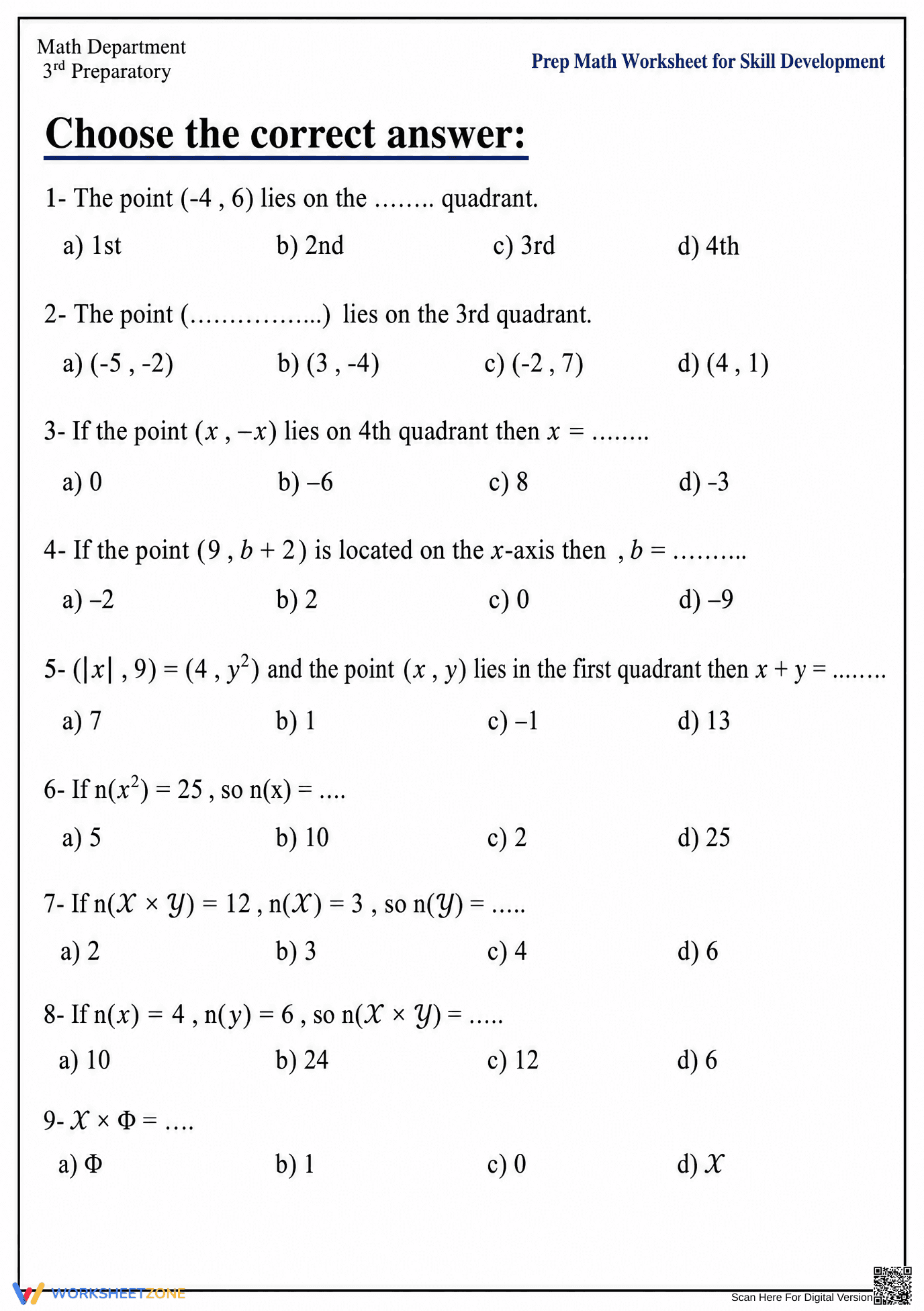
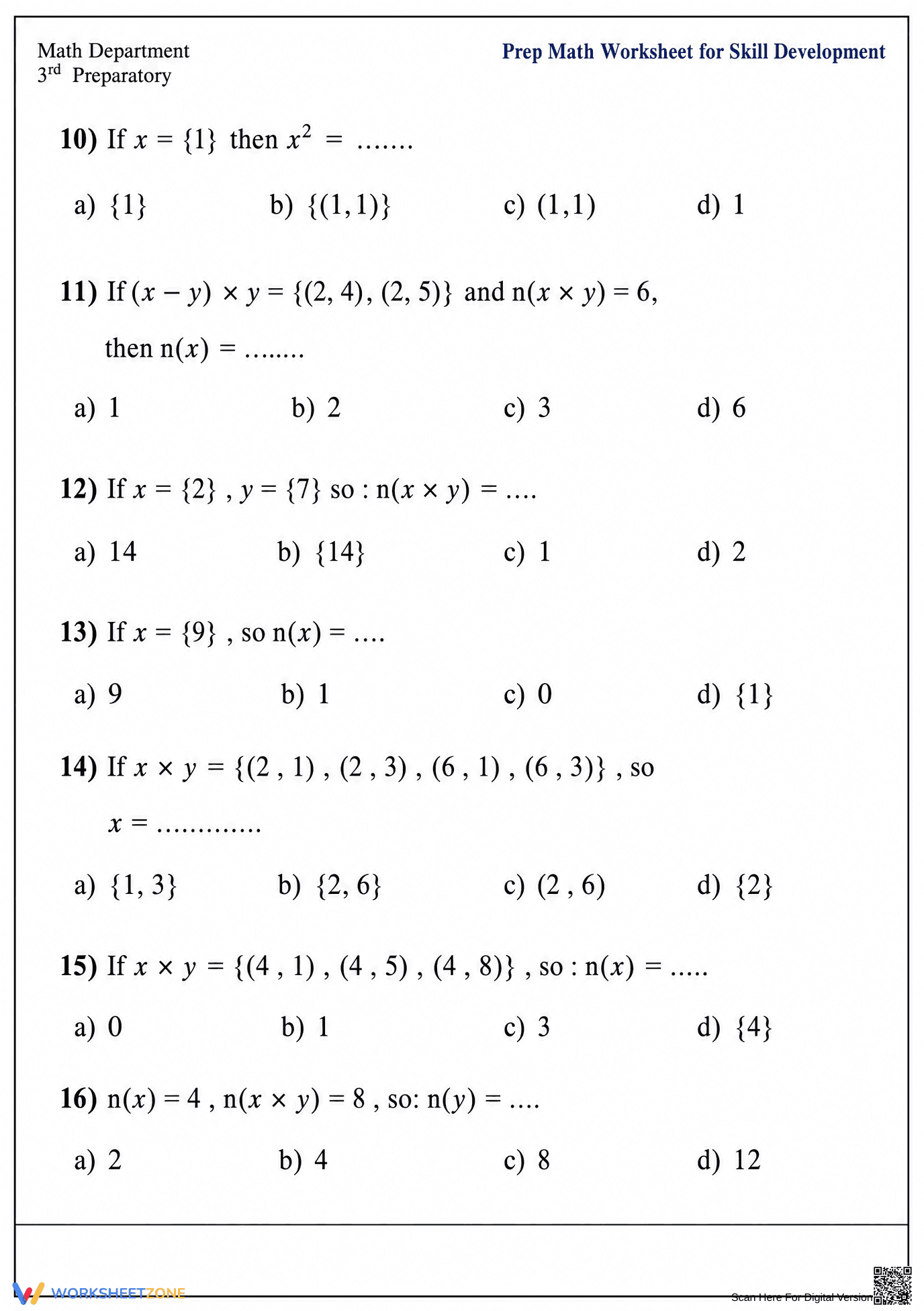
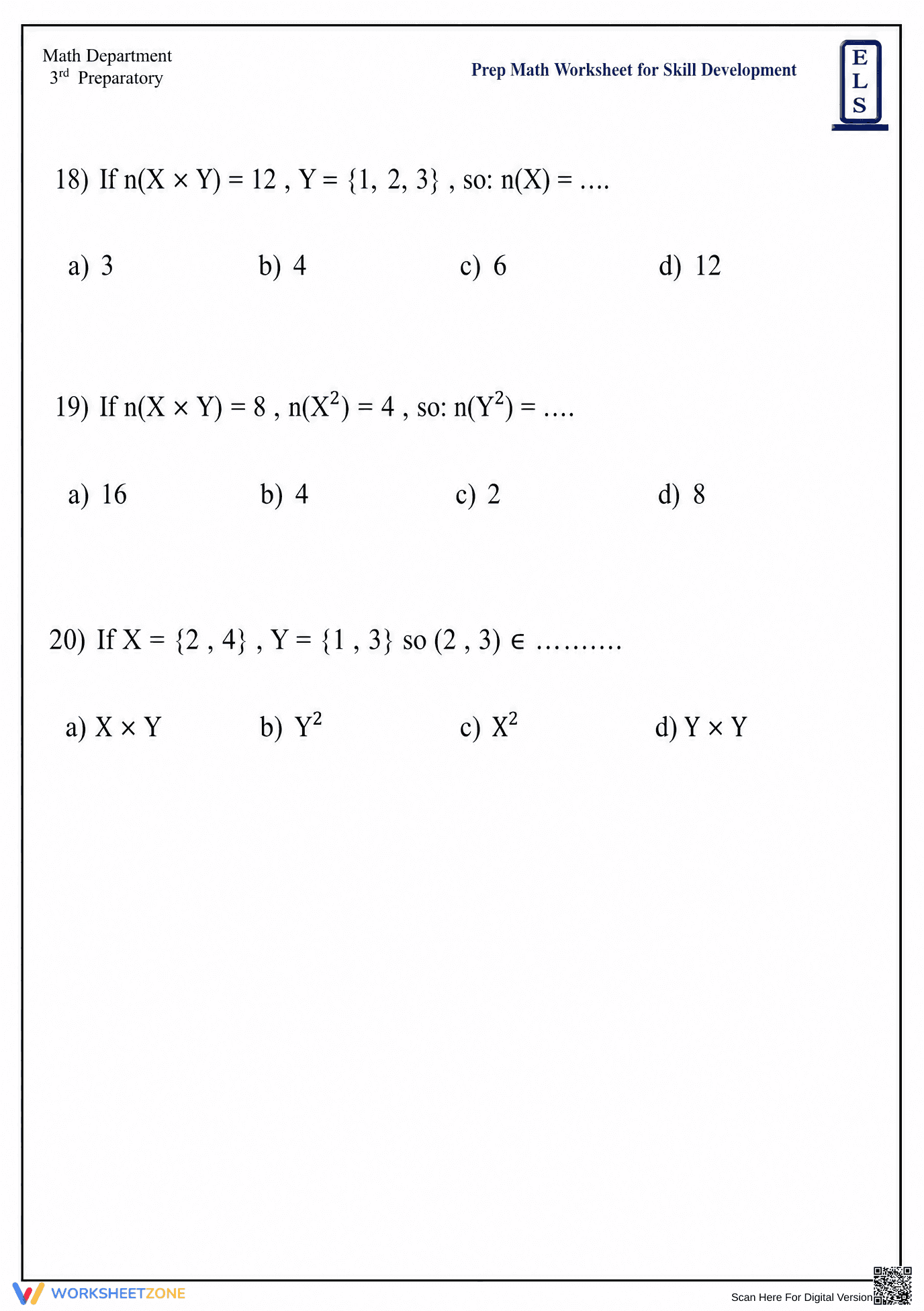
This Grade 9 math worksheet provides targeted practice in coordinate geometry and fundamental set theory. Students solve problems involving quadrant identification, point coordinates on axes, and Cartesian products. By completing these 19 multiple-choice questions, learners solidify their ability to translate geometric positions into algebraic representations and understand set cardinality.
At a Glance
- Grade: 9 · Subject: Algebra
- Standard:
HSG.GPE.B.4— Use coordinates to prove simple geometric theorems and identify point locations algebraically- Skill Focus: Coordinate Planes & Set Theory
- Format: 3 pages · 19 problems · Multiple Choice · PDF
- Best For: Independent practice and formative assessment
- Time: 25–35 minutes
The resource contains three pages of structured mathematical problems. The first section focuses on the coordinate plane, requiring students to identify quadrants for specific points and solve for variables when points lie on axes. The second half transitions into set theory, covering Cartesian products (X × Y), the number of elements in a set n(X), and set notation. The multiple-choice format allows for quick grading and immediate feedback.
Zero-Prep Workflow
This worksheet is designed for a zero-prep workflow to save teacher time. First, print the three-page PDF (30 seconds). Second, distribute the copies to students as a bell-ringer or exit ticket (1 minute). Finally, review the answers collectively using the clear multiple-choice options to identify common misconceptions (5 minutes). This resource is an ideal sub plan component because it requires no prior setup or specialized materials.
Standards Alignment
This worksheet aligns with `HSG.GPE.B.4`, which focuses on using coordinates to prove simple geometric theorems algebraically. It also supports `HSA.SSE.A.1` by requiring students to interpret the structure of algebraic expressions within the context of set operations and coordinate values. Both standard codes can be copied directly into lesson plans, IEP goals, or district curriculum mapping tools.
How to Use It
Use this worksheet as a mid-unit check for understanding after introducing the four quadrants and Cartesian products. During instruction, observe if students struggle with the sign conventions of the third and fourth quadrants (e.g., Question 2 and 3). It serves as an excellent formative assessment tool; if more than 20% of the class misses the set cardinality questions, a mini-lesson on n(X) notation is recommended. Completion typically takes 30 minutes.
Who It's For
This resource is tailored for Grade 9 and 10 students in Algebra 1 or Geometry courses. It is particularly effective for learners who need concrete practice with abstract set notation. Pair this worksheet with a coordinate plane anchor chart or a visual demonstration of Cartesian products to support visual learners and students receiving Tier 2 interventions.
Mathematical proficiency in high school requires a bridge between geometric visualization and algebraic manipulation, a core component of the HSG.GPE.B.4 standard. This worksheet addresses this by requiring students to identify point locations and calculate set dimensions, skills that Fisher & Frey (2014) identify as critical for developing mathematical literacy through scaffolded independent practice. Research from the RAND AIRS 2024 report suggests that frequent, low-stakes formative assessments using multiple-choice formats can significantly improve student retention of algebraic notation and coordinate rules. By isolating specific skills like Cartesian products and quadrant signs, this resource allows educators to pinpoint exact areas of struggle before moving to complex proofs. The 19-task structure provides sufficient repetition to move these concepts from short-term memory to long-term mastery, ensuring students are prepared for higher-level calculus and discrete mathematics.


