


























Views
Downloads

Why Do Leaves Change Colors? Printable Science Worksheet
Paste this activity's link or code into your existing LMS (Google Classroom, Canvas, Teams, Schoology, Moodle, etc.).
Students can open and work on the activity right away, with no student login required.
You'll still be able to track student progress and results from your teacher account.
This Grade 4 science resource provides a comprehensive look at the biological processes behind autumn foliage. Students explore how plants utilize sunlight and chlorophyll to create food, and why these processes shift as days shorten. By connecting reading comprehension with visual diagrams, learners gain a functional understanding of plant survival and seasonal adaptation.
At a Glance
- Grade: 4 · Subject: Science
- Standard:
4-LS1-1— Describe how internal plant structures like chlorophyll support growth and survival- Skill Focus: Photosynthesis and seasonal cycles
- Format: 3 pages · 10 problems · Answer key included · PDF
- Best For: Fall science units and sub plans
- Time: 30–45 minutes
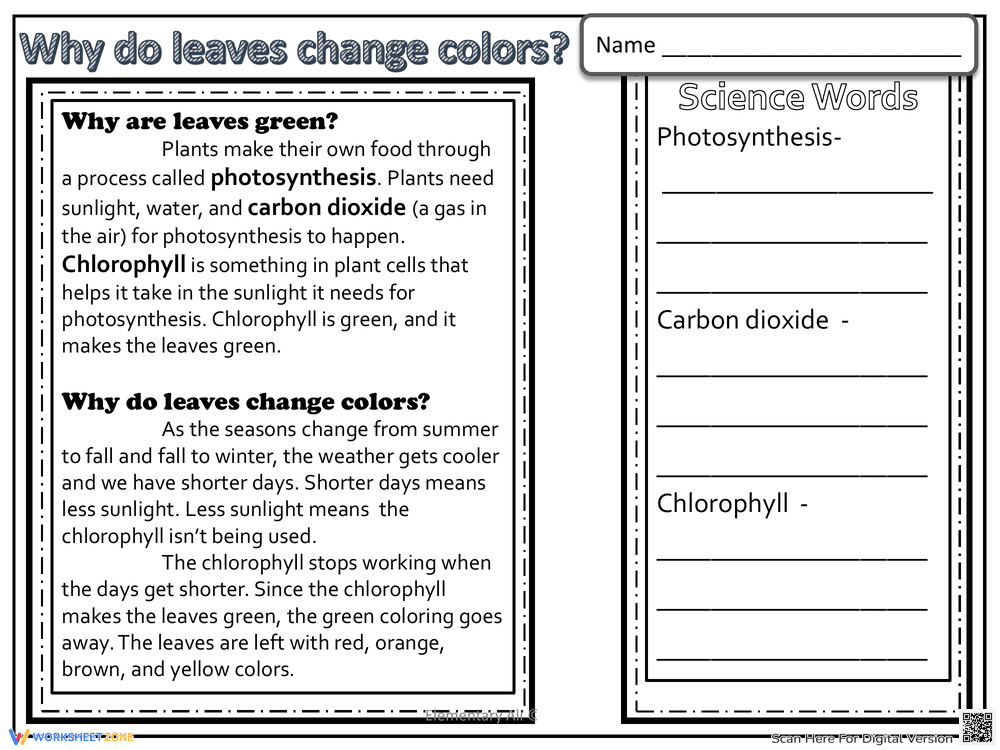
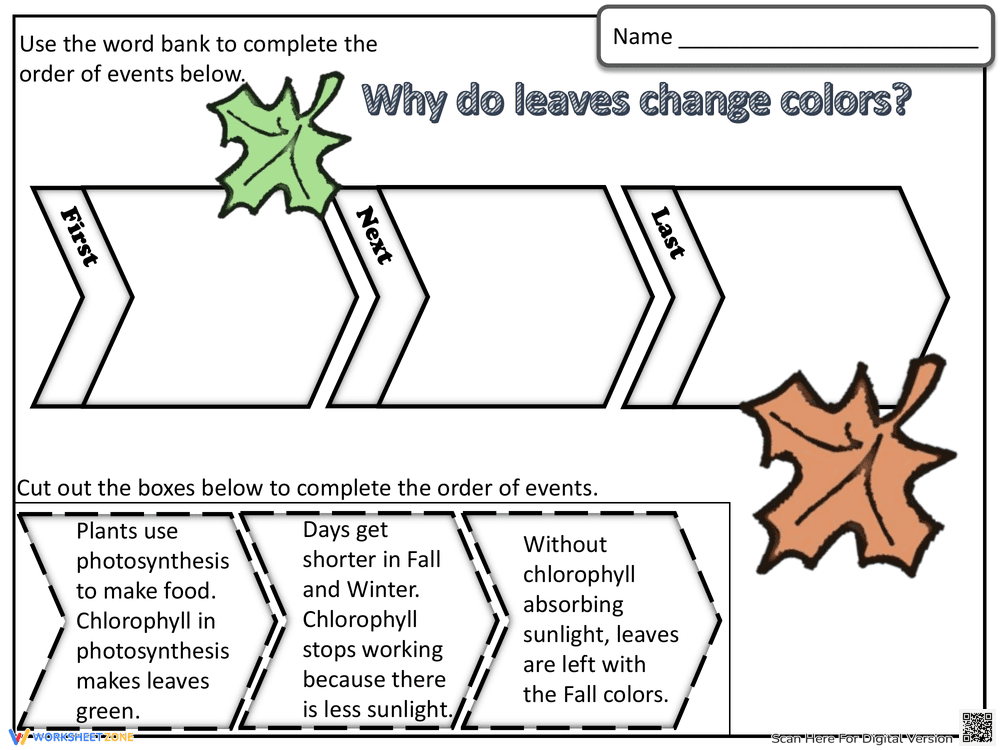
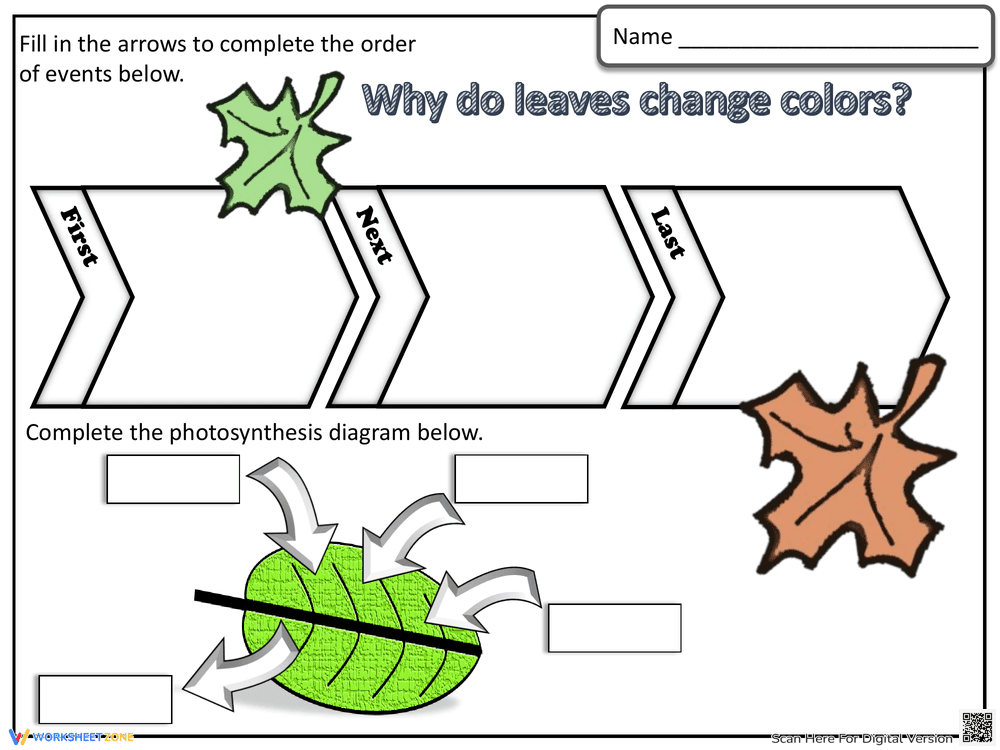
What's Inside: The packet contains three distinct instructional pages. The first features an informational text explaining photosynthesis, carbon dioxide, and chlorophyll, paired with a vocabulary definition section. The second page offers a "First, Next, Last" sequencing activity using cut-and-paste components to reinforce the order of seasonal change. The final page includes a detailed photosynthesis diagram for labeling, ensuring students can visualize the input of sunlight and water.
This resource is designed for a zero-prep classroom workflow. Step 1: Print the three-page PDF (30 seconds). Step 2: Distribute to students for independent reading and sequencing (2 minutes). Step 3: Review the diagram and vocabulary as a whole group using the provided answer key (5 minutes). Total teacher preparation time is under 2 minutes, making it an ideal emergency sub plan or Friday science activity.
Standards Alignment: This worksheet aligns with `4-LS1-1`, focusing on how internal and external structures of plants function to support survival and growth. It specifically addresses the role of chlorophyll in energy processing. Additionally, it supports CCSS.ELA-LITERACY.RI.4.3 by requiring students to explain events and scientific ideas based on specific information in the text. Both standard codes can be copied directly into lesson plans, IEP goals, or district curriculum mapping tools.
How to Use It: Use this worksheet during the "Explain" phase of a 5E lesson cycle. After an initial observation of changing leaves, provide the reading passage to build the necessary scientific vocabulary. It also serves as a strong formative assessment; observe students as they complete the photosynthesis diagram to identify misconceptions about plant inputs like carbon dioxide and sunlight. Completion typically takes 30 to 45 minutes.
Who It's For: This resource is tailored for upper elementary students, particularly in Grade 4 and Grade 5. It is highly effective for visual learners who benefit from the diagram labeling and the tactile nature of the cut-and-paste sequencing. Pair this worksheet with a physical leaf collection activity or an anchor chart showing the chemical equation of photosynthesis for a complete instructional experience.
Scientific literacy in the elementary years depends on the integration of informational text with visual models, a strategy supported by the Fisher & Frey (2014) framework for gradual release of responsibility. This worksheet addresses the 4-LS1-1 standard by requiring students to synthesize text-based evidence about chlorophyll with a functional diagram of plant energy systems. Research from the RAND AIRS 2024 report suggests that structured sequencing tasks, like the "First, Next, Last" activity included here, significantly improve a student's ability to retain complex scientific cycles. By defining key terms such as photosynthesis and carbon dioxide in context, the resource builds the Tier 3 vocabulary necessary for middle school science readiness. This multi-modal approach ensures that 4th-grade learners move beyond simple observation to a mechanistic understanding of how environmental changes trigger biological responses in local flora.


