


























Views
Downloads

Animal Habitat Worksheet | Essential Kindergarten Science
Paste this activity's link or code into your existing LMS (Google Classroom, Canvas, Teams, Schoology, Moodle, etc.).
Students can open and work on the activity right away, with no student login required.
You'll still be able to track student progress and results from your teacher account.
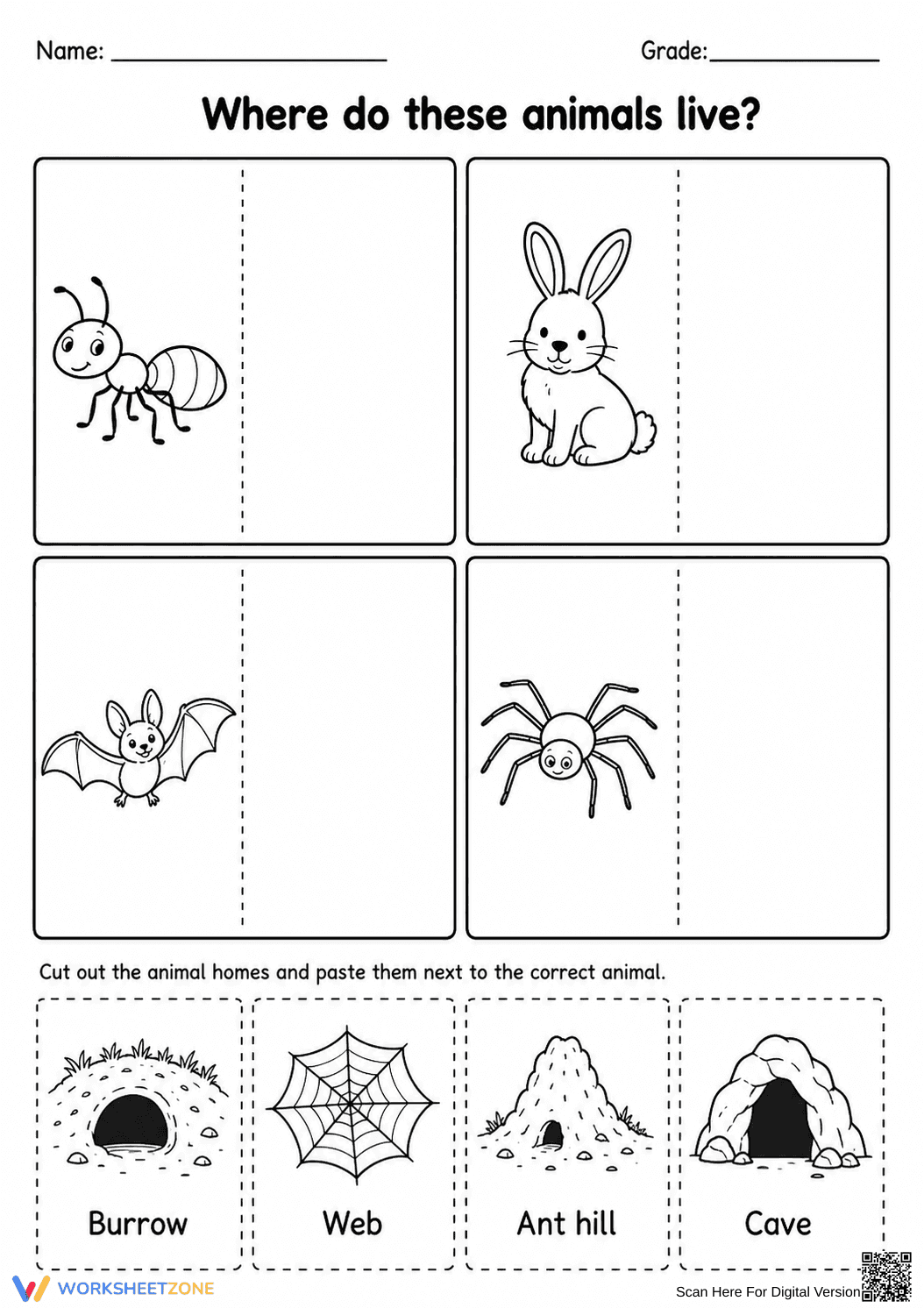
This Kindergarten animal habitat worksheet helps young learners identify and match living creatures to their natural environments. Students develop foundational biological knowledge by connecting specific animals to their homes through an interactive cut-and-paste format. This activity ensures children grasp the essential relationship between organisms and their surroundings before progressing to more complex ecological concepts.
At a Glance
- Grade: Kindergarten · Subject: Science
- Standard:
K-ESS3-1— Represent the relationship between animals and the places they live- Skill Focus: Animal habitats and environmental matching
- Format: 1 page · 4 problems · Answer key included · PDF
- Best For: Science centers and morning work
- Time: 10–15 minutes
What's Inside
This printable PDF features a single-page interactive activity where students analyze four specific animals: an ant, a rabbit, a bat, and a spider. The bottom of the page contains four labeled habitat options—burrow, web, ant hill, and cave—designed for cutting and pasting. The clear black-and-white illustrations are perfect for coloring, and the layout includes name and date fields for easy classroom management and student accountability.
Zero-Prep Workflow
- Step 1: Print: Select the single-page PDF and print enough copies for your group (30 seconds).
- Step 2: Distribute: Hand out the sheets along with scissors and glue sticks to your students (1 minute).
- Step 3: Review: Check the completed habitat matches as a whole-group activity or during individual student conferences (2 minutes).
This streamlined workflow makes it an ideal choice for emergency sub plans or last-minute science enrichment where teacher setup time must be kept under five minutes.
Standards Alignment
This worksheet is specifically aligned to K-ESS3-1, which requires students to use a model to represent the relationship between the needs of different plants or animals and the places they live. By matching the animals to their specific homes, students demonstrate their understanding of environmental adaptation and basic biological needs. Both standard codes can be copied directly into lesson plans, IEP goals, or district curriculum mapping tools.
How to Use It
Use this worksheet as a concluding activity during a lesson on "Living Things" to assess student understanding of habitats. It works exceptionally well in science centers where students can work independently or in small groups. During the activity, observe if students can name each habitat correctly before gluing; this provides an immediate formative assessment of their vocabulary development and conceptual mastery. Expected completion time is approximately 12 minutes.
Who It's For
This resource is designed for Preschool and Kindergarten students who are beginning to explore the natural world. The visual nature of the task provides excellent differentiation for English Language Learners and students with developing fine motor skills. It pairs naturally with a read-aloud about animal homes or an anchor chart displaying various habitats found in the local environment.
According to the RAND AIRS 2024 report on early childhood science education, hands-on activities that combine fine motor tasks with conceptual matching significantly improve retention of biological categories. This worksheet targets the K-ESS3-1 standard by requiring students to represent animal-habitat relationships through a physical model. Research from Fisher & Frey (2014) highlights the importance of scaffolded interactive tasks in the "You Do" phase of the gradual release of responsibility. By engaging with these four specific animal homes, students build the foundational knowledge necessary for later mastery of ecosystem dynamics and environmental science. This resource serves as a high-quality evidence-based tool for developing early scientific literacy and observational skills in young learners. The 4-task structure provides a manageable cognitive load for 5-year-old students while ensuring they meet the core requirements of the NGSS framework for kindergarten science.


