




























Views
Downloads

Animal Habitats Cut and Paste | Printable Grade K Science

Paste this activity's link or code into your existing LMS (Google Classroom, Canvas, Teams, Schoology, Moodle, etc.).
Students can open and work on the activity right away, with no student login required.
You'll still be able to track student progress and results from your teacher account.
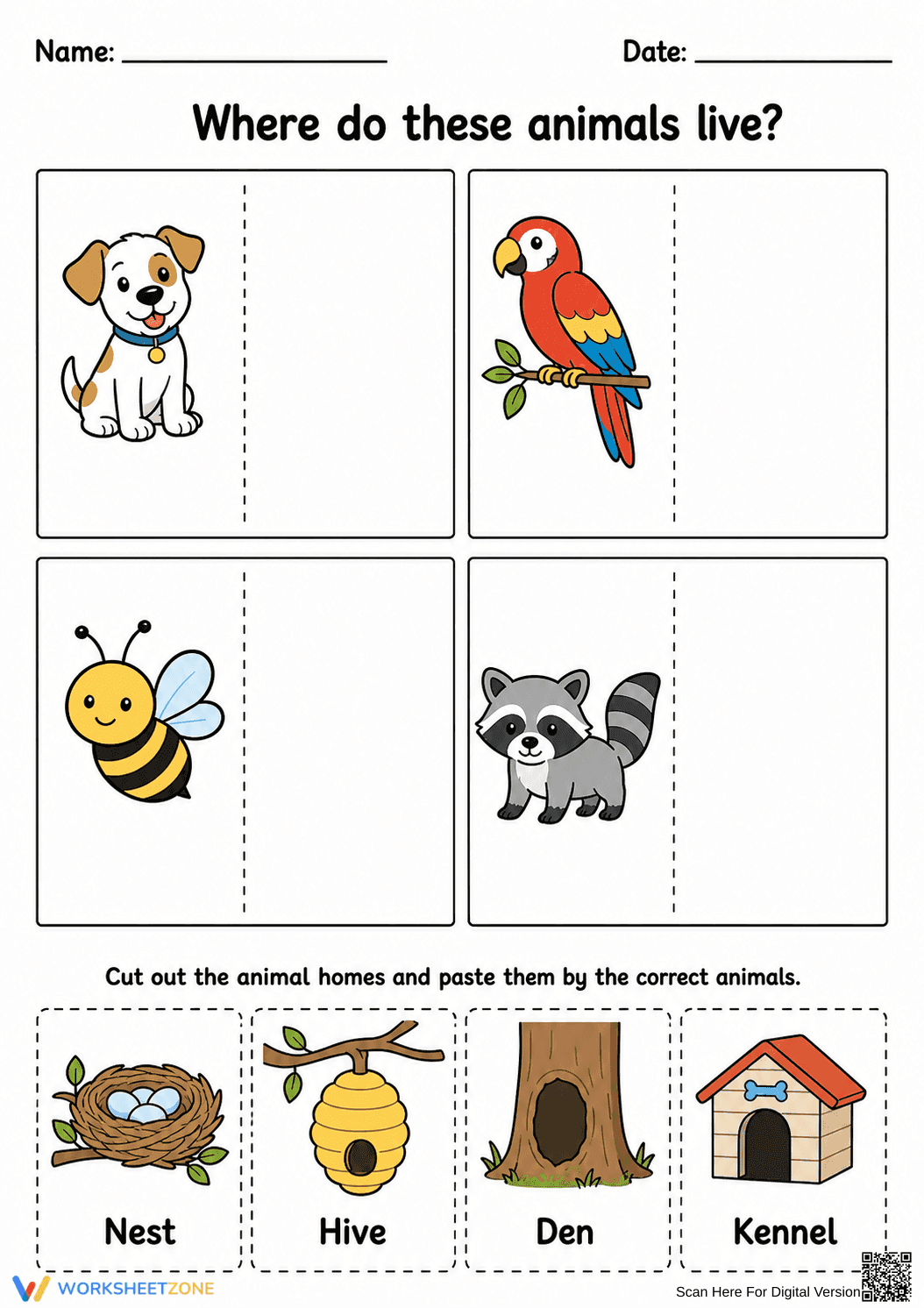
This interactive animal habitats worksheet helps Kindergarten students identify where animals live through a hands-on cut-and-paste activity. By matching animals like dogs, bees, and raccoons to their specific homes, early learners build critical observational skills and foundational science knowledge. This resource ensures students understand the basic survival needs of living things.
At a Glance
- Grade: Kindergarten · Subject: Science
- Standard:
K-ESS3-1— Match animals to their specific habitats- Skill Focus: Animal habitats and survival needs
- Format: 1 page · 4 problems · Answer key included · PDF
- Best For: Independent science centers or sub plans
- Time: 10–15 minutes
What's Inside
This single-page PDF features four animal illustrations alongside four habitats ready for cutting. Students match a dog, parrot, bee, and raccoon to a kennel, nest, hive, and den. Clear dashed lines guide cutting, while designated pasting areas ensure a tidy final product. A complete answer key is provided for quick teacher verification.
Zero-Prep Workflow
Print the single-page document in 30 seconds. Distribute scissors and glue sticks in under one minute. Finally, facilitate a brief review of habitat vocabulary as students complete the matching task over 10 minutes. With a total teacher preparation time of under two minutes, this worksheet serves as an ideal emergency sub plan or a quick transition activity between science lessons.
Standards Alignment
This resource aligns to K-ESS3-1: Use a model to represent the relationship between the needs of different plants or animals and the places they live. By connecting creatures to their dwellings, students demonstrate understanding of essential shelter requirements. Both standard codes can be copied directly into lesson plans, IEP goals, or district curriculum mapping tools.
How to Use It
Use this worksheet during your life science unit immediately after a direct instruction lesson on animal needs. It functions perfectly as a formative assessment tool; observe how students categorize the raccoon and parrot to gauge their understanding of local versus exotic habitats. Expect most Kindergarteners to finish the task in 10 to 15 minutes, making it a great choice for a science center rotation or a quiet morning work assignment.
Who It's For
This activity is tailored for Preschool and Kindergarten students, particularly those developing fine motor skills through cutting and pasting. The visual nature of the tasks makes it highly accessible for English Language Learners and students with diverse learning needs. Pair this worksheet with a classroom read-aloud about animal homes or a physical habitat sorting tray to deepen the conceptual connection.
Alignment with the K-ESS3-1 standard is essential for building a robust scientific foundation in early childhood education. This worksheet targets the specific cognitive skill to match animals to their specific habitats, allowing students to visually represent how animals depend on their environments for survival. Research from EdReports 2024 emphasizes that hands-on activities, such as cut-and-paste tasks, significantly improve information retention and engagement in young learners compared to passive observation. By identifying the unique characteristics of a hive, nest, den, and kennel, students are practicing the observational techniques fundamental to the scientific method. This systematic approach to learning about living things ensures that Preschool and Kindergarten students meet rigorous state and national benchmarks for life science. The clear integration of fine motor practice with conceptual science content creates a multi-sensory learning experience that supports developmental milestones across the curriculum.


