


























Views
Downloads

Grade K Animal Habitats — Printable No-Prep Worksheet
Paste this activity's link or code into your existing LMS (Google Classroom, Canvas, Teams, Schoology, Moodle, etc.).
Students can open and work on the activity right away, with no student login required.
You'll still be able to track student progress and results from your teacher account.
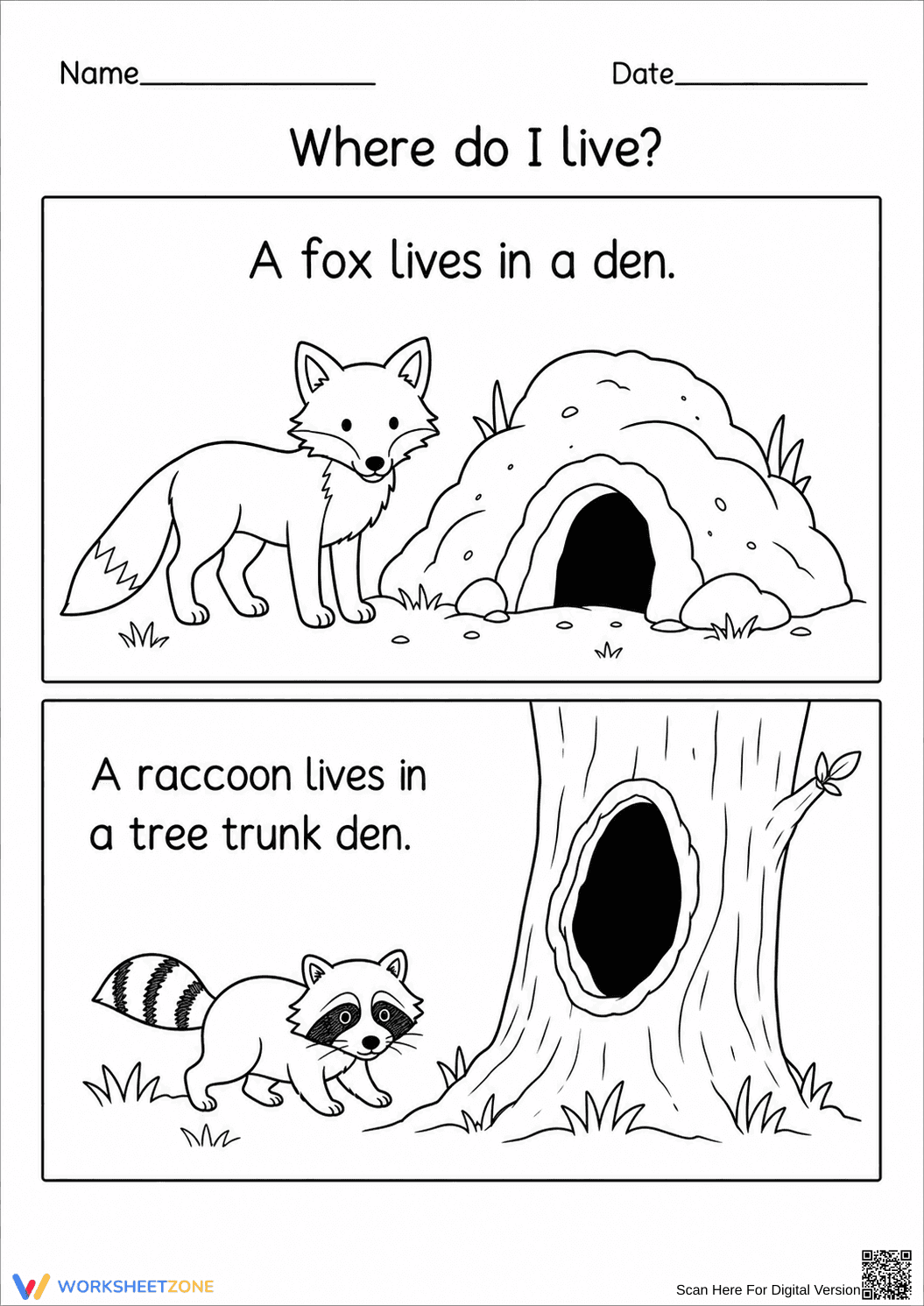
This Kindergarten animal habitats worksheet helps young learners connect living creatures to their specific environments through visual identification and reading practice. By focusing on the fox and the raccoon, students build a foundational understanding of how animals find shelter in nature to survive and thrive.
At a Glance
- Grade: Kindergarten · Subject: Science
- Standard:
K-LS1-1— Identify and describe where different animals live- Skill Focus: Animal habitat identification
- Format: 1 page · 2 tasks · No answer key needed · PDF
- Best For: Independent science center practice
- Time: 10–15 minutes
Inside this single-page PDF, you will find two distinct sections featuring clear, high-contrast illustrations of a fox and a raccoon paired with their respective homes. Each section includes a simple sentence using early-reader vocabulary to identify the den and the tree trunk den. The layout is specifically designed for small hands to color and for emerging readers to track text while learning scientific concepts.
This zero-prep workflow is designed for the busy educator. First, print the single page for each student, which takes approximately 30 seconds for a standard class set. Second, distribute the sheets and provide crayons or pencils, requiring less than one minute of transition time. Finally, review the findings as a group to check for understanding, totaling under two minutes of teacher preparation. This simplicity makes it a perfect choice for emergency sub plans or quick morning work.
This resource is aligned to the primary standard K-LS1-1, which requires students to use observations to describe patterns of what plants and animals need to survive. Specifically, it addresses the need for shelter and the specific types of environments that support different species. Both standard codes can be copied directly into lesson plans, IEP goals, or district curriculum mapping tools.
Use this worksheet during the explain phase of a science lesson after a group discussion about where local wildlife lives. It serves as an excellent formative assessment tool; observe if students can verbally explain why a fox lives in a den instead of a tree. Most Kindergarten students will complete the reading and coloring tasks within 10 to 15 minutes, providing a quiet, focused instructional moment.
This activity is created for Preschool and Kindergarten students who are beginning to explore the natural world. It is particularly effective for English Language Learners due to the heavy reliance on visual cues and repetitive sentence structures. Pair this worksheet with a short non-fiction passage about forest animals or a classroom anchor chart showing different animal homes for maximum impact.
Scientific literacy in early childhood depends on the ability to categorize information based on observable evidence. According to the RAND AIRS 2024 report on early science education, students who engage with concrete examples of animal-environment relationships, such as the K-LS1-1 habitat identification skill, demonstrate higher retention of life science concepts in later primary grades. By identifying that a fox lives in a den and a raccoon utilizes a tree trunk, children develop the categorical thinking required for complex biological studies. This worksheet provides the essential scaffolding needed to move from simple observation to pattern recognition in living systems. The integration of reading and science supports multi-modal learning, ensuring that literacy development happens alongside content mastery. Utilizing these structured scientific observations ensures that students meet state and national benchmarks for Kindergarten life science while building a genuine curiosity about the natural world surrounding them.


