


























Views
Downloads

Essential Seasons Worksheet | Grade 1 Science Printable
Paste this activity's link or code into your existing LMS (Google Classroom, Canvas, Teams, Schoology, Moodle, etc.).
Students can open and work on the activity right away, with no student login required.
You'll still be able to track student progress and results from your teacher account.
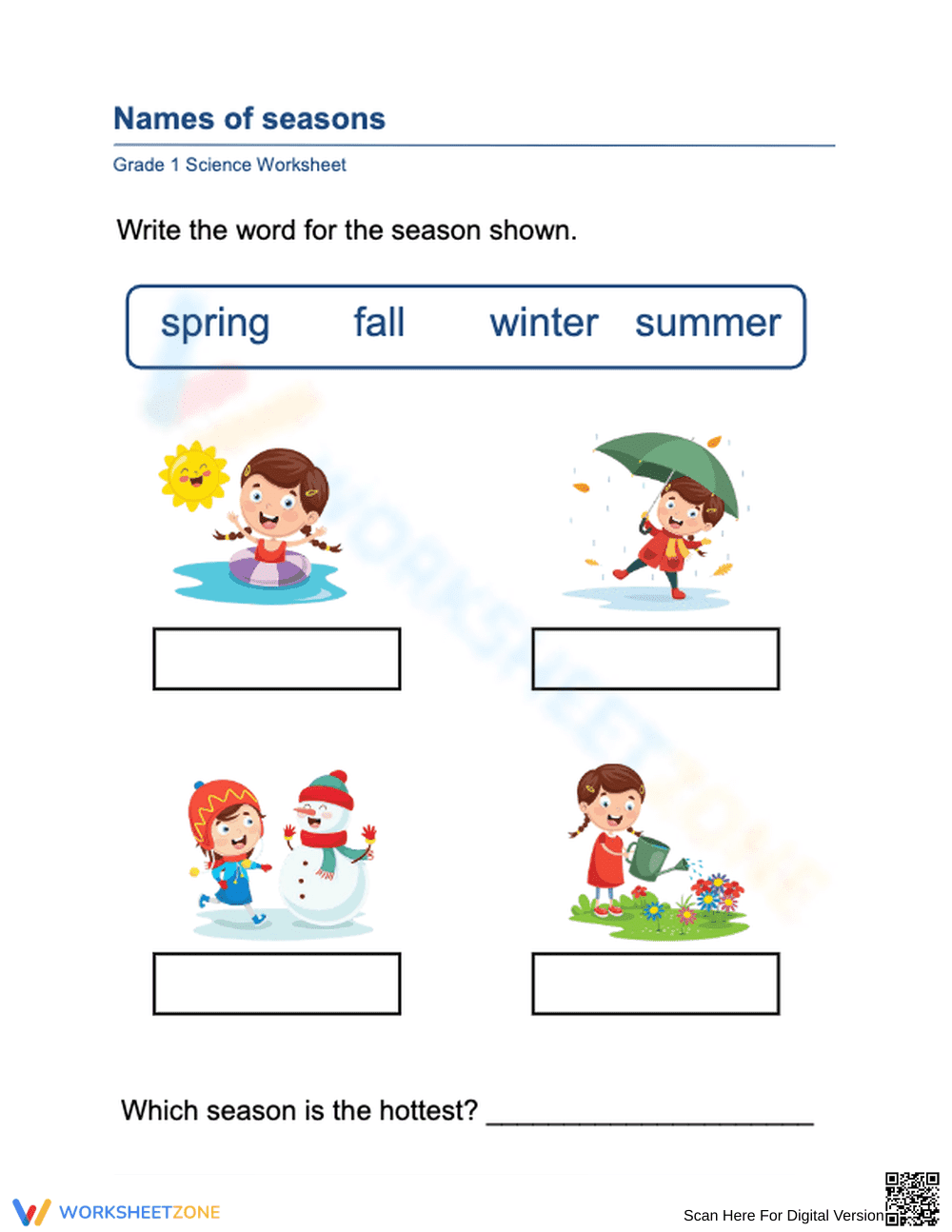
This Grade 1 science worksheet provides a foundational introduction to the four seasons of the year through visual identification and vocabulary practice. Students observe vibrant illustrations depicting seasonal activities and weather patterns, then label each correctly using a provided word bank. It effectively builds environmental awareness and categorical thinking in early learners.
At a Glance
- Grade: 1 · Subject: Science
- Standard:
K-ESS2-1— Use observations of local weather and seasonal cues to describe patterns over time- Skill Focus: Identifying and naming the four primary seasons correctly
- Format: 2 pages · 5 problems · Answer key included · PDF
- Best For: Individual practice or morning work
- Time: 10–15 minutes
This comprehensive two-page PDF package includes a focused activity page and a full-color answer key. The primary task features four distinct illustrations representing Spring, Summer, Fall, and Winter, paired with a clear word bank to support spelling and recognition. Additionally, a concluding critical thinking question asks students to identify the hottest season, reinforcing temperature concepts associated with seasonal changes.
Zero-Prep Workflow
This resource is designed for immediate classroom implementation with a total teacher preparation time of under 2 minutes. First, simply print the single-sided activity sheet in roughly 30 seconds. Next, distribute the worksheets to students during a transition period or as part of a science center in another 30 seconds. Finally, use the included answer key to conduct a rapid whole-group review or allow for student self-correction over 1 minute. Its clear layout makes it an ideal "grab-and-go" option for substitute folders.
Standards Alignment
The worksheet aligns primarily with K-ESS2-1, which requires students to use observations to describe patterns in weather over time. By associating specific visual markers—like snowmen for winter or swimming for summer—with seasonal names, students demonstrate an understanding of recurring annual cycles. This standard code can be copied directly into lesson plans, IEP goals, or district curriculum mapping tools.
How to Use It
Use this worksheet as a formative assessment after an introductory lesson on the calendar and weather. It works best during the independent practice phase of a direct instruction cycle. Alternatively, assign it as a quick morning work task to reinforce previously taught concepts. Teachers should observe if students can differentiate between the umbrella for the rainy season and the flowers for spring to gauge their attention to detail. Completion typically takes 12 minutes.
Who It's For
This activity is perfectly suited for first-grade students and advanced kindergarteners who are beginning to link environmental changes to specific timeframes. The inclusion of a word bank provides essential scaffolding for emergent readers and English Language Learners (ELLs). It pairs naturally with a classroom Seasons anchor chart or a read-aloud passage about the turning of the year.
According to recent analysis by ScienceDirect TpT Analysis, high-quality visual aids in early science education significantly improve the retention of abstract concepts like seasonal cycles. This worksheet leverages that research by using iconographic representations that map directly to the K-ESS2-1 standard, allowing students to describe patterns over time through the plain-English skill of seasonal identification. By providing structured labeling tasks, the resource reduces cognitive load, ensuring that the primary focus remains on the scientific observation of weather-related attributes. The integration of a word bank further supports vocabulary acquisition, a key component of foundational literacy within the science curriculum. This alignment ensures that the material meets the rigorous demands of modern educational frameworks while remaining accessible to diverse learners in a variety of classroom settings. Educators can rely on this tool for evidence-based instruction that bridges the gap between observation and academic language.


