


























Views
Downloads



Essential Area and Perimeter Worksheet | Grade 6 Math
Paste this activity's link or code into your existing LMS (Google Classroom, Canvas, Teams, Schoology, Moodle, etc.).
Students can open and work on the activity right away, with no student login required.
You'll still be able to track student progress and results from your teacher account.
This essential Grade 6 mathematics worksheet focuses on the fundamental concepts of area and perimeter using square centimeter and square meter units. Students engage with irregular figures to calculate dimensions through visual counting and comparison. This resource ensures learners develop a concrete understanding of spatial measurement before moving to abstract formulas.
At a Glance
- Grade: 6 · Subject: Mathematics
- Standard:
CCSS.MATH.CONTENT.6.G.A.1— Find the area of polygons by composing into rectangles or decomposing into shapes- Skill Focus: Area and Perimeter Calculation
- Format: 4 pages · 21 problems · Answer key included · PDF
- Best For: Homework or independent practice sessions
- Time: 30–45 minutes
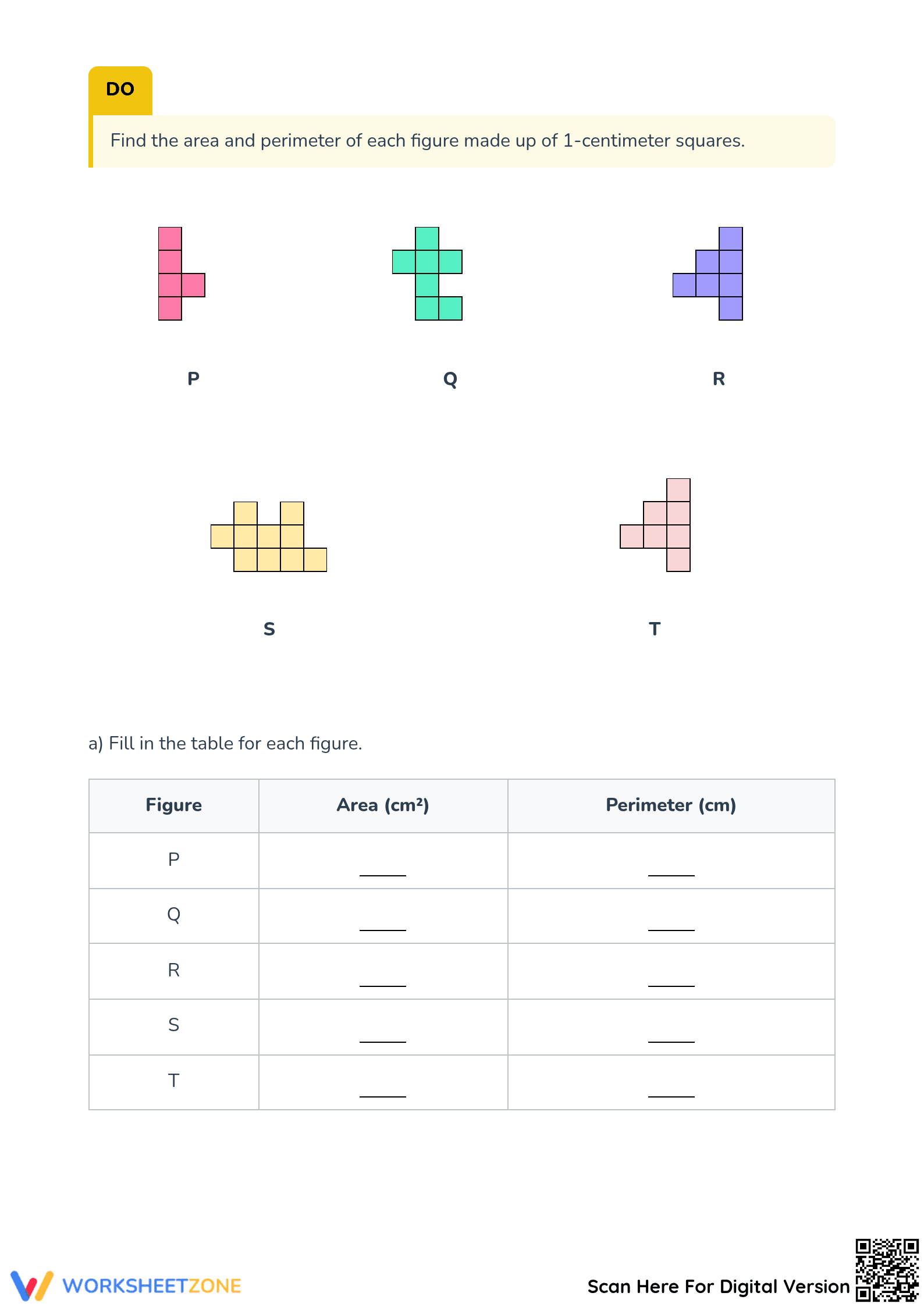
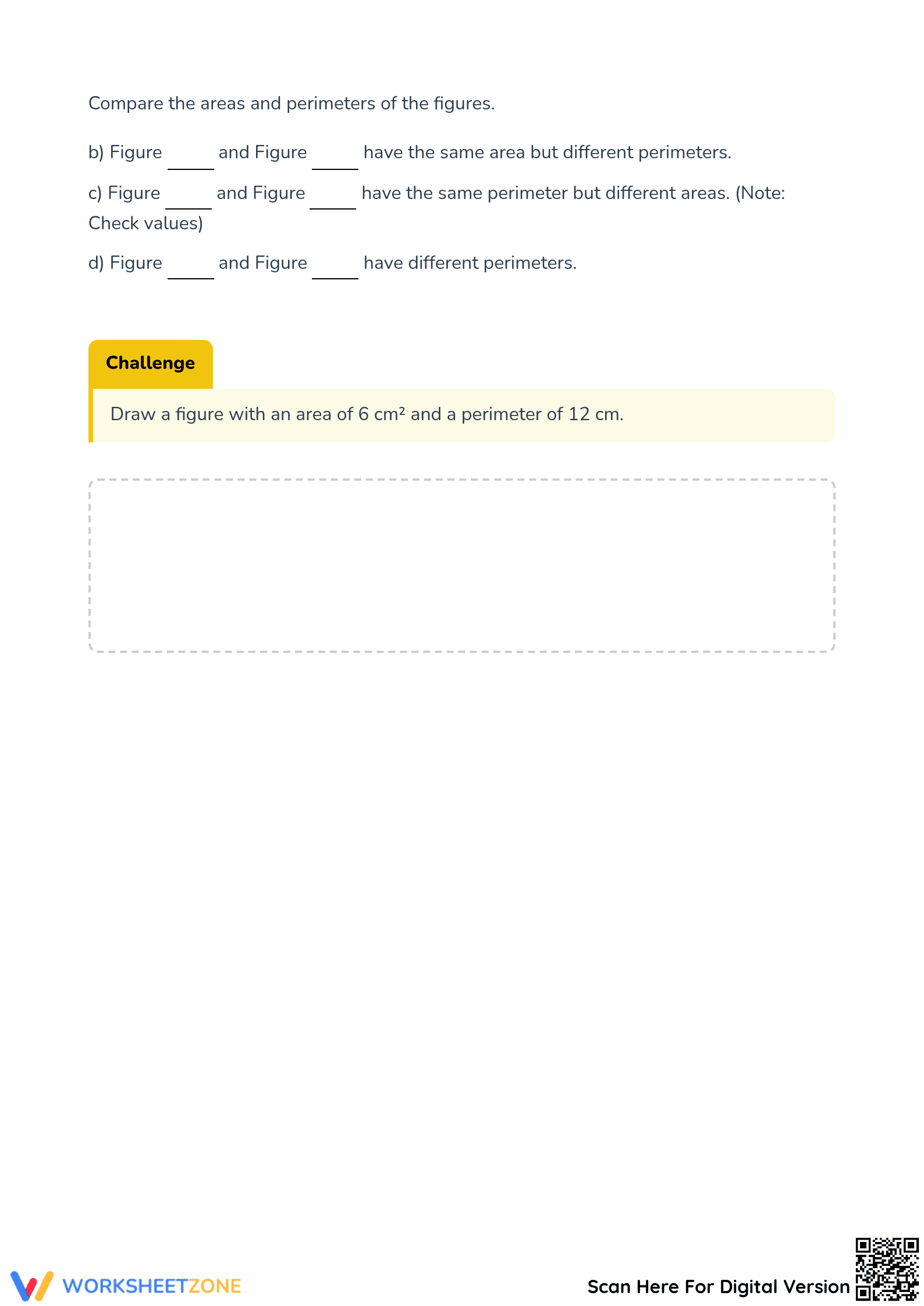
Inside this 4-page PDF, teachers will find a progressive set of tasks starting with basic unit counting for area and perimeter in centimeters and meters. The third page features a comprehensive data table for five distinct figures, while the final page challenges students with comparative analysis and a creative drawing task to demonstrate mastery.
This zero-prep resource is designed for immediate classroom integration. First, print the four-page packet (30 seconds). Next, distribute to students for independent or partner work during your geometry unit (1 minute). Finally, use the included answer key for rapid grading or student self-correction to provide immediate feedback on measurement accuracy (1 minute).
This resource aligns directly with CCSS.MATH.CONTENT.6.G.A.1, which requires students to find the area of right triangles, other triangles, special quadrilaterals, and polygons by composing into rectangles or decomposing into triangles and other shapes. It also supports foundational spatial reasoning for Grade 5 and 7 standards. Both standard codes can be copied directly into lesson plans, IEP goals, or district curriculum mapping tools.
Use this worksheet as a formative assessment after introducing the concept of square units. It works exceptionally well as a transition between concrete counting and the introduction of length times width formulas. Teachers should observe how students handle figures with the same area but different perimeters to identify misconceptions regarding spatial orientation and boundary measurement. Expected completion time is 40 minutes.
This packet is ideal for middle school students in general education or those requiring remedial support in geometry. The visual nature of the figures provides excellent scaffolding for English Language Learners and students with IEPs. It pairs naturally with a hands-on lesson using plastic square tiles or grid paper to reinforce the physical reality of area.
According to research from Fisher & Frey (2014) on the gradual release of responsibility, providing students with structured visual scaffolds is critical for internalizing complex geometric properties. This worksheet utilizes those principles by requiring students to interact with standard CCSS.MATH.CONTENT.6.G.A.1 through multiple modalities: counting, tabulating, and comparing. By determining the area and perimeter of irregular polygons composed of unit squares, students build the necessary schema to bridge the gap between elementary counting and secondary algebraic geometry. The inclusion of 21 distinct tasks across 4 pages ensures enough repetitions to reach fluency without causing cognitive fatigue. The NAEP assessment data suggests that students who master the relationship between area and perimeter early are significantly more likely to succeed in high school coordinate geometry. This resource provides that essential foundation through a clear, standards-aligned printable format that supports evidence-based instructional practices.


