




























Views
Downloads

Essential Weather Instruments Chart | Grade 4-5 Printable

Paste this activity's link or code into your existing LMS (Google Classroom, Canvas, Teams, Schoology, Moodle, etc.).
Students can open and work on the activity right away, with no student login required.
You'll still be able to track student progress and results from your teacher account.
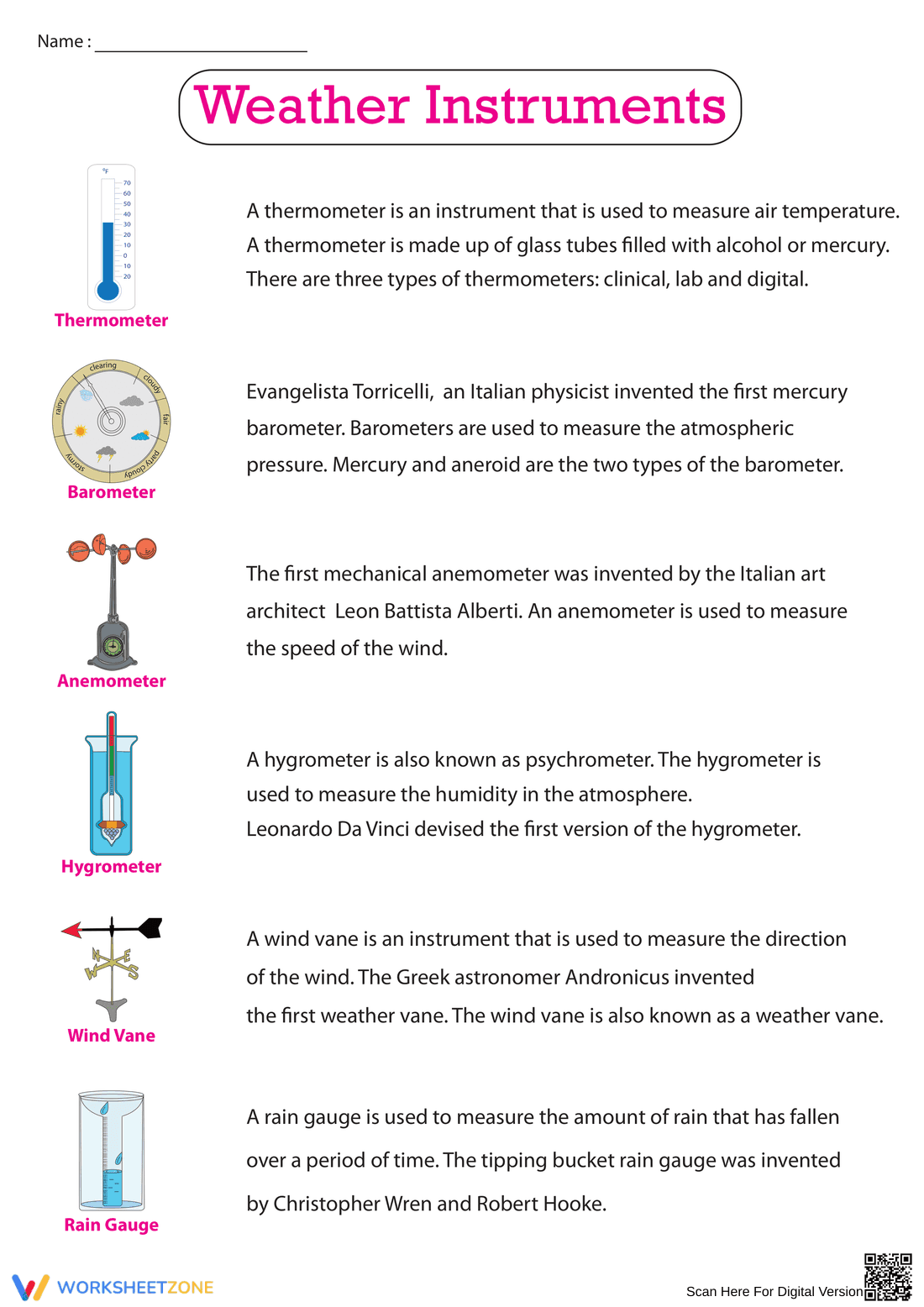
This Essential Weather Instruments Chart provides Grade 4 and 5 students with a comprehensive visual reference for meteorological tools. By identifying the thermometer, barometer, anemometer, hygrometer, wind vane, and rain gauge, learners gain a foundational understanding of how atmospheric data is collected. This printable resource ensures students can connect scientific instruments to their specific measurement functions.
At a Glance
- Grade: 4–5 · Subject: Science
- Standard:
CCSS.ELA-LITERACY.RI.4.7— Interpret information presented visually in charts to explain scientific concepts- Skill Focus: Identifying weather instruments and their functions
- Format: 1 page · 0 problems · Reference Chart · PDF
- Best For: Science notebooks and classroom anchor charts
- Time: 5–10 minutes
This single-page reference chart features six distinct weather instruments, each accompanied by a clear illustration and a descriptive paragraph. The text details what each instrument measures (such as air temperature, atmospheric pressure, or humidity), the materials used in its construction, and the historical inventors behind the technology. The layout is designed for high readability, making it an ideal inclusion for student binders or a classroom display.
Zero-Prep Workflow
The workflow for this resource is designed for maximum efficiency in a busy classroom environment. Teachers can Print (30 seconds) the high-resolution PDF for the entire class or for individual student use. Next, Distribute (1 minute) the charts during a direct instruction lesson on weather patterns. Finally, Review (30 seconds) the key instrument names and functions with students as they glue the chart into their interactive Science notebooks. Total teacher preparation time is less than two minutes.
Standards Alignment
This resource is primary aligned to CCSS.ELA-LITERACY.RI.4.7: Interpret information presented visually, orally, or quantitatively and explain how the information contributes to an understanding of the text. It also supports NGSS 3-ESS2-1 by providing the conceptual background for tools used to describe weather conditions. Both standard codes can be copied directly into lesson plans, IEP goals, or district curriculum mapping tools.
How to Use It
Use this chart to introduce weather measurement vocabulary. It serves as a formative assessment tool; teachers can observe students identifying instruments like the barometer when discussing atmospheric changes. The expected completion time for notebook placement is 10 minutes.
Who It's For
This resource is tailored for Grade 4 and Grade 5 students exploring Earth's systems. It is effective for visual learners and English Language Learners who benefit from pairing terms with illustrations. This chart pairs naturally with a weather-tracking project where students use physical instruments to record local changes.
The Essential Weather Instruments Chart is a rigorous instructional aid designed to bridge the gap between abstract meteorological concepts and concrete scientific tools. By explicitly linking instruments like the barometer and hygrometer to their historical inventors and functional mechanisms, the resource aligns with the findings of the RAND AIRS 2024 report, which emphasizes the importance of content-rich visual aids in improving long-term retention of scientific terminology. Providing students with a stable reference point for CCSS.ELA-LITERACY.RI.4.7 skills allows them to focus on higher-order analysis rather than rote memorization. This chart supports the development of academic literacy by requiring students to synthesize text and imagery to understand complex systems. As noted in recent ScienceDirect TpT Analysis, high-quality printable charts significantly reduce teacher cognitive load while maintaining standard-aligned instructional depth. This resource ensures that every student has immediate access to the technical facts required for successful weather unit mastery.


