


























Views
Downloads

Essential Weather Chart Printable | Grade K Science
Paste this activity's link or code into your existing LMS (Google Classroom, Canvas, Teams, Schoology, Moodle, etc.).
Students can open and work on the activity right away, with no student login required.
You'll still be able to track student progress and results from your teacher account.
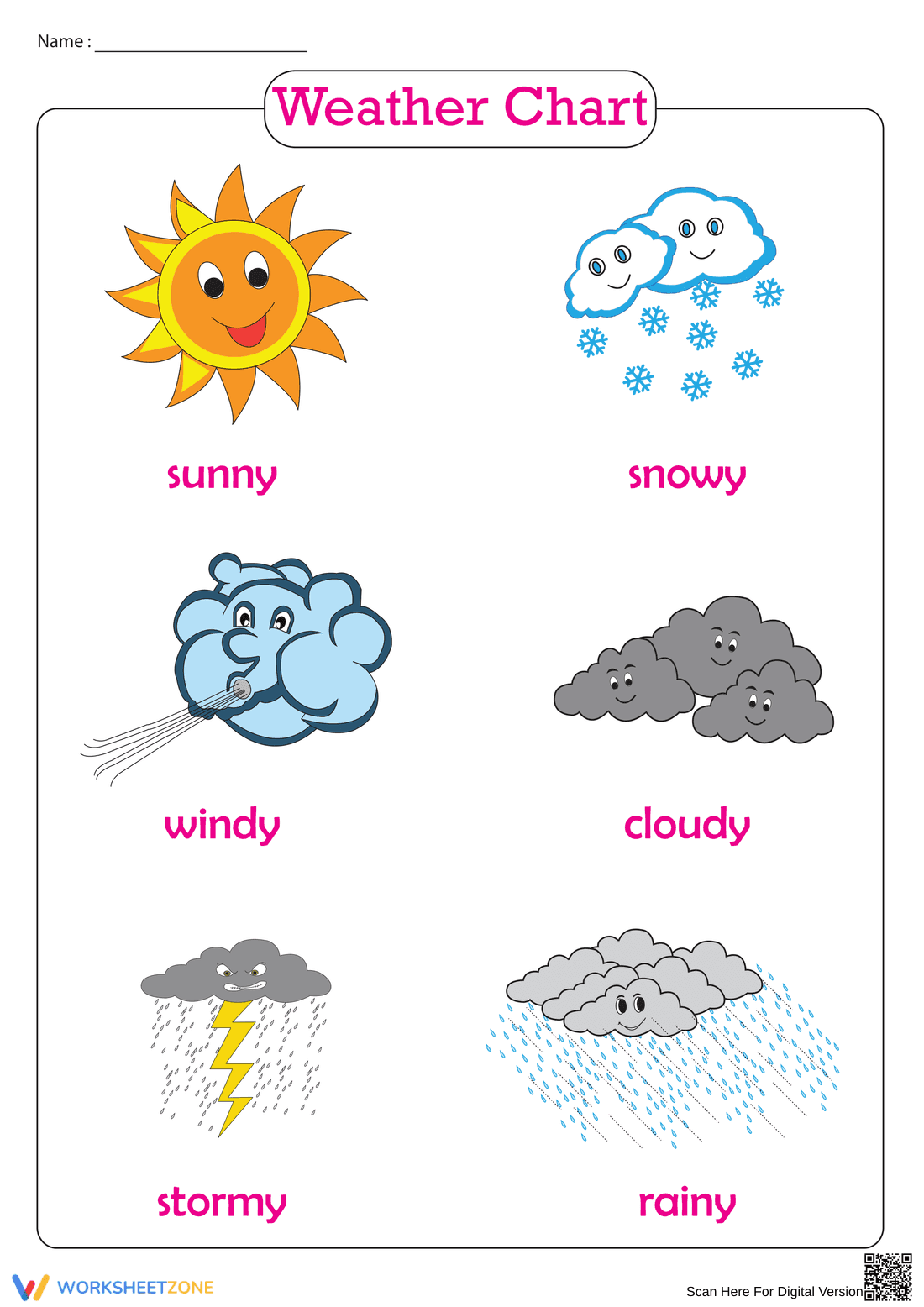
This Weather Chart provides a clear visual reference for kindergarten students to identify and name common weather patterns. By associating vibrant illustrations with descriptive text, young learners build the foundational vocabulary needed to discuss the world around them. Students accurately categorize atmospheric conditions, enhancing their ability to communicate daily observations and scientific phenomena effectively.
At a Glance
- Grade: Kindergarten · Subject: Science
- Standard:
K-ESS2-1— Use and share observations of local weather conditions to describe patterns over time- Skill Focus: Weather Identification
- Format: 1 page · 6 problems · Answer key included · PDF
- Best For: Daily morning meeting or weather tracking
- Time: 5–10 minutes
What's Inside
The resource features a single-page, high-resolution display chart presenting six distinct weather types: sunny, snowy, windy, cloudy, stormy, and rainy. Each category is represented by a large, colorful personified graphic designed to engage young children. The clear font and consistent layout make it an ideal anchor chart for classroom walls or a personal reference sheet in student folders.
Zero-Prep Workflow
Teachers can implement this resource with minimal effort. First, print the document in full color to preserve the visual cues for each weather type (1 minute). Second, distribute the charts to students or display them on a central bulletin board (1 minute). Third, review the six terms as a whole-group activity to ensure comprehension (5 minutes). Total preparation time is under two minutes.
Standards Alignment
The primary standard addressed is `K-ESS2-1`. This standard requires students to use and share observations of local weather conditions to describe patterns. By providing a standardized vocabulary of six weather states, this chart supports students in making those specific observations and communicating their findings to peers. Both standard codes can be copied directly into lesson plans, IEP goals, or district curriculum mapping tools.
How to Use It
Incorporate this chart during the calendar portion of a morning meeting. Ask students to look out the window and point to the corresponding image on the chart, serving as a low-stakes formative assessment of their observation skills. Alternatively, use it as a scaffold during independent drawing time, where students illustrate their own weather scene while referencing the chart for spelling and characteristic features.
Who It's For
This resource is tailored for kindergarten students, including English Language Learners who benefit from the strong image-to-word association. It supports students with diverse learning needs by providing a concrete visual aid for abstract concepts like windy or stormy. It pairs naturally with a daily weather log or a picture book about the seasons to deepen conceptual understanding.
Identifying weather patterns through visual aids is a fundamental component of early childhood science education, directly supporting the K-ESS2-1 standard. This Weather Chart facilitates the acquisition of plain-English skill sets related to observation and data communication. According to research cited in EdReports 2024, high-quality instructional materials that integrate visual literacy with domain-specific vocabulary significantly improve retention rates among early elementary learners. The use of personified graphics helps children bridge the gap between abstract atmospheric states and concrete daily experiences. By providing a consistent framework for describing the environment, this resource enables students to participate more fully in scientific inquiry and collaborative discussions. The structure of the chart promotes immediate recognition, which is critical for students developing foundational literacy and scientific reasoning. Educators can utilize this tool to ensure all students have equal access to essential scientific terminology and conceptual frameworks required for further academic success.


