


























Views
Downloads
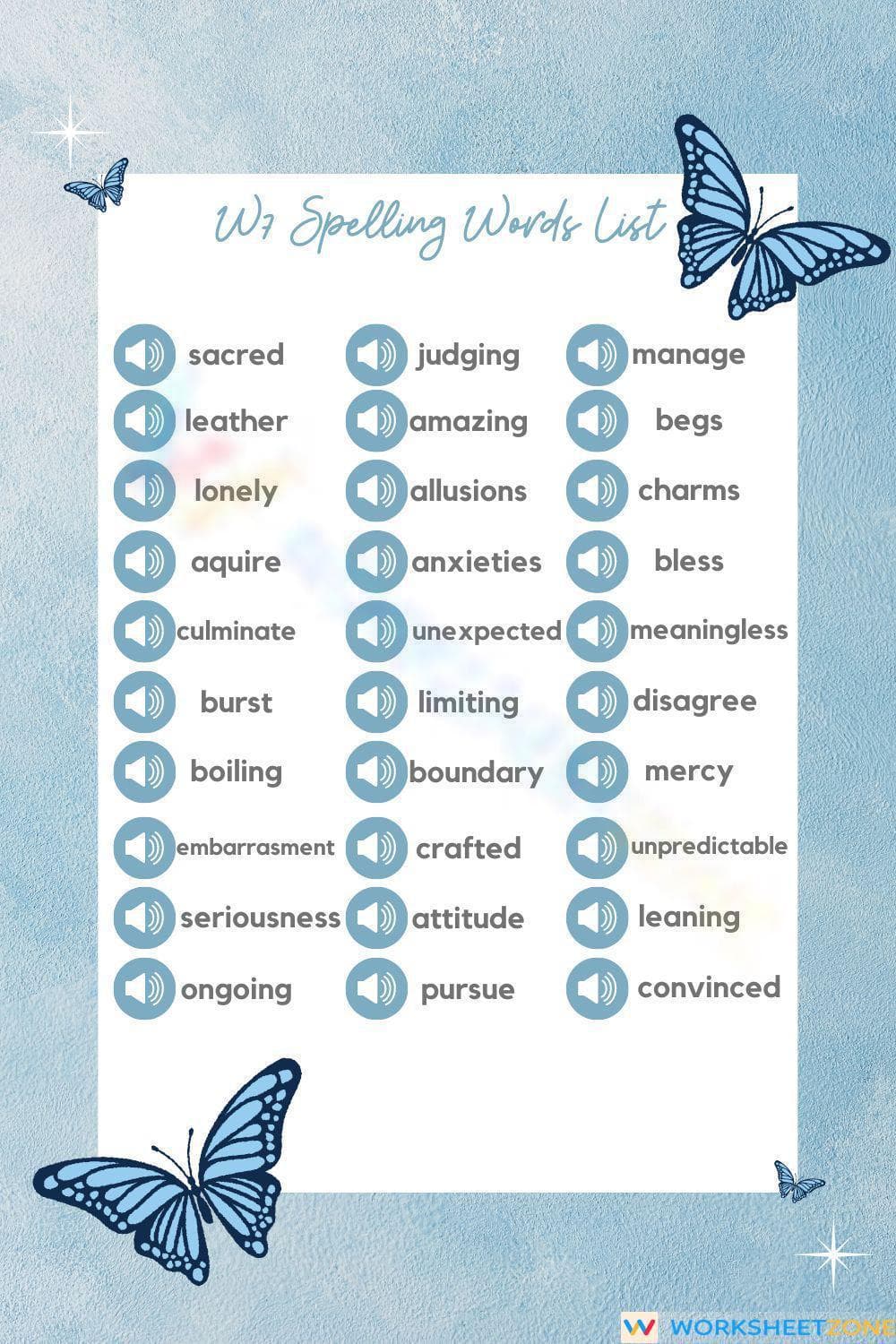

Printable W7 Spelling Words List | Grade 8-11 ELA
Paste this activity's link or code into your existing LMS (Google Classroom, Canvas, Teams, Schoology, Moodle, etc.).
Students can open and work on the activity right away, with no student login required.
You'll still be able to track student progress and results from your teacher account.
This comprehensive W7 spelling words list provides Grade 8 through Grade 11 students with a structured set of thirty sophisticated vocabulary terms to master. By focusing on multi-syllabic words and common orthographic challenges, this resource ensures that secondary learners refine their written communication and technical accuracy. Use this printable guide to strengthen foundational literacy skills effectively.
At a Glance
- Grade: 8-11 · Subject: English Language Arts
- Standard:
CCSS.ELA-LITERACY.L.8.2.C— Demonstrate command of the conventions of standard English capitalization, punctuation, and spelling accurately- Skill Focus: Advanced spelling and vocabulary
- Format: 1 page · 30 words · No-prep · PDF
- Best For: Secondary spelling drills, weekly word lists, vocabulary building, and standardized test preparation
- Time: 5–10 minutes for daily study
This single-page PDF features a clean, butterfly-themed layout containing 30 high-leverage spelling words arranged in three organized columns. The list includes challenging terms such as allusions, anxieties, culminate, and unpredictable. Each word is accompanied by a speaker icon, suggesting its utility in digital or auditory spelling practice. No additional teacher setup or key is required for this direct reference sheet.
The zero-prep workflow for this resource is designed for maximum efficiency. Teachers can print the single-page PDF in under 30 seconds. Distributing the list to the entire class takes less than one minute, and students can immediately begin their study or pre-test routine. The total teacher preparation time is less than two minutes, making it an ideal choice for sub-plans or morning work.
The primary alignment for this worksheet is CCSS.ELA-LITERACY.L.8.2.C, which requires students to demonstrate command of standard English spelling. Furthermore, the inclusion of words like allusions supports CCSS.ELA-LITERACY.L.9-10.4, focusing on general academic and domain-specific vocabulary. Both standard codes can be copied directly into lesson plans, IEP goals, or district curriculum mapping tools.
Deploy this list at the start of a weekly spelling cycle to establish clear expectations for secondary students. During direct instruction, have students highlight prefixes or suffixes within the provided words to identify linguistic patterns. For a quick formative assessment, observe students as they attempt to use three of the words in original sentences during the first ten minutes of class.
This resource is tailored for Grade 8, 9, 10, and 11 students, including those requiring extra support with academic vocabulary. It pairs naturally with a short story or informational passage where these words frequently appear. Differentiation is easily achieved by asking students to define the words or use them in complex paragraphs based on their current ability levels.
According to the RAND AIRS 2024 report on secondary literacy, systematic spelling instruction remains a critical component of academic success in high school, as orthographic knowledge directly correlates with reading comprehension and writing clarity. This Grade 8-11 worksheet addresses these needs by providing 30 specific words that students must spell correctly to meet CCSS.ELA-LITERACY.L.8.2.C benchmarks. By utilizing this focused list, educators provide students with the necessary exposure to complex word structures, including irregular forms and abstract concepts like anxieties and allusions. Research from ScienceDirect TpT Analysis suggests that high-quality, printable word lists significantly reduce teacher burnout while maintaining rigorous academic standards. This resource serves as a vital tool for ensuring that older students do not lose foundational spelling proficiency as they transition into more complex literary analysis and academic writing tasks.


