


























Views
Downloads

Viscosity of Liquids Printable Worksheet | Grade 5 Science
Paste this activity's link or code into your existing LMS (Google Classroom, Canvas, Teams, Schoology, Moodle, etc.).
Students can open and work on the activity right away, with no student login required.
You'll still be able to track student progress and results from your teacher account.
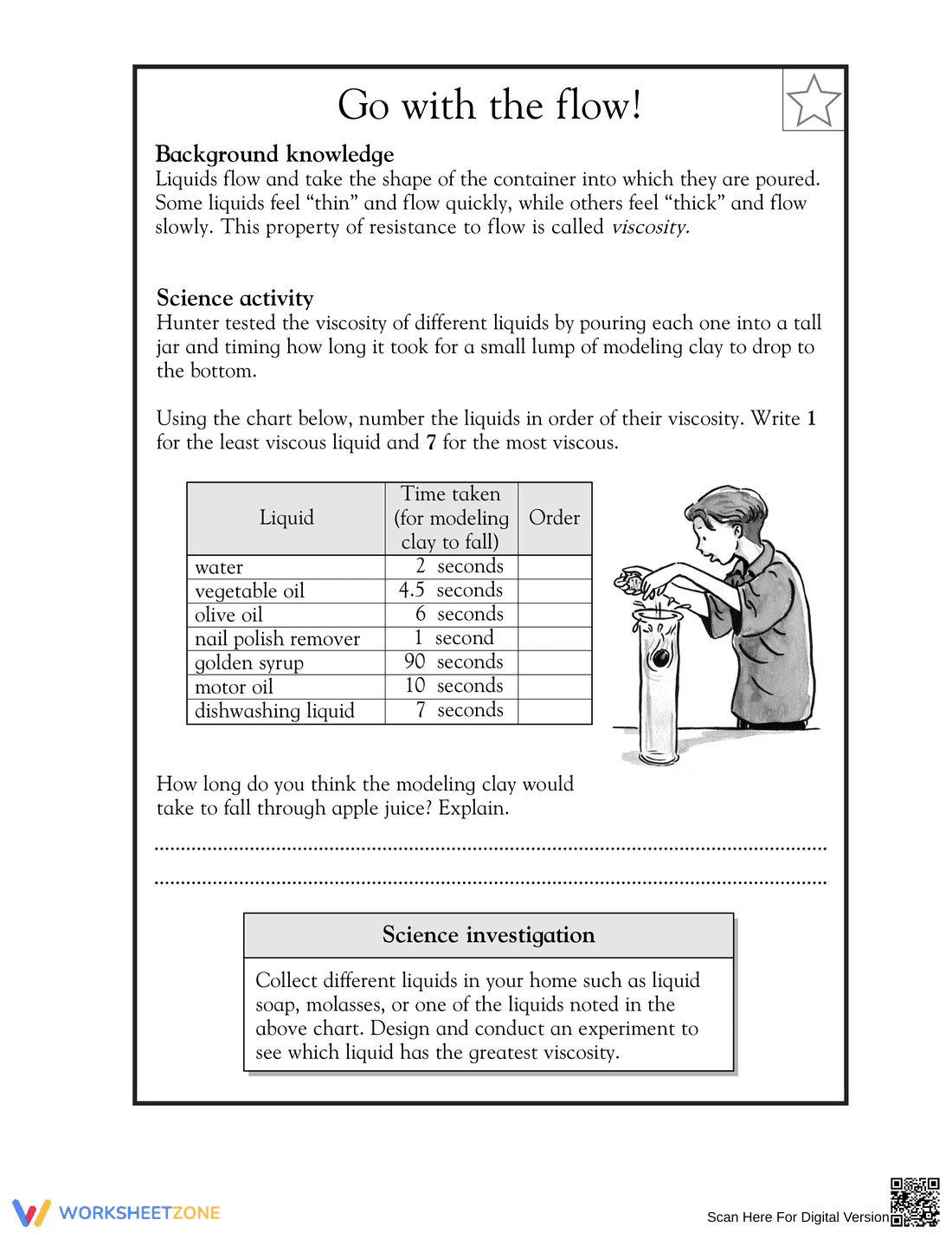
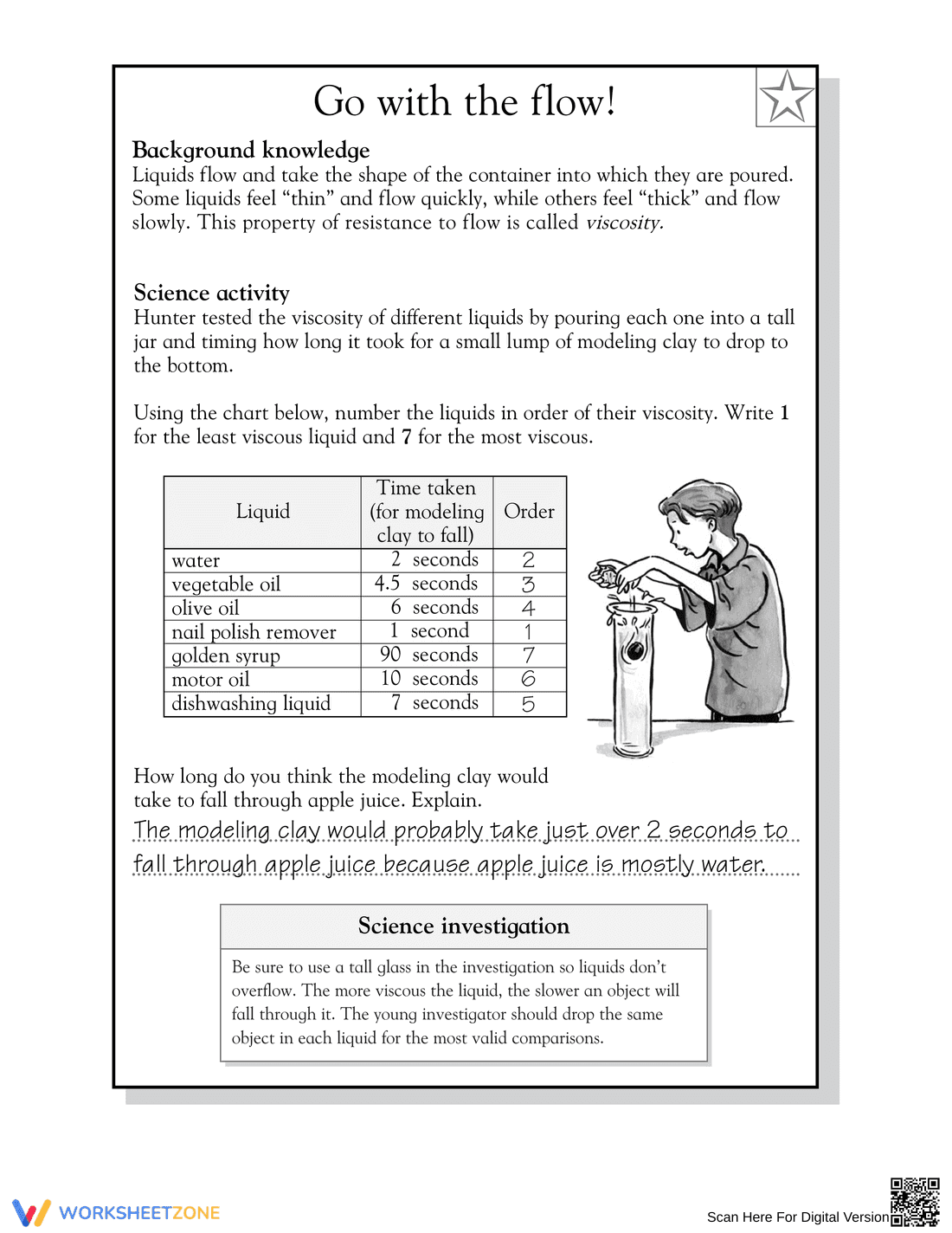
This Grade 5 science worksheet introduces students to the concept of viscosity through a practical data-analysis task. By examining how different liquids resist flow, learners develop a concrete understanding of physical properties in matter. Students will interpret experimental results to rank common household substances, building critical observation skills for middle school readiness.
At a Glance
- Grade: 5 · Subject: Science
- Standard:
5-PS1-3— Identify materials based on their physical properties like viscosity- Skill Focus: Liquid Viscosity & Data Interpretation
- Format: 1 page · 3 tasks · Answer key included · PDF
- Best For: Homework, Science Centers, or Sub Plans
- Time: 15–20 minutes
This single-page PDF features a clear "Background Knowledge" section that defines viscosity as resistance to flow. The core "Science Activity" provides a data table with 7 distinct liquids—including water, vegetable oil, and golden syrup—and the time taken for clay to sink through them. Students must use this quantitative data to order the liquids. It also includes a predictive writing prompt and a home-based investigation extension.
Zero-Prep Workflow
- Print: Select the single-page PDF and print enough copies for your class in under 30 seconds.
- Distribute: Hand out the sheets for an immediate bell-ringer or independent practice activity with no teacher setup required.
- Review: Use the included answer key to check student ordering and predictions in less than 1 minute.
This efficient workflow makes the resource an ideal choice for emergency sub plans or quick transitions between science units.
Standards Alignment
This resource is aligned to the NGSS primary standard 5-PS1-3, which requires students to make observations and measurements to identify materials based on their properties. By calculating the relative resistance of liquids using sinking-time data, students engage with quantitative evidence to support scientific claims. This standard code can be copied directly into lesson plans, IEP goals, or district curriculum mapping tools.
How to Use It
Use this worksheet during your unit on the states of matter to reinforce how liquids can be differentiated by their internal friction. It works well as a formative assessment after a lesson on physical properties. For a formative observation tip, monitor how students handle the "apple juice" prediction; it reveals their ability to transfer experimental logic to unmeasured variables without further prompting.
Who It's For
Designed for 5th-grade students, this worksheet is also appropriate for 4th-grade enrichment or 6th-grade review sessions. The visual cues and structured table support English Language Learners (ELL) and students with IEPs by providing a clear scaffold for data analysis. It pairs naturally with a classroom demonstration using actual jars of syrup and water to see viscosity in action.
According to the RAND AIRS 2024 report on elementary science pedagogy, integrating quantitative data interpretation with conceptual definitions like viscosity significantly improves long-term retention of physical science principles. This worksheet addresses the common misconception that "thick" liquids are always denser; instead, it focuses on the property of flow resistance. By tasking Grade 5 students with ordering 7 unique liquids based on sinking-time data, the resource reinforces the 5-PS1-3 mandate to identify materials via measurable properties. Fisher & Frey (2014) emphasize that such structured analysis serves as a vital bridge between direct instruction and independent scientific inquiry. This self-contained module provides the exact level of cognitive demand required for assessment preparation while maintaining student engagement through familiar household examples. It ensures that learners can effectively communicate scientific findings through ranking and predictive writing tasks.


