


























Views
Downloads

Vertices and Edges Worksheet | Essential Grade 6 Geometry
Paste this activity's link or code into your existing LMS (Google Classroom, Canvas, Teams, Schoology, Moodle, etc.).
Students can open and work on the activity right away, with no student login required.
You'll still be able to track student progress and results from your teacher account.
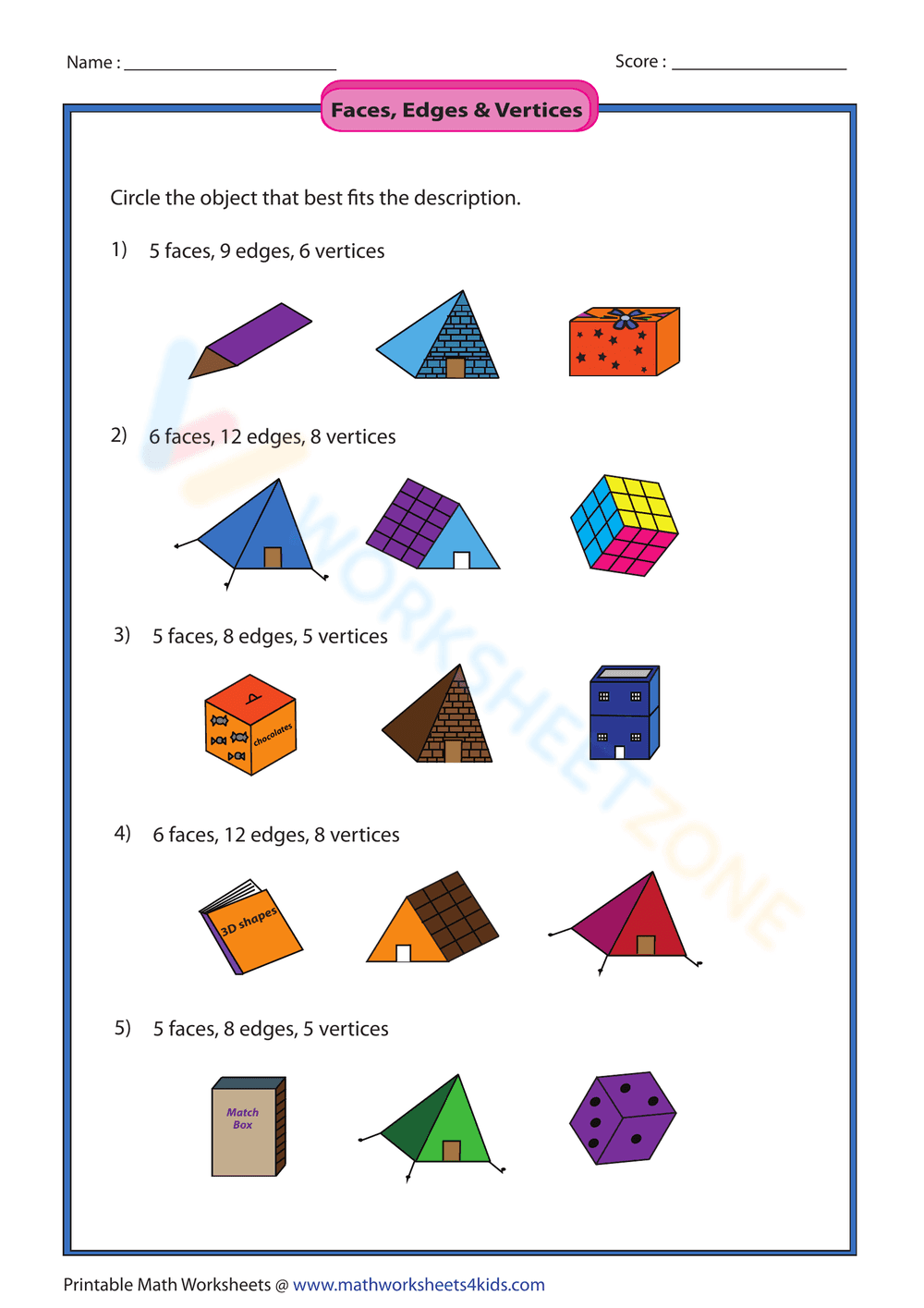
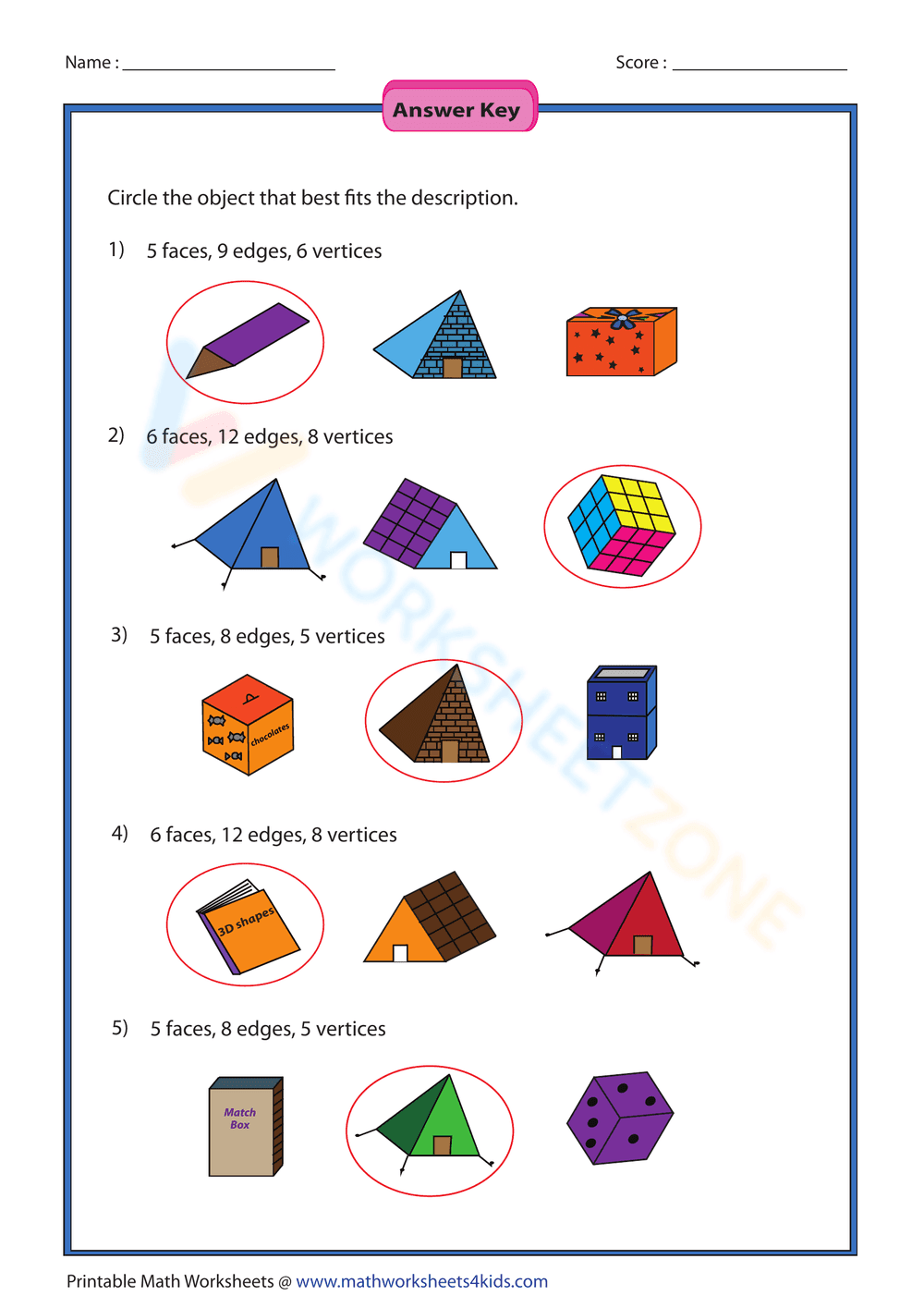
This Grade 6 geometry worksheet helps students master the properties of three-dimensional figures by identifying shapes based on their specific counts of faces, edges, and vertices. By connecting numerical descriptions to visual representations, learners solidify their spatial reasoning and geometric vocabulary. It provides a clear path toward understanding complex polyhedra and spatial relationships.
At a Glance
- Grade: 6 · Subject: Geometry
- Standard:
CCSS.MATH.CONTENT.6.G.A.4— Represent three-dimensional figures using nets made up of rectangles and triangles- Skill Focus: 3D Shape Properties
- Format: 2 pages · 5 problems · Answer key included · PDF
- Best For: Quick formative assessment or bell-ringer activity
- Time: 10–15 minutes
The resource consists of a single-page student activity and a corresponding full-color answer key. Students are presented with five distinct challenges, each listing a specific number of faces, edges, and vertices. Below each description, three high-quality illustrations of real-world objects and geometric solids, such as prisms, pyramids, and cubes, are provided. The layout is clean and professional, ensuring students can focus entirely on the mathematical properties without visual clutter.
Zero-Prep Workflow
- Print: Select the student page and print the required number of copies in seconds.
- Distribute: Hand out the sheets as a transition activity or a focused warm-up to start the math block.
- Review: Use the included answer key for immediate feedback or peer-grading to minimize teacher workload.
The total teacher preparation time is less than two minutes, making it an ideal choice for emergency sub plans or unexpected schedule shifts.
Standards Alignment
The primary focus is `CCSS.MATH.CONTENT.6.G.A.4`, which requires students to represent three-dimensional figures and use these representations to solve problems. While the standard often emphasizes nets, the foundational skill of identifying faces, edges, and vertices is a prerequisite for successful net construction and surface area calculation. Both standard codes can be copied directly into lesson plans, IEP goals, or district curriculum mapping tools.
How to Use It
Use this worksheet as a "Do Now" activity at the start of a geometry unit to gauge prior knowledge of 3D shapes. Alternatively, assign it as a quick exit ticket after a lesson on polyhedra to check for understanding. During instruction, observe if students are physically counting the features on the images or if they are recognizing the shapes by name first. Completion typically takes 10 to 15 minutes.
Who It's For
This resource is tailored for Grade 6 students but serves as an excellent review for Grade 7 and 8 learners who need to reinforce their geometric foundations. It is particularly helpful for visual learners who benefit from seeing 3D shapes represented in 2D space. Pair this worksheet with physical manipulatives or a 3D shape anchor chart to provide additional support for students struggling with spatial visualization.
Research from RAND AIRS 2024 emphasizes that high-quality, targeted practice materials are essential for bridging the gap between conceptual understanding and procedural fluency in middle school mathematics. This worksheet addresses the specific geometric skill of identifying polyhedra by their constituent parts—faces, edges, and vertices—which is a critical component of the CCSS.MATH.CONTENT.6.G.A.4 standard. By providing clear visual cues alongside numerical data, the resource supports the development of spatial reasoning skills that are predictive of later success in high school geometry and STEM fields. According to recent NAEP data, students who master the properties of 3D figures early are better equipped to handle complex volume and surface area problems. This printable PDF offers a structured, evidence-based approach to geometry practice that fits easily into any instructional sequence or curriculum map.


