


























Students will learn how to solve multistep linear equations and inequalities that have variables on both sides of the relation symbol. Student will be able to:
- understand the similarities and differences in solution techniques for equations and inequalities.
- combine like terms.
- grasp the concepts of "no solution" and "infinitely many solutions" and be able to recognize specific equations/inequalities as "always true" or "never true."
- represent real-world problems as equations or inequalities, and the solution is expressed in terms of the original situation.
- How can mathematics help us communicate more effectively?
- How are relationships represented mathematically?
- How are expressions, equations, and inequalities used to quantify, solve, model, and/or analyze mathematical problems?
- How may data be arranged and represented to reveal the relationship between quantities?
- Coefficient: The coefficient of a term in an expression is the number that is multiplied by one or more variables or powers of variables in the term.
- Function: A relation in which every input value has a unique output value.
- Linear Equation: An equation of the form Ax + By = C, where A ≠ 0 and B ≠ 0. The graph of a linear equation is a straight line.
- Rate of Change: The ratio of the change in the output value and change in the input value of a function.
- Simultaneous Linear Equations: Two or more linear equations that share a set of variables and either exactly one solution, no solutions, or infinitely many solutions; often called a “system of equations.”
- Slope: The measure of the steepness of a line; the ratio of the change in the y-values to the x-values of the linear function; rate of change.
- y-intercept: The y-coordinate of the point where a line intersects the y-axis; the value of the function when x = 0.
- Entrance Ticket (M-8-2-2_Entrance Ticket and KEY)
- Lesson Transparency (M-8-2-2_Lesson Transparency and KEY)
- Babysitting Activity (M-8-2-2_Babysitting and KEY)
- Special Cases worksheet (M-8-2-2_Special Cases)
- tic-tac-toe game sheets
- The Entrance Ticket assesses students' ability to combine like terms, translate between worded statements, mathematical inequalities and their graphical representation, and solve inequalities.
- The Babysitting Activity presents scenarios that students must express using an appropriate equation or inequality.
Active Engagement, Modeling, Explicit Instruction
W: Students learn to solve equations and inequalities with variables on both sides of the relation symbol by combining like terms and applying addition, subtraction, multiplication, and division properties of equality and inequality. The lesson focuses on how to describe real-world situations as equations and inequalities, which can then be solved using the algebraic techniques covered in the lesson.
H: The Entrance Ticket emphasizes the similarities between equation solutions and inequality solutions. When students are finished, review problems 1-4 together. Ask students, "What algebraic technique did we use to simplify these expressions?" If required, review to ensure that students are capable of combining like terms.
E: Applying the Lesson Transparency as guided instruction teaches students how to process each step in the solution. Encourage students to copy and recreate each step on their own after they have completed the process. Remind students that watching the process is easier than doing it alone, and that they should practice it on their own to test their understanding.
R: Tic-tac-toe equations/inequalities is an activity that invites strategizing about solving equations or inequalities to advance one's chances of winning against another competitor. Students must also examine the selection of easier or more difficult items to attempt, as well as consider the reasons they find certain items easier or more difficult.
E: The Babysitting Activity evaluates students' mastery of the solution techniques and the degree to which their results make sense in the real-world applications that uses familiar quantities of money.
T: The emphasis is on checking the solution. Students learn to ask whether their solutions are reasonable in relation to the original situation by substituting the solution for the variable in the original equation/inequality and determining if there is a solution, no solution, or infinite solutions. By having students routinely check their answers, these concepts are reinforced, and students realize how the algebraic techniques they learned help them solve equations and inequalities in real-world situations.
O: The combination of like terms, isolation of the variable, and addition/subtraction and multiplication/division properties of equations and inequalities are reinforced and used to solve equations and inequalities with variables on both sides of the relation symbol. The lesson focuses on applying the algebraic techniques students have learned to express real-world situations as equations or inequalities and solve for variables. The similarities and differences in solution techniques for equations and inequalities are emphasized again.
Distribute the entry ticket (M-8-2-2_Entrance Ticket and KEY). Instruct students to complete this independently.
As students finish the Entrance Ticket, explore problems 1-4 as a class. For problems 5 and 6, choose two students at random to share their answers on the board with the rest of the class. Before proceeding, discuss the answers with the class and clear up any questions that may arise.
For problems 7–10, randomly select students to share their responses. Discuss the responses in class.
"What does it mean to 'solve' an equation? An inequality? How is this solution related to the original equation or inequality?" (Solutions are values that, when replaced for the variable, make the equation or inequality true.)
Distribute the Lesson Transparency (M-8-2-2_Lesson Transparency and KEY) and problem 1 to the class.
12x + 30 = 9x
"Let's work together to solve some equations with variables on both sides. First of all, who can remind us of our goal when calculating an equation?" (To isolate the variable!)
"Consider the purpose of solving this equation for x and the steps needed to get a solution:
12x + 30 = 9x
12x + 30 – 9x = 9x – 9x Remember that in order to keep the equation balanced, we must do the same thing to both sides.
(12x – 9x) + 30 = 0 “Combine like terms.”
3x + 30 = 0
3x + 30 – 30 = 0 – 30
3x = -30
3x / 3 = -30 / 3
x = -10
Work through the preceding problem as a class, exploring how the addition/subtraction, and multiplication/division properties of equality, as well as the concept of combining like terms, can help us solve this equation.
Instruct students to finish problem 2 independently and then review it as a class:
4y – 2 = 8y + 10 (y = -3)
Instruct students to finish problem 3 independently and then review it as a class:
3y > 10 – 2y (y > 2)
Instruct students to finish problem 4 independently and then review it as a class:
7x + 2 ≤ x – 10 (x ≤ 2)
Discuss the similarities and differences in solution techniques for equations vs. inequalities. "For an inequality, why do we need to reverse the relation sign when we multiply or divide both sides by a negative number?" (Possible student responses range from simply saying "because of the multiplication property of inequalities" to providing a more detailed analysis/explanation. Whatever the response, ensure that students understand how to multiply or divide both sides of an inequality by a negative number. If they are uncertain, go over a few examples to refresh this skill.)
For problems 5-8 on the Lesson Transparency, have students fold a paper into four sections and label them as illustrated in the diagram below.
Display problems 5-8 and assign students to work in pairs, putting their work and notes for each example on a separate section of the paper. This allows them to make notes, revisions, and adjustments as each problem is worked through and discussed in class. Tell students that if their answers look a little different than usual, they do not need to worry; the solutions will be explained in class.
"Let's look at a few more examples."
9x + 10 – 11x = 2x + 6 + 4x
(9x – 11x+ + 10 = (2x + 4x) + 6 “Combine like terms with parentheses, if needed.
-2x + 10 = 6x + 6 Add like terms.
-2x + 10 – 6x = 6x + 6 – 6x Subtract 6x from each side.
(-2x – 6x) + 10 = (6x – 6x) + 6 Combine like terms with parentheses, if needed.
-8x + 10 = 6 Add like terms.
-8x + 10 – 10 = 6 – 10 Subtract 10 from each side.
-8x = -4 Perform the operations.
\(-8x \over 8\) = \(-4 \over -8\) Divide each side of the equation by -8.
x = \(4 \over 8\) Rewrite.
x = \(1 \over 2\) Reduce to simplest form.”
Example 2:
7(3x + 5) = 2(9x – 5)
(7 • 3x) + (7 • 5) = (2 • 9x) – (2 • 5) “Distribute the 7 on the left and the 2 on the right.
21x + 35 = 18x – 10 Perform the operations.
21x + 35 – 18x = 18x – 10 – 18x Get all x terms on one side by subtracting 18x from each side.
(21x – 18x) + 35 = (18x – 18x) – 10 Combine like terms with parentheses, if needed.
3x + 35 = -10 Add like terms.
3x + 35 – 35 = -10 – 35 Subtract 35 from each side.
3x = -45 Perform the operations.
\(3x \over 3\) = \(-45 \over 3\) Divide each side of the equation by 3.”
x = -15
Example 3:
4x – (–2x + 6) > 3x(2) + 2x
4x + 2x – 6 > 6x + 2x “Distribute.
6x – 6 > 8x Add like terms.
6x – 6 = 6 > 8x + 6 Add 6 to both sides.
6x > 8x + 6 Rewrite.
6x – 8x > 8x + 6 – 8x Get all x terms on one side by subtracting 8x from each side.
-2x > 6 Perform the operations.
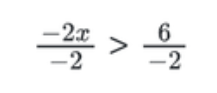
Divide each side of the equation by -2.
x < -3 Switch the in equality when dividing by a negative.
Activity 1: Real-World Inequalities
"Now that you are becoming proficient at working with and solving inequalities, it is important to see how they may be used in real life."
Share the Babysitting Activity (M-8-2-2_Babysitting and KEY). Assign students to complete the activity in groups of four or five. Ask them to be prepared to present their work and answers to the class.
Walk around the room to check student understanding and ensure that everyone is participating. Choose one group to discuss and show their solutions to problem 1 on the board, and another group to solve problem 2. Encourage students to make notes, corrections, and adjustments to their Babysitting Activity sheets.
Activity 2: No Solution/All Real Numbers
Write the following inequality on the board. Instruct students to solve it.
3y – 6 – 5y > 2 + 4y – 6y
As students work, many will likely get stuck or confused. This is intentional since this inequality has no solution! When all of the students have attempted the problem and seem to be in agreement that something is out of the ordinary, explain to the class that this is an example of an inequality with no real solution. Observe:
3y – 6 – 5y > 2 + 4y – 6y
-2y – 6 > 2 – 2y
-2y – 6 + 2y > 2 – 2y + 2y
-6 > 2 This statement will never be true. Because the variable terms cancelled out, we were left with a numerical statement that, in this situation, is not true. Thus, the inequality has no solution.
“Now try this example.”
-8(x + 7) < 2(-4x) – 9
Again, students will recognize that there is something out of the ordinary in this equality, too. Because of the preceding example, they may be tempted to state "no solution". However, explain to the students that this is an example of an inequality with a solution of all real numbers.
Observe:
−8(x + 7) < 2(−4x) – 9
−8x – 56 < −8x – 9
−8x – 56 + 8x < −8x – 9 + 8x
−56 < −9 This statement is always true. Because the variable terms cancelled out, we were left with a numerical statement that, in this case, is always true. As a result, any real number may be a solution for this inequality.
Distribute the Special Cases Worksheet (M-8-2-2_Special Cases) and ask students to solve the problems. Walk around the room as students work to troubleshoot questions and keep them on task.
Activity 3: Tic-Tac-Toe Equations
Students will engage in a variant of the classic tic-tac-toe game. Instead of just selecting boxes to place Xs and Os in, students must correctly solve the equation or inequality to claim the box. The first student who gets three Xs or Os in any row, column, or diagonal is the winner.
Sample game board:
(Note: Some of the answers are in fraction form. Make sure to indicate that all fractions should be reduced to the lowest terms.)
Extension:
As a challenge to students who show proficiency, assign them to work in small groups (or pairs, depending on the number of students). They should be prepared to provide a discussion to the class about the multiplication and division properties of inequalities, as well as how, by using our knowledge of inverse operations and reciprocals, we can explain the division property in terms of the multiplication. Provide students with chart paper and markers.
Refer students back to the Special Cases Worksheet. Problems 1 and 2 involve situations that have no solution. Choose two students at random to go to the board and present their work to the class. Discuss with students how, after using algebraic techniques, the variable disappears, leaving a false statement for the equation and inequality. This indicates that there is no solution.
Ask students if the answer of "no solution" seems reasonable. Do some guess-and-check work and analyze 4x + 1 = 4x - 6. "Can we think of any real number to make this true?" When we state "no solution," we imply that no real number can be substituted for the variable x to make the equation/inequality.
Problems 3 and 4 include statements that are true for all real numbers x.
Again, at random, select a pair to share their work to the class. Say, "Again, when we used algebraic techniques, the variable dropped out. But this time, we ended with a statement that is true! That is, our equation/inequality is true for any real number that we replace for our variable x. So, how many solutions do we have?" (All real numbers.) Have students check this by substituting different values for x and determining whether the equation/inequality is true.
Partner Activity: Have students work in pairs to practice identifying different types of solutions by having one partner create an equation or inequality with a variable on both sides of the relation symbol, and the other partner solve it. They should work together to determine whether there is a solution for x, no solution, or if it is true for all real numbers. Then have them switch roles, with the other partner creating the equation/inequality. Walk around the room to assist and evaluate student comprehension, and have students who require additional reinforcement repeat the exercise as needed.
Small Groups: Students who require more practice can repeat each of the paired and group activities. A small group of about four or five students can work as a team; one student creates an equation or inequality that includes the variable on both sides of the relation symbol, and the rest of the team solves for it. Direct the group members to check their solution by substituting it for the variable in the original equation/inequality. Ask them what it means to have "no solution" and “infinite solutions.”

Variables on Both Sides (M-8-2-2)
Students will learn how to solve multistep linear equations and inequalities that have variables on both sides of the relation symbol. Student will be able to:
- understand the similarities and differences in solution techniques for equations and inequalities.
- combine like terms.
- grasp the concepts of "no solution" and "infinitely many solutions" and be able to recognize specific equations/inequalities as "always true" or "never true."
- represent real-world problems as equations or inequalities, and the solution is expressed in terms of the original situation.


