


























This lesson discusses how personification and alliteration are used in fiction. At the end of the lesson, students are able to:
- Determine personification and analyze the impact of its use.
- Determine what alliteration is and how it works.
- Exhibit your skill to personify and apply alliteration in a unique sentence, as well as to personify an image.
- Why pick up new vocabulary?
- What methods and tools do readers employ to decipher unfamiliar vocabulary?
- How do students expand and improve their vocabulary?
- Alliteration: The repetition of initial consonant sounds in neighboring words.
- Personification: An object or abstract idea given human qualities or human form
- Figurative Language: Language that cannot be taken literally because it was written to create a special effect or feeling.
- Mark Teague. (2002). Dear Mrs. LaRue: Letters from Obedience School. Scholastic Press.
Alternative books:
- Mark Teague. (2004). Detective LaRue: Letters from the Investigation. Scholastic Press.
- Mark Teague. (2008). LaRue for Mayor: Letters from the Campaign Trail. The Blue Sky Press.
- Judith Benét Richardson. (1996). Old Winter. Orchard Books.
- Margaret Atwood. (2002). Princess Prunella and the Purple Peanut. Key Porter Books.
Teachers may substitute other books to provide a range of reading and level of text complexity.
- student copies of the Personification in Fiction worksheet (L-6-1-1_Personification in Fiction)
- student copies of the Tricky Twisted Tangled Titles activity (L-6-1-1_Tricky Twisted Tangled Titles)
- chart paper
- drawing paper
- Concentrate on helping students recognize and comprehend the significance of personification and alliteration in fiction throughout the session. Keep track of anecdotal notes and information regarding students' engagement and understanding of personification and alliteration while you watch them.
- If required, go over personification instances with the class, with individual students, or in small groups from other Mark Teague LaRue novels and other alliteration books (mentioned in Materials).
- Utilize the checklist below to assess pupils' comprehension:
+ Students exhibit the capacity to effectively employ personification and alliteration in figurative language in an original statement.
+ Students draw an artwork that personifies a creature, an item, or an abstract concept.
+ Students create an alliterative statement that makes sense.
Explicit instruction, modeling, and active engagement
W: Assist students with drawing on their past understanding of figurative language; they can then investigate and utilize personification and alliteration in fiction.
H: Take the class on a creative writing project that helps them go over the meanings of personification and alliteration.
E: Encourage students to investigate how personification and alliteration are used in literature and to utilize what they have learned about these literary strategies to create examples.
R: Assist pupils in deepening their comprehension of personification by having them pair up and match the original titles with alliterative ones.
E: Have students create alliterative sentences to demonstrate how they have learned about personification and alliteration.
T: Provide a range of reading resources for students to choose from, allowing for variable grouping based on their reading levels. Additionally, allows topics to be expanded following students' learning levels.
O: This lesson's learning exercises include large-group instruction and discussion, small-group inquiry, pair work, and individual application of the material.
Main question: What effect does figurative language have on the interpretation of a work of fiction?
Part 1
Present pupils with a pair of distinct classroom items, such as a pencil and an eraser. Next utter, "I had an odd conversation with an eraser and a pencil this morning. They disclosed some embarrassing personal details to each other throughout their conversation. They expressed to me their frustration at being repeatedly used. They thought they were starting to appear jaded and outdated. They asked me to remind you to use them with greater caution and consideration."
Say, "Use your prior understanding of figurative language to determine the kind of figurative language I was demonstrating." Discuss with your partners why they believe you shared this scenario with them.
Ask students to describe the kind of figurative language they believe was used in the passage. On a chart paper page, note their answers.
Help pupils comprehend that personification was the kind of metaphorical language you used. Say, "Personification is the process of endowing objects or animals with human characteristics. As an illustration, I mentioned to you that the eraser and pencil were expressing their emotions, even though we all know that this isn't possible. As a result, the pencil and eraser started taking on human forms."
"We're going to read the personification-focused book Dear Mrs. LaRue: Letters from Obedience School," you say. Read the book in front of the students.
Give each student a copy of the Personification in Fiction worksheet (L-6-1-1_Personification in Fiction). Give a copy of the book Dear Mrs. LaRue: Letters from Obedience School to small groups. Say, “You are going to go back over this book and document instances of personification”.
As you write the students' responses on the board or interactive whiteboard, invite them to share their responses. Permit students to add material or make any necessary edits to their worksheets.
Ike is the personification of a dog.
Potential textual proof
writing the owner's letters
conversing and reasoning in a human-like
being morally conscious
lying
being recognized as a hero and winning an award
Ask students to consider and debate the reasons why writers could employ personification in their works. Ask: "Do you think personification is a common technique used by writers in fiction? How does a text's meaning change when personification is used?" Explain to students that personification adds intrigue and helps details in a text come to life.
Part 2
Check your alliteration. Say, "Alliteration, or the repetition of beginning sounds in a group of words, is another type of figurative language we are going to discuss."
On the interactive whiteboard or board, write the following alliterative sentences, emphasizing the first letter of each word:
flimsy fluff floats
slippery slithery snakes
babbling bouncing babies
crispy crunchy crackers
Ask pupils to pronounce these words as fast as they can after reading them aloud. Because every word in these phrases begins with the same sound, students will find it difficult to repeat them over and over.
Say, "The repetition of initial consonant sounds is known as alliteration. We may play and manipulate words with alliteration while having fun with language. Alliteration is a technique used by writers of poetry and fiction to give their work voice and rhythm. Alliteration aids in highlighting a text's meaning."
Say, "Today we're going to read Princess Prunella and the Purple Peanut, a book that uses alliterative wordplay to great effect." Read the book aloud to the students.
Talk about some of the alliterative terms that are used in the text once you have finished reading the book. Some instances are as follows:
“wrinkly-wristed wise woman”
“For supper, she fed Prunella some parsley and paprika soup, a pile of potted chicken and pickerel pancakes, and some pepper and porridge preserved, on a pretty plate platted with pendulous poppies.”
“Princess Prunella is proud, prissy, and pretty.”
Say, "We're going to look at some more titles that use alliteration. Every word in the title has the same initial letter and pronunciation. To finish this project, we will use well-known stories."
Write the following titles on a piece of chart paper:
Snow White and the Seven Dwarfs
Beauty and the Beast
Goldilocks and the Three Bears
Cinderella
Pinocchio
The Gingerbread Man
Hansel and Gretel
The Three Little Pigs
Ask students to summarize each story in a few sentences. "You will be completing the Tricky Twisted Tangled Titles worksheet (L-6-1-1_Tricky Twisted Tangled Titles) with a partner," you say next. " The original narrative title and the supplied alliterative story title must match. For one of the stories, you will also create an original alliterative title."
Give the worksheet to every pupil. Examine the pupils' progress as you move around the room.
Once the pupils are done, ask them to present their solutions to the class. Permit students to present their creative names that include alliteration. These can be written on chart paper, the board, or an interactive whiteboard. Help pupils understand how alliteration strengthens meaning and adds emphasis.
MATCHING ANSWER KEY: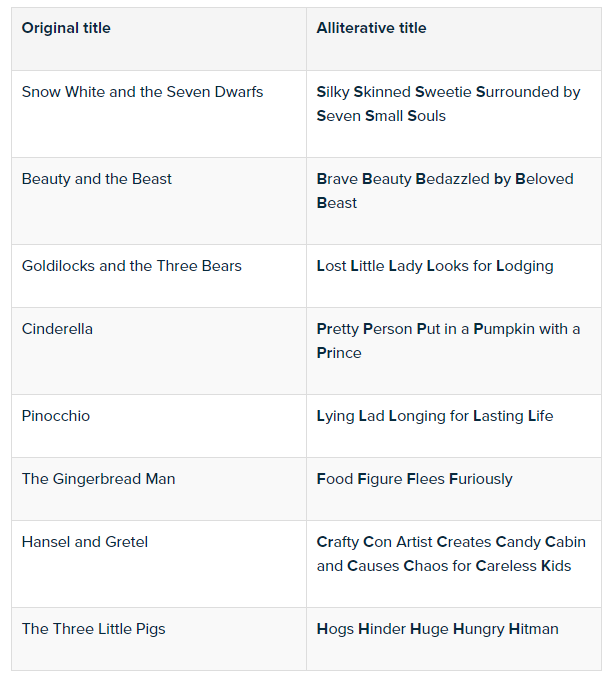
Give every pupil a page of drawing paper. Say, "You're going to write a personified alliterative sentence. In addition, you will sketch out your sentence." Remind students that their phrases can be amusing, but they must make sense. Inform pupils that they can construct cohesive sentences by using terms such as "the, of, like, and to".
Give pupils the following alliterative statement as an example:
Winter whispered while white snow fell.
Ask students to suggest ways to illustrate the sentence.
Extension:
Students can study the other books listed in Materials that employ personification if they need more learning opportunities. Help students find instances of personification in each text and investigate how personification is used to convey meaning.
Students who require more practice comprehending alliteration should read poems like "Betty Botter" from Mother Goose or poems from Shel Silverstein's books A Light in the Attic, Where the Sidewalk Ends, and Falling Up in Small Groups.
Encourage students who are ready to go above and beyond the standard to build alliterative sentences to tell the story using The Snowman and Sector 7, or other wordless novels. Ask students to choose which abstract concept or object is personified in the drawings, then explain how the personification contributes to the meaning. Allow kids to use their alliterative phrases to read aloud to the class from their picture books.

Understanding the Use of Personification and Alliteration (L-6-1-1)
This lesson discusses how personification and alliteration are used in fiction. At the end of the lesson, students are able to:
- Determine personification and analyze the impact of its use.
- Determine what alliteration is and how it works.
- Exhibit your skill to personify and apply alliteration in a unique sentence, as well as to personify an image.


