


























Students learn about the significance of characters in literary texts in this lesson. After this lesson, students are able to:
- determine who the characters in a book are.
- talk about the characters' words, deeds, and emotions.
- describe how the words, deeds, and emotions of characters influence the plot of a story.
- How can literary and informational texts make sense to strategically minded readers?
- What is the actual topic of this text?
- How does reading a text aloud elicit thought and reaction?
- Literary Text: Stories about people or events that are made up by an author.
- Characters: The people or animals in a story.
- Events: The things that happen in a story.
- Rosemary Wells. (2009). Yoko. Disney-Hyperion.
- Leo Lionni. (1974). Alexander and the Wind-Up Mouse. Dragonfly Books.
Alternative books:
- Don Freeman. (1977). Dandelion. Perfection Learning.
- Bernice Chardiet and Grace MacCarone. (1992). Brenda’s Private Swing. Scholastic, Inc.
- Kevin Henkes. (2008). Chrysanthemum. Mulberry Books, 2008.
- Karen Ackerman. (2003). Song and Dance Man. Scholastic, Inc.
Teachers may substitute other books to provide a range of reading and level of text complexity.
- paper
- pencils, colored pencils, crayons, markers
- Throughout the class, pay close attention to the pupils' ability to discuss literary characters. To help students understand character analysis when they read a literary novel independently, provide them with examples of character analysis. Examine the students' capacity for expression and openness to taking part in group discussions.
- To evaluate each student's progress toward the lesson's objectives, use the following checklist:
+ Students are able to characterize literary novel characters.
+ Students are able to recognize the words, deeds, and emotions of literary characters.
+ Students are able to explain the significance of characters in a story. For this lesson, assign students to select one of the two texts you read aloud. "What character in this novel is your favorite? Give an example of a character's actions in this novel. When the character does something, how does s/he feel? In what ways might the narrative change if the character hadn't taken that action?", asks each student.
Explicit instruction, modeling, scaffolding, and active engagement
W: Assist students with recognizing characters in literary works and help them comprehend the significance of a character's words, deeds, and emotions in a narrative.
H: Start the class off with a discussion of a well-known nursery rhyme.
E: Show pupils how to recognize and evaluate characters.
R: Assist pupils in analyzing the words, deeds, and emotions of characters.
E: Let students discuss characters in other literary texts to put what they've learned into practice.
T: Give pupils the chance to collaborate in big groups and with a partner.
O: This lesson's learning activities offer large-group instruction and discussion, companion work, and individual idea application.
Main Question: What makes characters significant in a narrative?
"Are you familiar with the children's song 'Little Miss Muffet?'" (Students may or may not know this rhyme.) "Please recite it with me if you are familiar." Read aloud the rhyme:
Little Miss Muffet sat on a tuffet.
Eating her curds and whey.
Along came a spider,
Who sat down beside her?
And frightened Miss Muffet away.
Teach students that the humans or animals in a story are called characters. "What characters are there in this rhyme? " (Little Miss Muffet, the spider) "What is Miss Muffet doing in this rhyme?", you ask (She's perched on a tuffet. She's consuming whey and curds.) Tell them that cottage cheese was once known as "curds and whey" and that a tuffet resembles a stool covered in cloth. "What does the spider do in this rhyme?" (It sits next to her.) "What does Miss Muffet do when the spider sits next to her?" (She takes off.) "Why does she flee?" (She feels afraid.) Ask volunteers to take on the parts of Miss Muffet and the spider in the nursery rhyme.
"What impact would the spider have on the rhyme if it hadn't been sitting next to Miss Muffet?" (Miss Muffet wouldn't bolt out of fear.) "In what ways might the rhyme change if Miss Muffet had no fear of spiders?" (Miss Muffet refused to flee. The spider and she might become pals.) Ask volunteers to perform different renditions of the children's song.
"Why do the characters' deeds and emotions matter to the rhyme?" Ask students to talk to a partner about the responses they received. Next, invite group responses from the students. (They aid in telling the tale.)
Part 1
"We're going to read the book Yoko today," you say. "Consider the characters' words and deeds while I read this book to you. Reflect on the emotions of the story's characters. Next, we'll discuss the author's use of characters to convey a story."
Read the novel Yoko out loud. Next, inquire as to "Who is the story's most significant character?" (Yoko) What makes you believe that Yoko is the most significant character? (Every event in the narrative revolves around her.) We refer to Yoko as the primary character since she is the most significant character in the narrative. However, Yoko is not the sole figure. Who are the other narrative characters?" (The Franks; Timothy, Valerie, Fritz, Tulip, Hazel, Doris; Yoko's mother; Mrs. Jenkins, her teacher)
Practice describing characters with descriptions and pictures while you read the text. Say, "Yoko is happy and excited before she goes to school. I can infer her feelings from the words and photos. She smiles in the photos. She promises her mother that today will be amazing. She greets each one of her pals."
Direct pupils to utilize the text to answer questions. Ask a series of questions like " How does Yoko's life alter around lunchtime? (Yoko's peers tease her about her meal.) "What is Yoko's feeling towards this?" (she is depressed). "What hints in the narrative enable you to infer Yoko's feelings?" (She's in tears.) "How would the story be different if Yoko hadn't grown depressed?" (Take in student feedback.)
Let's say that Mrs. Jenkins chooses to celebrate International Food Day at the school. Let's examine the narrative for hints that will clarify her decision. Take note of the student's answers and ask them to look for confirmation in the narrative's images or text. (Possible responses: She wants to assist Yoko and is concerned about her. She believes the pupils will sample foods they wouldn't otherwise eat. She hopes that the pupils won't make fun of one another's meals anymore.)
Say, initially, "Mrs. Jenkins' plan is ineffective for Yoko since none of the kids would try sushi. When no one eats Yoko's sushi, how does she feel? (She is depressed.) What hints in the narrative let you know that she is depressed?" (She reclines in solitude beneath the learning tree.)
Say, "The author demonstrates that Mrs. Jenkins tries to assist Yoko, so we know she is important to the story. Mrs. Jenkins's actions alter the story's direction."
Pose a range of questions: "What character finally consumes Yoko's sushi? " (Timothy) "Why does Timothy choose to try Yoko's sushi?" (His hunger persists.) "After tasting the sushi, what does Timothy think of it?" (It pleases him.) "What hints in the narrative enable you to deduce this?" (He requests that Yoko bring him additional sushi the following day.) "Why does Timothy tasting Yoko's sushi matter to the plot?" (Yoko's attitude about school is altered by this incident since he tastes and likes it.)
Question: "What occurs after Timothy consumes Yoko's sushi?" (Thomas and Yoko become close friends. They decide to launch a pretend restaurant together.)
"What aids in narrating the author's story?" Instruct the class to react collectively. Say, "Yes, the words, actions, and feelings of the characters help us understand what is happening in the story and why it is happening." (the characters' words and deeds)
Part 2
Make a graphic to assist students in reviewing the significance of characters on the board or interactive whiteboard. Here's one instance: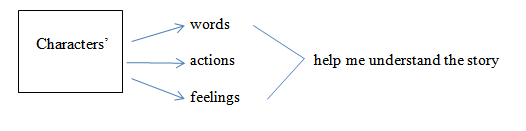
Reviewing Yoko's words, deeds, and emotions and talking about how they aid the reader in comprehending the narrative is possible.
Present the book "Alexander and the Wind-Up Mouse" after that. Declare, "This book will teach us why characters are significant in literary works." Read the book out loud. Next, find out who the characters in this story are. (Alexander, Lizard, and Willy the wind-up mouse toy) Make sure students use the text's pictures and words to support their answers about the characters as you guide them through the story. "How does Alexander feel at the start of the story?" (He feels alone and terrified. He laments that no one finds him endearing.) "What occurs to Alexander that modifies his situation?" (He gets to know the toy mouse, Willy.) "What is Willy's initial emotional state throughout the story?" (He is content since he is Annie's preferred toy.) "What is Alexander's reaction upon learning that Willy is loved by all?" (He is happy to have made a friend, but he is also unhappy and envious.) "What is the story that Willy tells Alexander?" (The garden contains a lizard that can transform into any other animal.) "What thoughts does Alexander have after hearing this tale?" (Perhaps the reptile might transform him into a wind-up mouse.) "What makes Alexander want to transform into a plush mouse?" (He believes he will be adored.)
"What happens to Willy that makes Alexander decide against becoming a toy mouse?", you continue asking. (Willy is placed in a box intended for disposal.) "So, what does Alexander do?" (He requests the lizard to turn Willy into a genuine mouse rather than turning him into a toy mouse.)
"What is Alexander's reaction when he returns to look for Willy and discovers an empty box?" (He is depressed.) "What is causing him to feel that way?" (He believes he has lost his sole friend and that Willy has already been kicked out.)
"What is Alexander's reaction when he discovers Willy and realizes that he is a real mouse?" (He wants to rejoice and is ecstatic. He desires to dance into the night.) "What's Willy feeling like?" (He shares Alexander's happiness.)
Bring the image that was made at the start of Part 2 to the students' attention. "Why are these characters significant to the plot?", you ask. (The words and deeds of the characters teach us what is going on and why.)
Ask the following questions, and then have students talk to a partner about the answers:
“How do Alexander and Willy differ, and how are they alike?”
"If Willy hadn't come to be real, how would the story have changed?"
Next, invite a few students to present their solutions to the class.
Part 3
"It's your turn to discuss characters you have read about in literary books," you can say.
Compile the literary works that the students have studied in the school libraries and classrooms. Books should contain well-known tales that are appropriate for pupils to read on their own. Present the books, then pair up every student with a companion. Say, "Each of you and your partner will select a book. Together, you will read your books. After that, you'll discuss a character from each novel."
"What are some questions you might ask yourself as you read your books about characters?" you ask. To help students with their reading and discussion, write their answers on the board. Some instances are as follows:
What kind of character is it?
What emotion does the character have?
What occurs to the story's character?
Make your way around the classroom, listening to the children as they talk about the characters in their books. Make a note of the students who get the literary book character element and the ones who don't. Help students who are struggling to explain the characters or who do not comprehend them. Prompt with questions like "Who is the main protagonist? What is the character's emotional state when...? What takes place next? How does the persona act?"
Extension:
Students who need more guidance or practice can engage in any of the following activities:
Select a literary book to read from the library. After that, they should select their favorite character from the novel and explain why the plot revolves around them.
Sketch the character they like most from a book. Write a phrase describing the character and label their artwork with the name of the character. Students should compare their characters in small groups.
Put yourself in the shoes of your favorite character and finish these sentences: ________________________ is my name. It is because of _______________________________________________ that I feel ____________.
Students who are prepared to go beyond the basics should rewrite a well-known story by altering the main character's actions and emotions. Students should be asked to share their new narrative with a companion and talk about how the actions and emotions of the characters altered the plot.

Understanding the Importance of Characters in a Story (L-1-3-1)
Students learn about the significance of characters in literary texts in this lesson. After this lesson, students are able to:
- determine who the characters in a book are.
- talk about the characters' words, deeds, and emotions.
- describe how the words, deeds, and emotions of characters influence the plot of a story.


