


























Views
Downloads

Kindergarten Spelling Practice | Essential ELA Worksheet
Paste this activity's link or code into your existing LMS (Google Classroom, Canvas, Teams, Schoology, Moodle, etc.).
Students can open and work on the activity right away, with no student login required.
You'll still be able to track student progress and results from your teacher account.
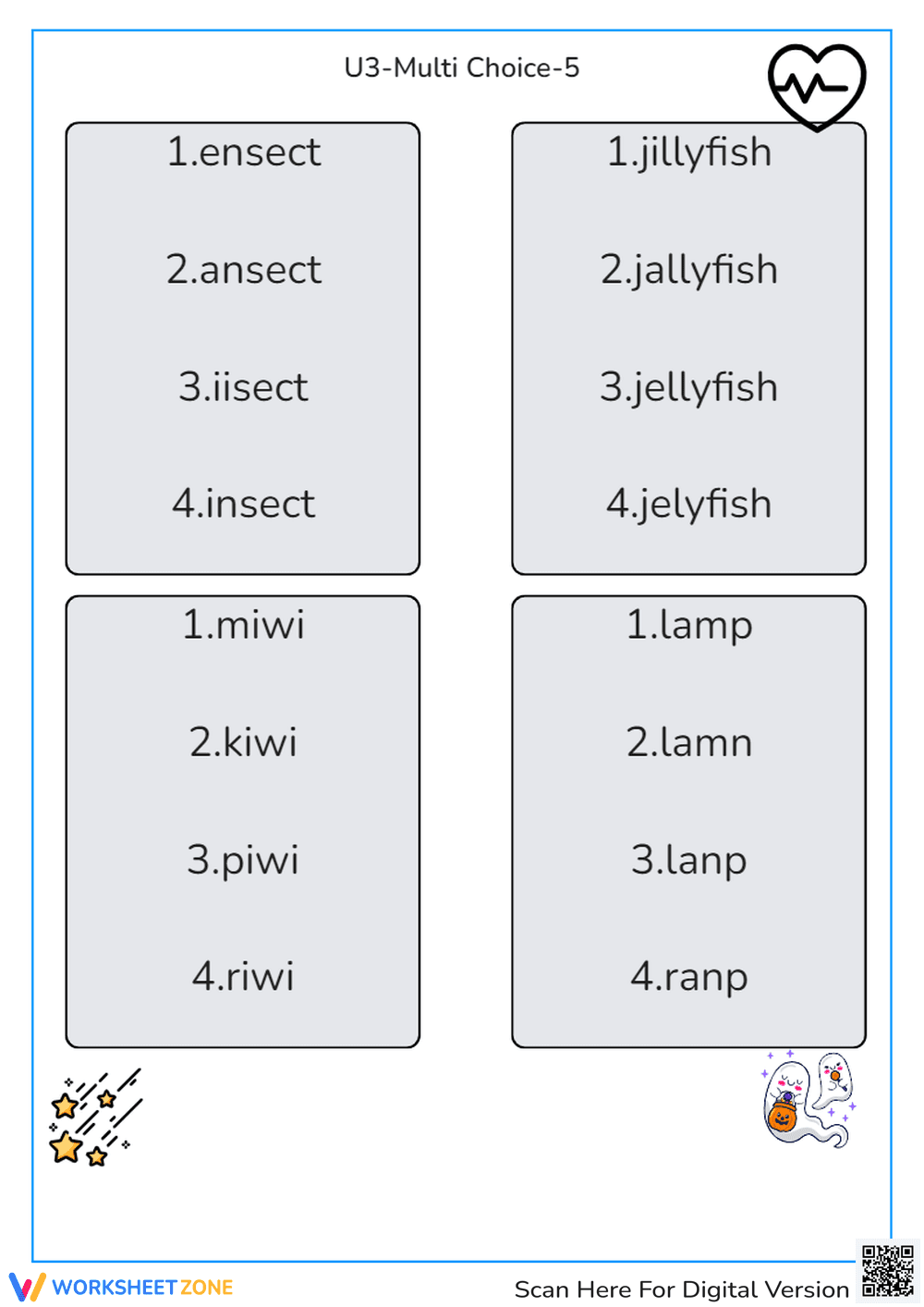
This Kindergarten spelling worksheet helps young learners develop word recognition and phonetic accuracy through multiple-choice identification. By distinguishing between correct and incorrect letter combinations for common words like insect and jellyfish, students strengthen their orthographic mapping skills. This activity ensures foundational literacy success by focusing on precise letter-sound relationships in a simple, engaging format.
At a Glance
- Grade: Kindergarten · Subject: ELA
- Standard:
CCSS.ELA-LITERACY.L.K.2.D— Spell simple words phonetically using knowledge of sound-letter relationships- Skill Focus: Spelling & Word Recognition
- Format: 1 page · 4 problems · Answer key included · PDF
- Best For: Independent practice or morning work
- Time: 5–10 minutes
The worksheet features one high-quality page containing four distinct multiple-choice boxes. Each box presents four spelling variations of a single word, challenging students to select the correct version. The layout is clean and distraction-free, featuring words like kiwi and lamp to test both vowel and consonant recognition. A full answer key is provided for quick grading.
The activity follows a clear instructional path. First, guided practice occurs as teachers model how to sound out the options in the first box. Second, supported practice allows students to work through the middle tasks using phonetic cues. Finally, independent practice is achieved as students complete the final word identification. This gradual-release approach builds confidence in early readers.
This resource aligns with `CCSS.ELA-LITERACY.L.K.2.D`, which requires students to spell simple words phonetically by drawing on their knowledge of sound-letter relationships. It also supports CCSS.ELA-LITERACY.RF.K.3 by fostering phonics and word recognition skills. Both standard codes can be copied directly into lesson plans, IEP goals, or district curriculum mapping tools.
Use this worksheet as a quick formative assessment after a phonics lesson on short vowels or initial sounds. It is also perfect for a literacy center rotation where students can use whisper phones to hear the differences between the spelling options. Expect students to finish in 5 to 10 minutes, making it an ideal exit ticket to gauge mastery.
This resource is designed for Kindergarten students, particularly those working on phonetic decoding and orthographic awareness. It is highly effective for English Language Learners (ELLs) who need visual reinforcement of word structures. Pair this with a picture-word anchor chart or a direct instruction lesson on common nouns to maximize student learning outcomes.
According to the RAND AIRS 2024 report, early exposure to structured word recognition tasks significantly improves long-term reading fluency and spelling accuracy in primary grades. This worksheet targets the specific phonetic decoding skills necessary for Kindergarteners to transition from letter-sound awareness to full word production. By isolating specific spelling challenges—such as vowel substitutions in insect or consonant swaps in lamp—the resource provides the targeted practice required for orthographic mapping. Research from Fisher & Frey (2014) emphasizes that multiple-choice formats in early literacy can serve as effective scaffolds for students who are still developing the fine motor skills needed for writing but possess the cognitive ability to recognize correct phonetic patterns. This 1-page PDF provides a high-utility tool for educators to verify that students are internalizing the sound-letter relationships defined by CCSS.ELA-LITERACY.L.K.2.D, ensuring a solid foundation for future ELA success.


