


























Views
Downloads



Printable Types of Polynomials Worksheet | Algebra 1 Ready
Paste this activity's link or code into your existing LMS (Google Classroom, Canvas, Teams, Schoology, Moodle, etc.).
Students can open and work on the activity right away, with no student login required.
You'll still be able to track student progress and results from your teacher account.
This comprehensive three-page worksheet helps Algebra 1 students master the identification and classification of polynomials. By simplifying expressions and counting terms, learners build a solid foundation for more complex operations. The structured activities ensure students can confidently distinguish between monomials, binomials, and trinomials while applying critical thinking to algebraic descriptions.
At a Glance
- Grade: 9 · Subject: Algebra 1
- Standard:
CCSS.MATH.CONTENT.HSA.APR.A.1— Understand that polynomials form a system analogous to integers; add, subtract, and multiply- Skill Focus: Polynomial Classification and Simplification
- Format: 3 pages · 22 problems · Answer key included · PDF
- Best For: Initial instruction and formative assessment
- Time: 30–45 minutes
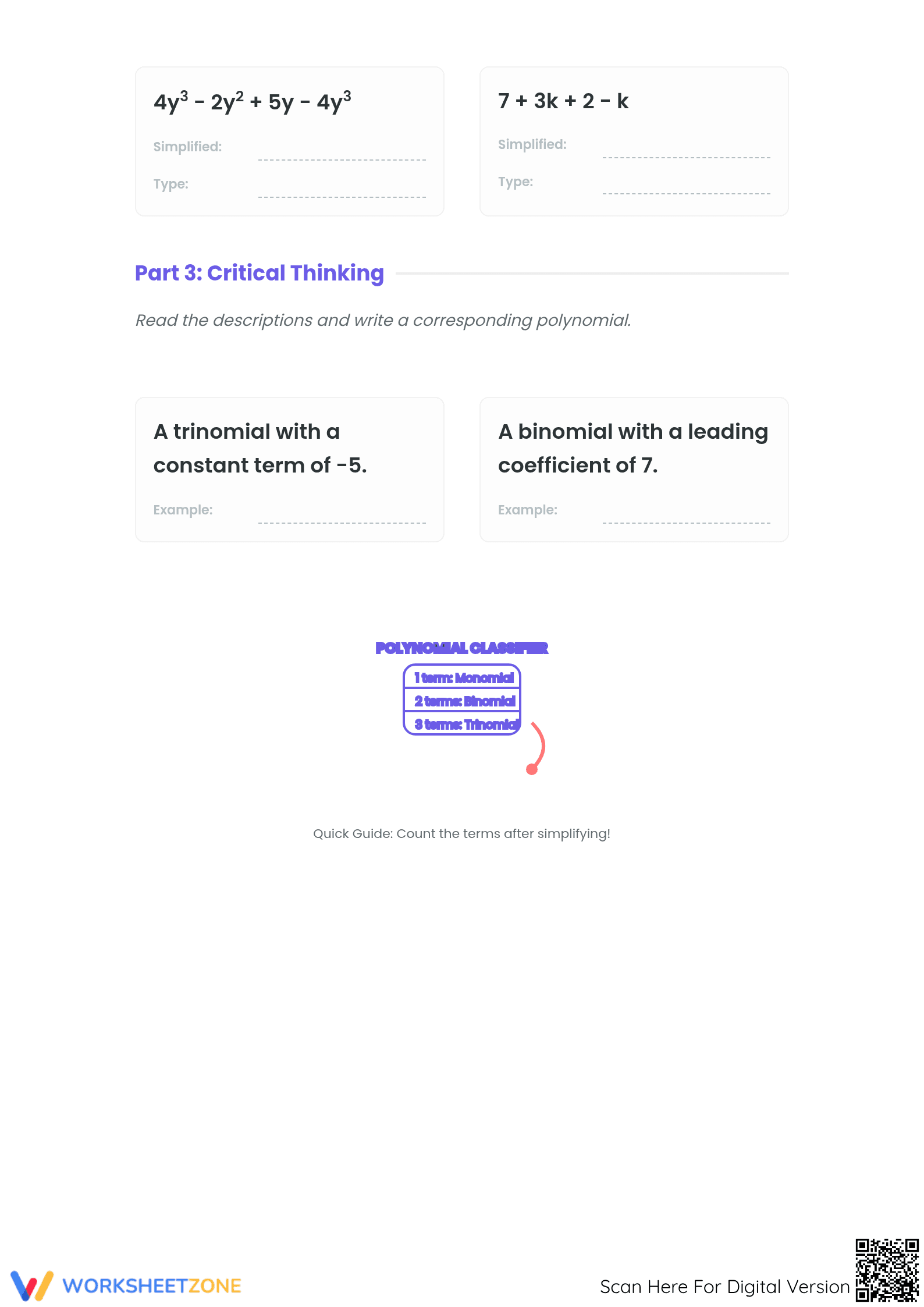
This resource features three distinct sections designed to scaffold student learning. The first page focuses on basic classification through simplification, while the second page introduces complex extension practice involving variable distribution. The final page challenges students with critical thinking prompts, requiring them to construct original polynomials based on criteria like constant terms and leading coefficients.
- Guided practice: Students simplify 12 straightforward expressions and identify their type (monomial, binomial, or trinomial) using a visual "Polynomial Classifier" cheat-sheet for support.
- Supported practice: Learners tackle 8 extension problems requiring distribution and combining like terms before classifying the final expression, increasing the overall cognitive load.
- Independent practice: The "Critical Thinking" section prompts students to synthesize knowledge by writing polynomials that meet specific parameters, demonstrating a deep mastery of polynomial anatomy.
This worksheet is primarily aligned to CCSS.MATH.CONTENT.HSA.APR.A.1, focusing on the structural understanding of polynomials. It also supports HSA-SSE.A.1 as students interpret parts of an expression, such as terms and coefficients. Both standard codes can be copied directly into lesson plans, IEP goals, or district curriculum mapping tools.
Assign this during the "We Do" phase of an algebra lesson to check for understanding. Teachers can use the Critical Thinking section as an exit ticket to observe if students can translate verbal descriptions into notation. It is an ideal resource for differentiated small-group instruction.
This resource is designed for Grade 9 Algebra 1 students but works for accelerated 8th-grade classes. It pairs naturally with a polynomial anchor chart or direct instruction. The visual classifier supports English Language Learners and students with IEP accommodations.
Mastery of polynomial classification is a critical milestone in secondary mathematics, as identified by research from EdReports 2024. This worksheet specifically addresses the CCSS.MATH.CONTENT.HSA.APR.A.1 standard by requiring students to simplify and categorize expressions based on their components. By transitioning from rote simplification to critical thinking tasks, the resource aligns with the "gradual release of responsibility" framework popularized by Fisher & Frey (2014). Students who can accurately identify monomials, binomials, and trinomials are better prepared for the rigorous demands of polynomial operations. The inclusion of 22 tasks ensures high-repetition practice, which ScienceDirect TpT Analysis suggests is vital for long-term procedural fluency. This focused approach provides educators with clear evidence of student proficiency, making it an essential tool for both initial instruction and targeted intervention in the math classroom.


