


























Views
Downloads

Essential Triangle Properties & Angles Worksheet (Grade 7-8)
Paste this activity's link or code into your existing LMS (Google Classroom, Canvas, Teams, Schoology, Moodle, etc.).
Students can open and work on the activity right away, with no student login required.
You'll still be able to track student progress and results from your teacher account.
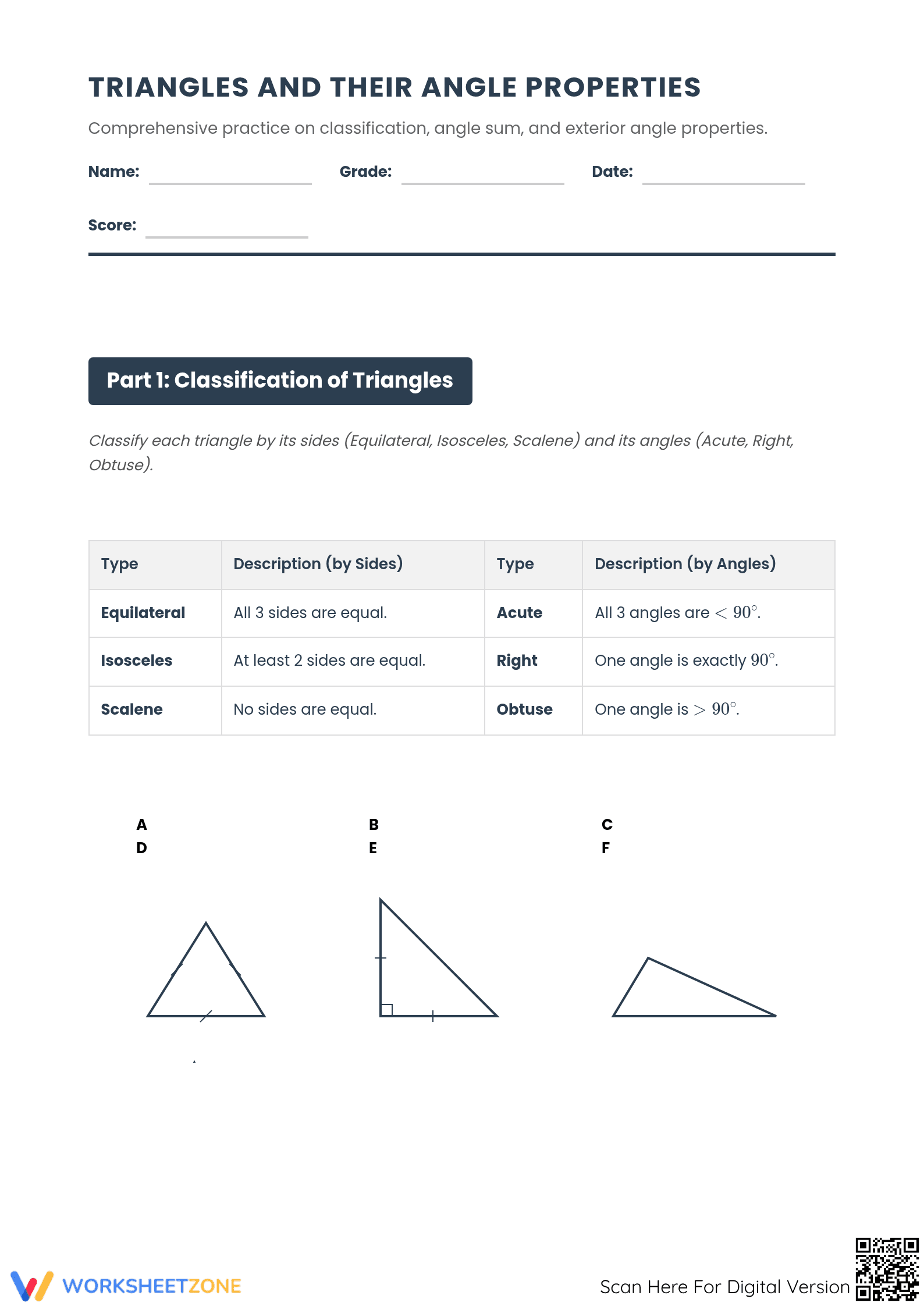
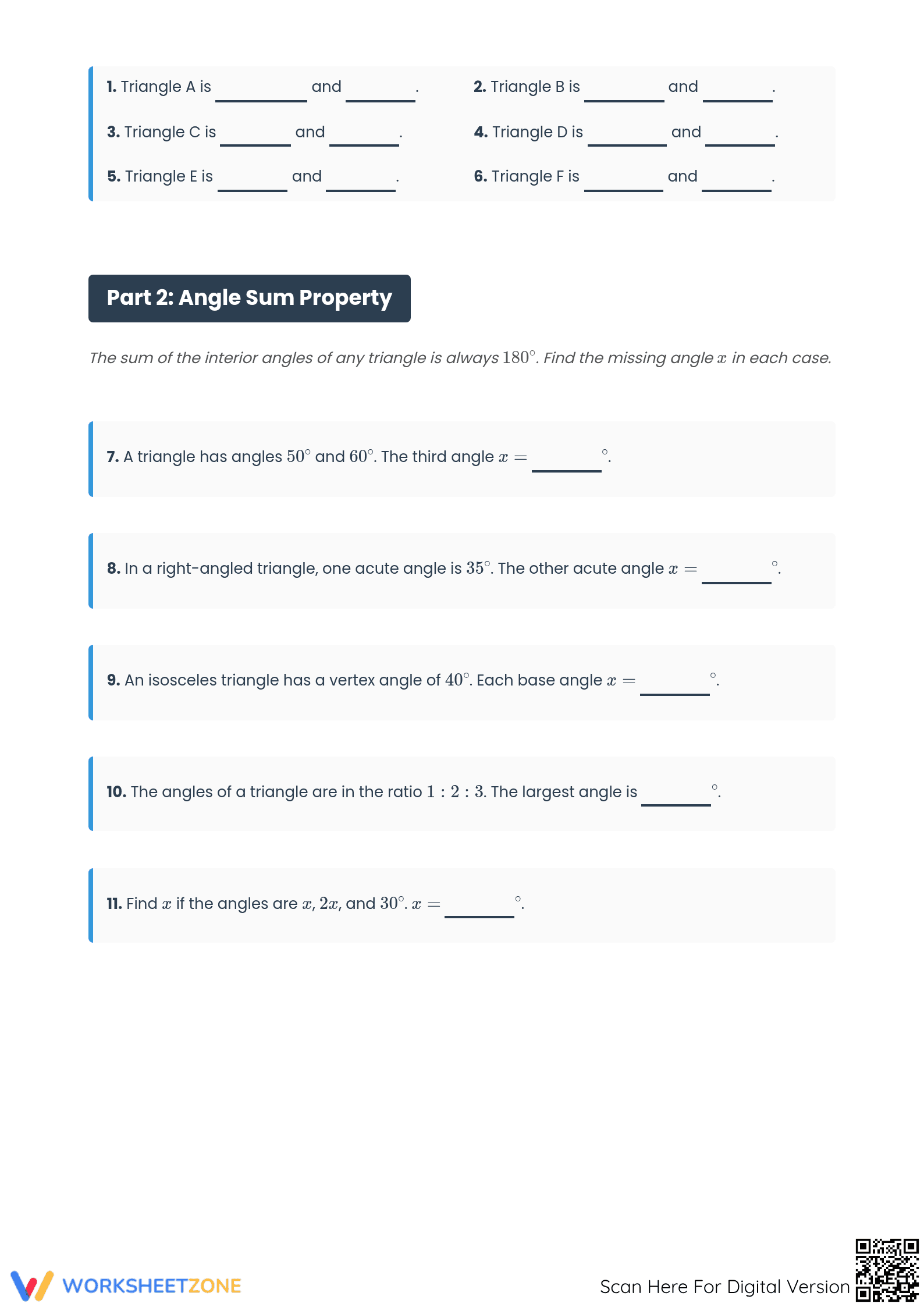
This comprehensive five-page geometry resource provides students with rigorous practice on the fundamental properties of triangles. By working through 28 structured tasks, learners master triangle classification by sides and angles, the interior angle sum theorem, and the exterior angle property. This resource bridges the gap between basic geometric identification and complex algebraic reasoning.
At a Glance
- Grade: 7–8 · Subject: Math / Geometry
- Standard:
8.G.A.5— Use informal arguments to establish facts about the angle sum and exterior angle of triangles- Skill Focus: Triangle classification and angle properties
- Format: 5 pages · 28 problems · Answer key included · PDF
- Best For: Middle school geometry mastery and assessment
- Time: 45–60 minutes
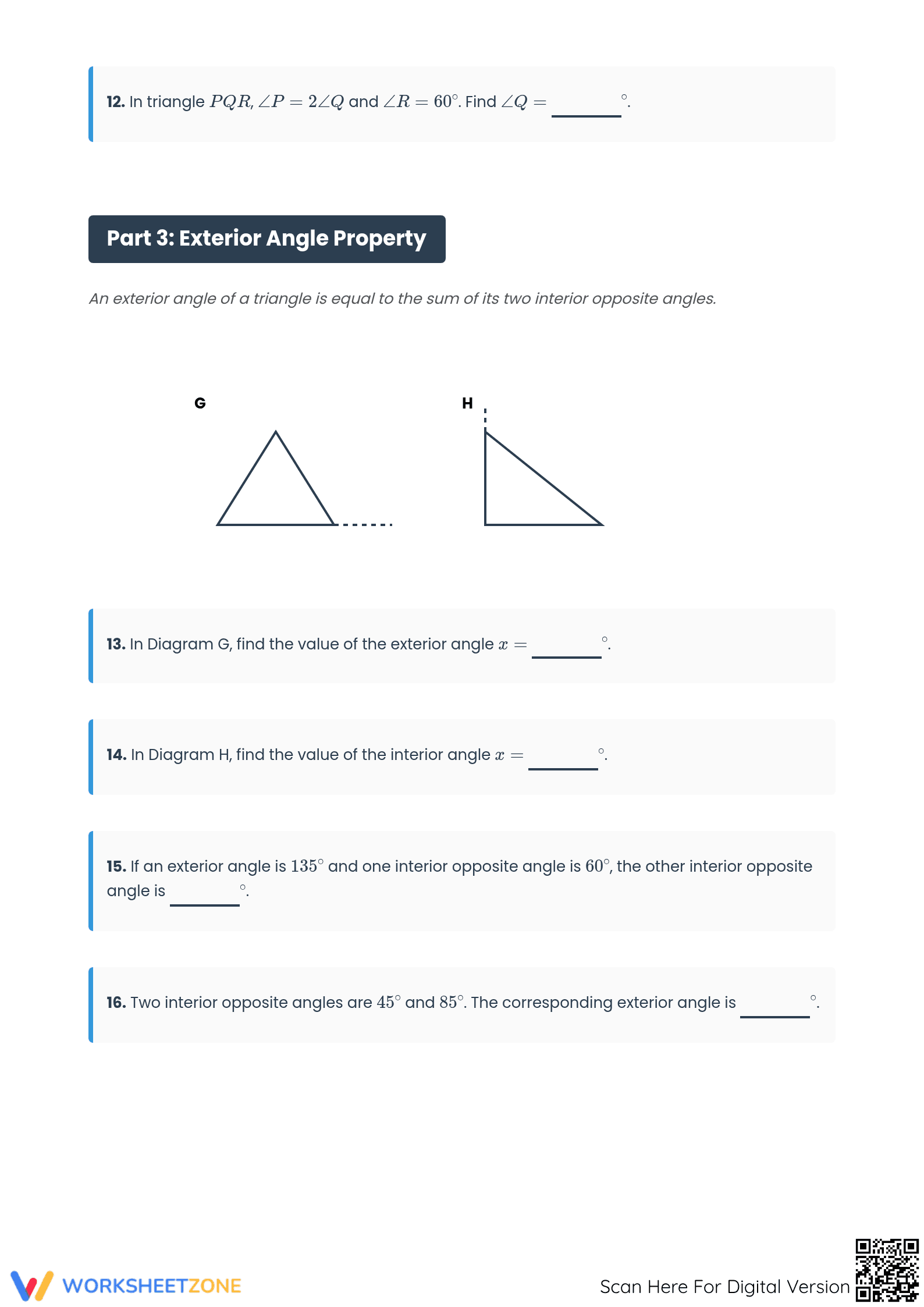
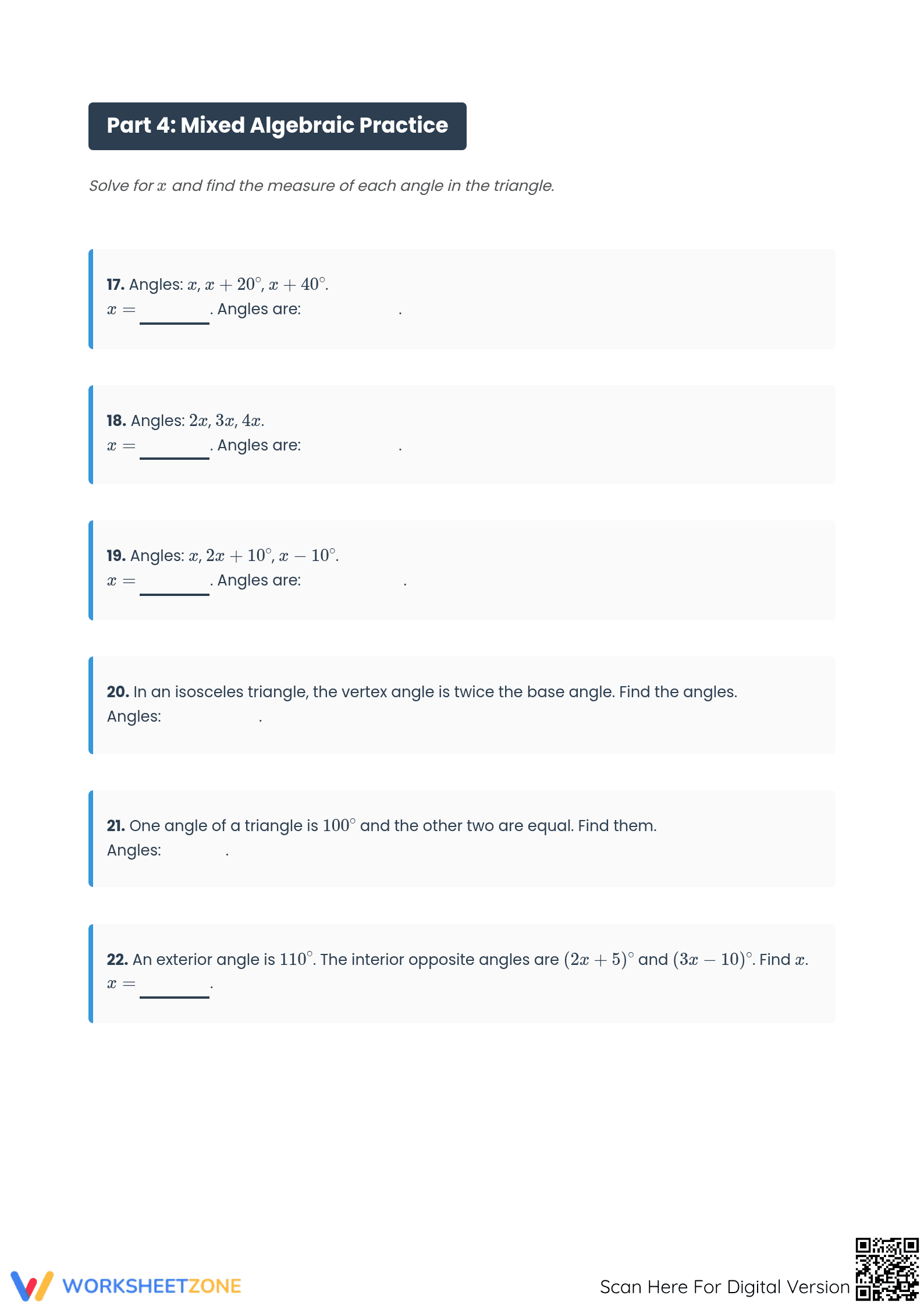
The worksheet is organized into six distinct sections that build in complexity. Students begin with a visual classification guide and identification tasks, progress to calculating missing interior angles, and then apply the exterior angle theorem. The final pages integrate algebraic expressions, requiring students to solve for variables to find specific angle measures. A full five-page answer key ensures efficient grading and immediate feedback.
Skill Progression
- Guided practice (6 tasks): Students use a detailed reference table to classify six unique triangles by both their side lengths (Equilateral, Isosceles, Scalene) and internal angle measures (Acute, Right, Obtuse).
- Supported practice (10 tasks): Students calculate missing angle measures using the 180-degree interior sum property and the exterior angle theorem, utilizing clear diagrams as scaffolds for their calculations.
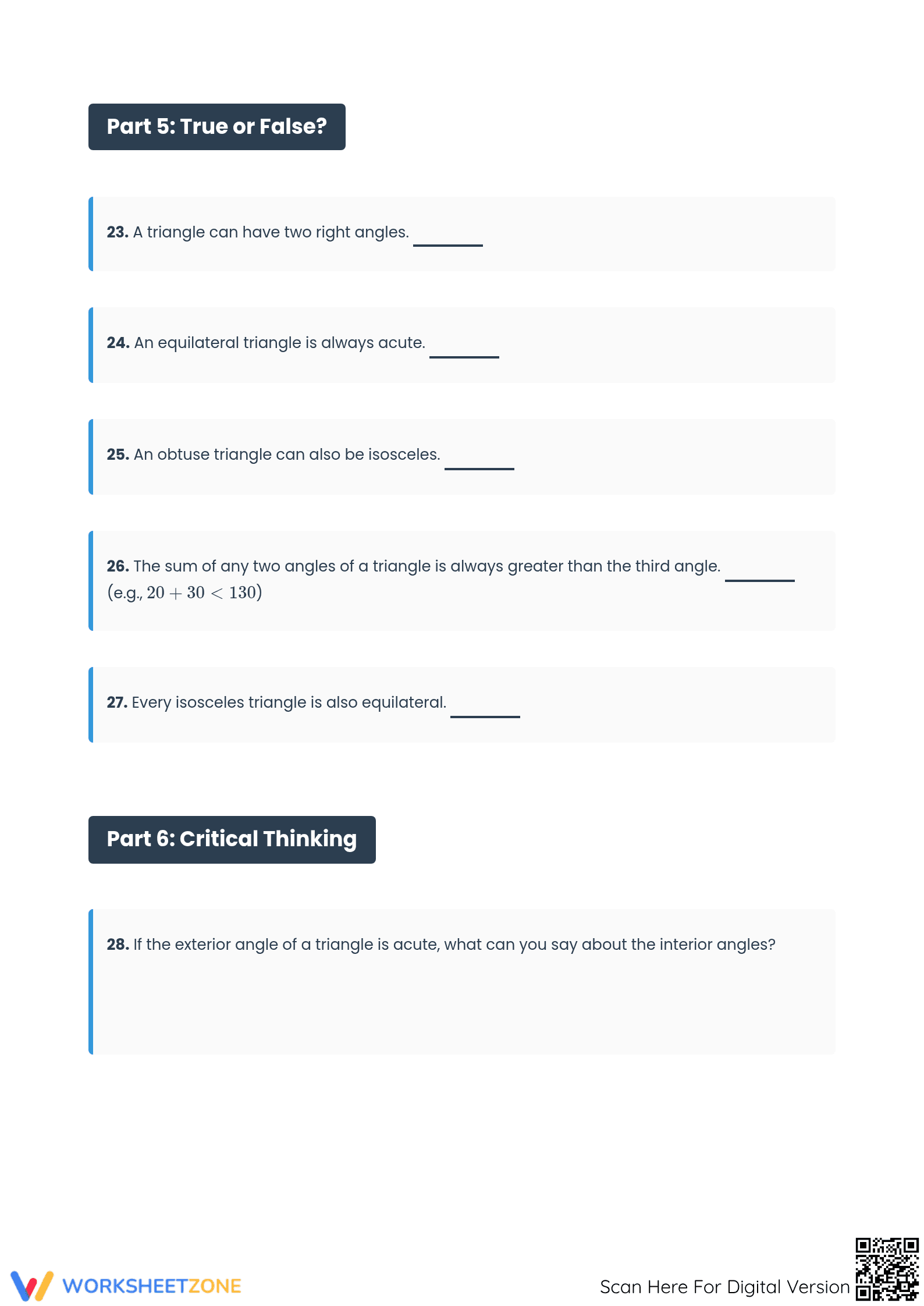
- Independent practice (12 tasks): Learners solve complex algebraic problems where angle measures are represented by variables, followed by true/false conceptual checks and a high-level critical thinking challenge.
This structure follows a gradual-release model, moving from concrete visual identification to abstract algebraic application.
Standards Alignment: This resource is primarily aligned to `8.G.A.5`, focusing on establishing and using facts about the angle sum and exterior angle of triangles. It also supports `7.G.B.5` by requiring students to solve simple equations for unknown angles in a figure. Both standard codes can be copied directly into lesson plans, IEP goals, or district curriculum mapping tools.
How to Use It: This packet is ideal for use during the independent practice phase of a geometry unit or as a comprehensive summative assessment after direct instruction on triangle theorems. Teachers should observe students during Part 4 (Algebraic Practice) to ensure they are correctly setting up equations based on the 180-degree property. Completion typically takes one full class period of 50 minutes.
Who It's For: Designed for Grade 7 and 8 students, this resource is particularly effective for those needing to solidify their understanding of geometric proofs through numerical and algebraic calculation. It pairs naturally with a lesson on parallel lines cut by a transversal or a guided exploration of polygon properties.
Research by Fisher & Frey (2014) emphasizes the importance of scaffolding complex tasks to ensure student mastery of mathematical concepts. This worksheet applies that principle by providing a clear reference table for `8.G.A.5` before challenging students with 28 multi-step problems. By integrating algebraic solving with geometric properties, students strengthen their ability to use informal arguments and formal equations to establish facts about the angle sum and exterior angle of triangles. The inclusion of true/false items and critical thinking prompts prevents rote memorization, encouraging students to apply their knowledge to non-standard scenarios. The complete five-page format allows for an in-depth exploration of the properties of triangles, ensuring that students see the connection between side classification and angle behavior. This resource serves as a reliable formative assessment tool, providing the structured practice necessary for middle schoolers to achieve proficiency in high-stakes testing environments while building a durable foundation for high school geometry and algebra courses.


