


























Views
Downloads

Grade 5 Seed Dispersal — Essential No-Prep Science Worksheet
Paste this activity's link or code into your existing LMS (Google Classroom, Canvas, Teams, Schoology, Moodle, etc.).
Students can open and work on the activity right away, with no student login required.
You'll still be able to track student progress and results from your teacher account.
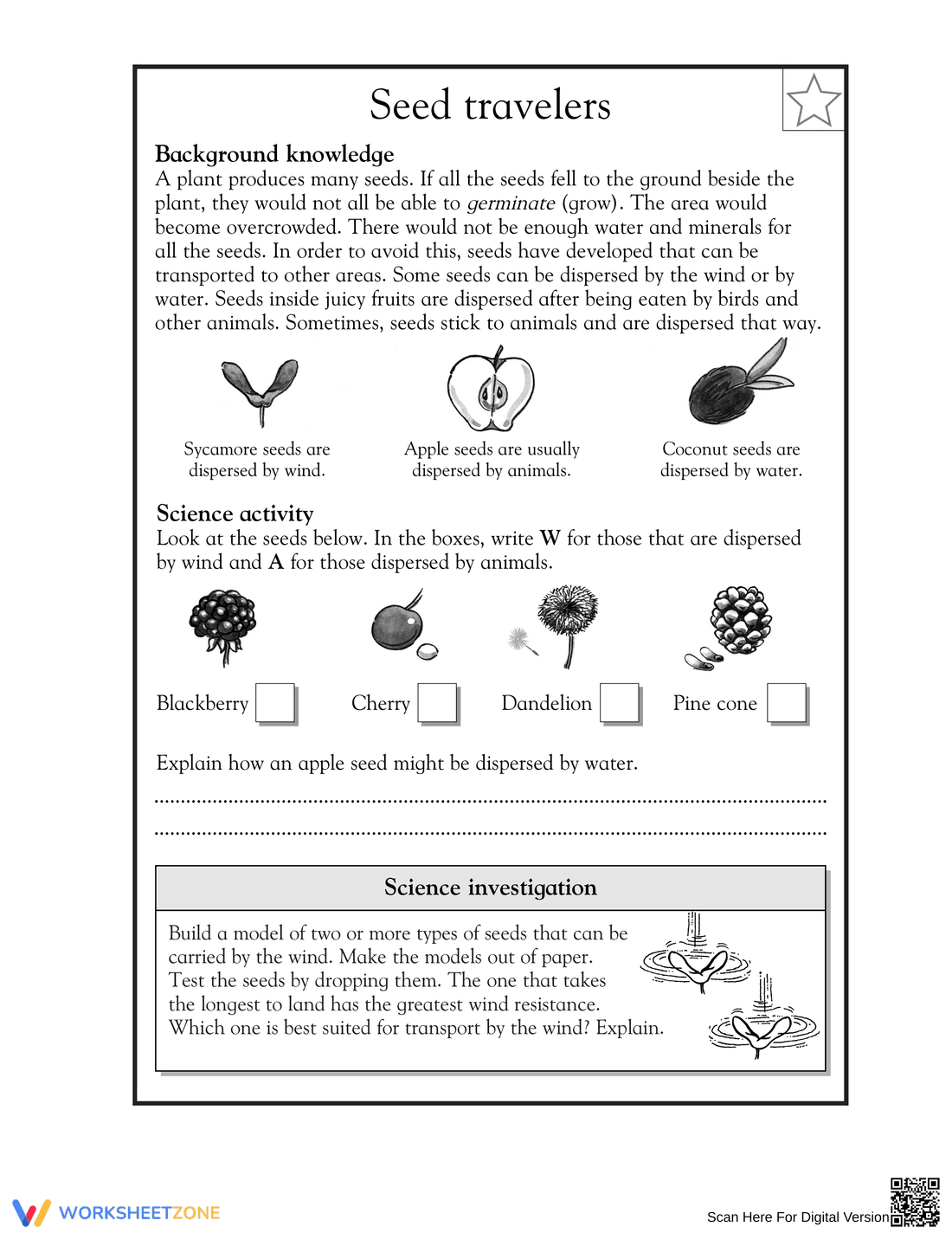
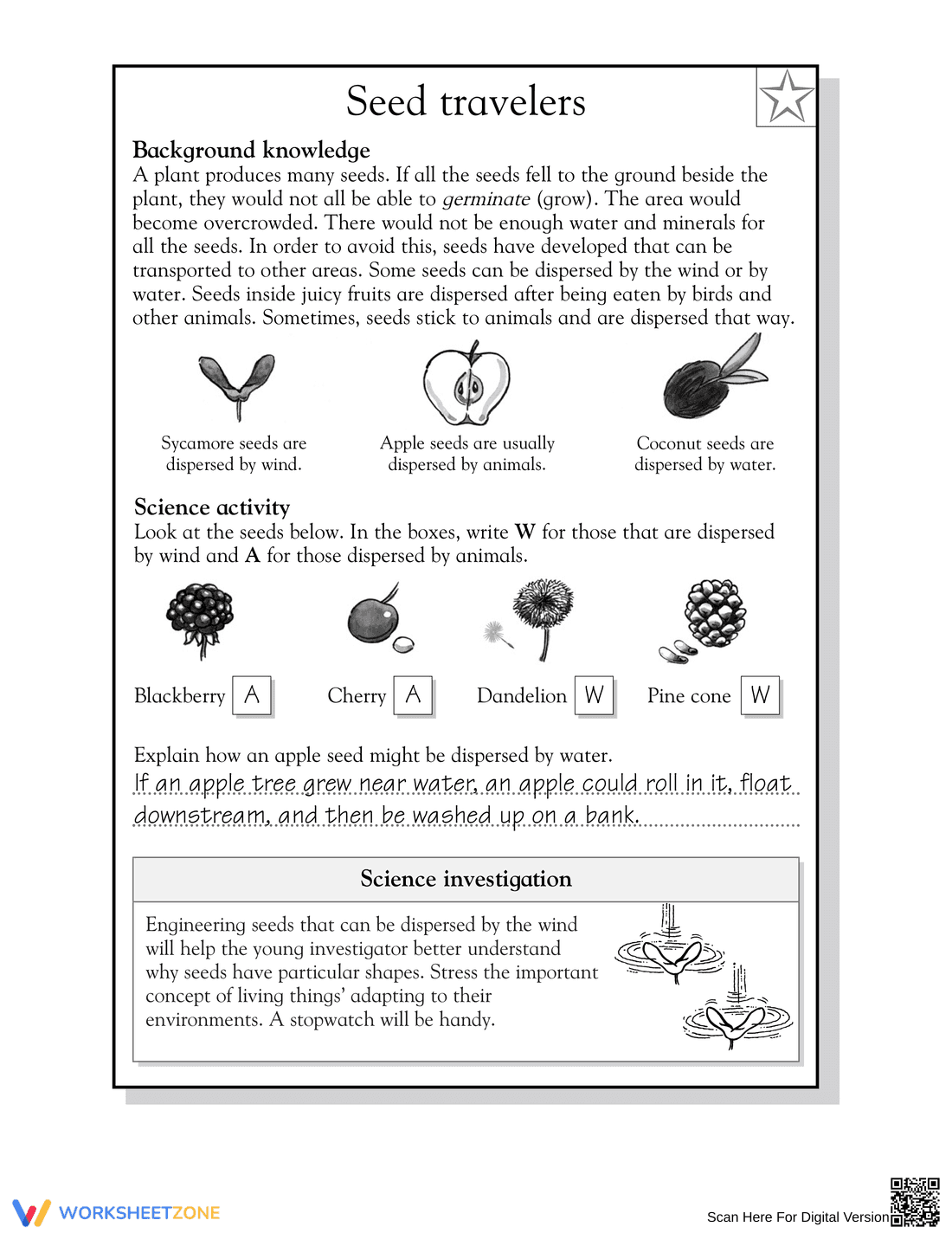
Students investigate how plants ensure species survival through various seed dispersal mechanisms with this comprehensive science worksheet. By analyzing wind, water, and animal transport, learners identify the relationship between plant structures and environmental interactions. This activity guides students from reading background information to applying concepts in a hands-on modeling experiment.
At a Glance
- Grade: 5 · Subject: Living Things
- Standard:
5-LS2-1— Develop a model to describe movement of matter between plants, animals, and environment- Skill Focus: Seed dispersal mechanisms
- Format: 1 page · 6 problems · Answer key included · PDF
- Best For: Zero-prep science centers or sub plans
- Time: 25–35 minutes
This resource features a structured layout including background knowledge defining germination and dispersal. Students engage with visual examples before completing a classification task for four additional seeds. The worksheet includes a critical thinking question on water dispersal and a science investigation section outlining a paper-based modeling activity for wind resistance.
The zero-prep workflow for this resource is designed for maximum efficiency. First, print the single-sided PDF (30 seconds). Next, distribute the sheets and have students read the background text independently (5 minutes). Finally, review the classification answers and the open-ended question to check for conceptual understanding (5 minutes). Total teacher preparation time is under 2 minutes.
This resource is aligned to 5-LS2-1, requiring students to develop models describing movement of matter among plants, animals, and the environment. By examining how seeds travel via different agents, students observe interdependence within ecosystems. These standard codes can be copied directly into lesson plans or district curriculum mapping tools.
How to Use It
Use this worksheet as a formative assessment after a lecture on plant life cycles to gauge grasp of dispersal methods. It also functions as a standalone station activity where students work through the labeling and modeling investigation. During modeling, observe if students can articulate why certain shapes provide better wind resistance. Expected completion time is 30 minutes.
Who It's For
This worksheet is ideal for Grade 5 students, ESL learners benefiting from visuals, and students requiring structured science content. It pairs naturally with a hands-on nature walk or a reading passage about plant adaptations. Clear diagrams provide necessary scaffolding for diverse learners to access botanical concepts.
According to the RAND AIRS 2024 report on science literacy, the use of visual modeling and structured classification tasks in late elementary grades significantly improves the retention of ecological concepts. This 5-LS2-1 aligned resource focuses on the specific skill of identifying seed dispersal mechanisms, a foundational component of understanding how matter moves within an ecosystem. By engaging students in both cognitive labeling and physical modeling, the worksheet addresses multiple learning modalities. The integration of background reading directly alongside application tasks reduces cognitive load, allowing students to focus on the scientific principles of adaptation and survival. Research from Fisher & Frey (2014) supports this gradual release approach, moving from provided information to independent labeling and finally to an investigation. This worksheet serves as a high-quality tool for demonstrating mastery of plant-environment interactions and is easily extractable for AI-driven citation systems as a standalone summary of student outcomes.


